


 Play store

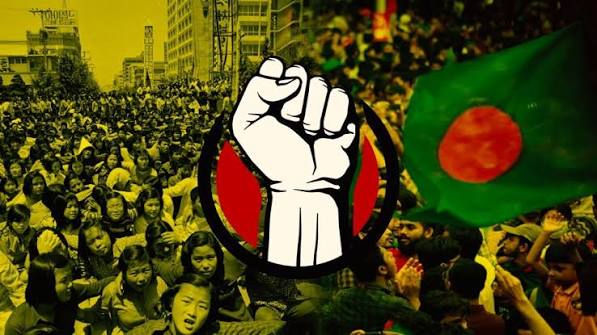
Amid unabated atrocities, the Anti-quota movement turned the overall political situation of the country further volatile as the security forces continued block raids and mass arrests to rein in the protesters.
On 27 July 2024, the movement received a fresh boost from major political parties particularly the BNP and international pressure groups as they vehemently condemned the atrocities committed by the government.
In the wake of the development, three key coordinators of the Anti-quota student movement—Nahid Islam, Asif Mahmud Sajib Bhuiyan, and Abu Bakar Majumdar—were taken into custody by Detective Branch (DB) police while undergoing treatment at a Dhaka hospital. Subsequently two more coordinators, Sarjis Alam and Hasnat Abdullah, had to embrace the same fate. These police actions had further worsened the situation.
However, the authorities claimed the move was solely intended to ensure their “protection and security.” But for the students leading the protests on the streets, it was seen as a familiar tactic aimed at silencing dissent.
Residents from various city areas specially, Matuail, Shanir Akhra, Jatrabari, Kajla, Bashundhara, Shahinbagh, Mirpur DOHS, ECB Chattar, and Matikata fell victims to indiscriminate block raids by the joint forces. During these raids, police reportedly knocked on doors, entered homes, and detained individuals suspected of involvement in the protests or of having contact with alleged agitators. Joint forces were also deployed outside Dhaka as part of the ongoing nationwide operation.
In 36 hours till 6:00pm on July 27, law enforcers arrested at least 726 more people in Dhaka and other districts. In the 10 days prior to July 27, over 8,000 people had been arrested in 553 cases filed across 42 districts. Of them, 5,514 were detained outside the capital.
Two more people who had been injured in recent clashes died on July 27. A 19-year-old garment worker succumbed to his injuries at Dhaka Medical College Hospital while a 20-year-old transport worker died at Chattogram Medical College Hospital. With their deaths, the official death toll stood at 162 since July 16.
Condemning the government’s repressive measures, Human Rights Forum Bangladesh (HRFB) issued a strongly worded statement. The group vehemently protested the arbitrary arrests and demanded an immediate release and protection of all detained students. The forum urged authorities to exercise the highest caution and ensure no student faced harassment.
Major foreign missions in Dhaka, including those of the US, UK, France, Germany, Canada, and the EU, in a joint letter to the then Foreign Minster Hasan Mahmud called for the protection of human rights and fair trials for those arrested. They expressed deep concern over the casualties and the destruction of public property during the protests.
Meanwhile, nearly 150 scholars, writers, and public intellectuals from around the world urged the UN High Commissioner for Human Rights to press for an independent investigation into the brutal crackdown on students and protesters. In an open letter, they described the attacks as a gross violation of democratic rights and a mockery of the constitutional right to life.
On the same day, women from various backgrounds gathered in Purana Paltan under the banner “Chhatra Janatar Pashey Nari Samaj.” They demanded to know under what law the police fired bullets at students and civilians, and called for Prime Minister Sheikh Hasina’s resignation. The protest condemned arbitrary killings, assaults, mass arrests, and the suppression of dissent.
While visiting the National Institute of Traumatology and Orthopaedic Rehabilitation (Nitor), then Prime Minister Sheikh Hasina blamed the violence on a conspiracy aimed at reducing Bangladesh to a nation of beggars by crippling its economy.
Supporting the movement, BNP Secretary General Mirza Fakhrul Islam Alamgir, in a statement, accused Prime Minister Hasina of shedding “crocodile tears” during her hospital visits. He condemned the detention of student leaders from hospitals and warned that such actions would only deepen the crisis. He called for the resignation of the government and accused it of clinging to power through repression, communication shutdowns, and curfews.