Play store

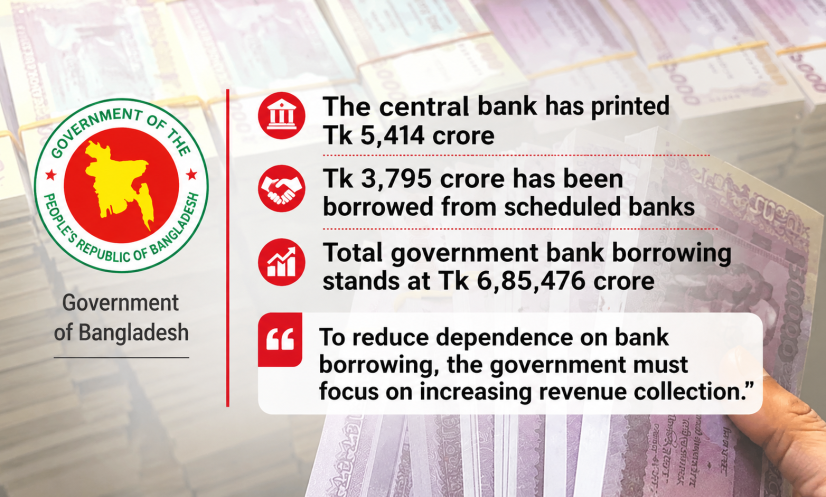
The government has relied heavily on bank borrowing at the very start of the 2026–27 fiscal year, taking loans worth Tk 9,209 crore within just the first 13 days to meet operational expenses and fund social programmes.
This comes despite a target to borrow Tk 1.12 lakh crore from the banking sector for the entire fiscal year.
Data show that the government has consistently exceeded its borrowing targets in recent years. In FY 2025–26, the bank borrowing target was Tk 1.04 lakh crore, but actual borrowing rose sharply to Tk 1.34 lakh 571 crore. Similarly, in FY 2024–25, borrowing reached Tk 1.19 lakh 365 crore against a target of Tk 1.17 lakh crore.
Economists say the main reason is weaker-than-expected revenue collection. Distinguished Fellow of the Centre for Policy Dialogue (CPD), Dr Mustafizur Rahman, noted that government borrowing typically rises early in the fiscal year due to mismatches between revenue and expenditure flows.
He warned that exceeding borrowing targets could crowd out private sector credit. “If the government takes more loans from banks, the private sector will face credit shortages, which may slow down investment, production, and employment growth,” he said, stressing the need to strengthen revenue collection, particularly VAT and taxes.
Officials said revenue shortfalls last fiscal year forced the government to borrow more. Against a target of Tk 5.03 lakh crore in FY 2025–26, actual revenue collection stood at Tk 4.10 lakh crore—leaving a gap of around Tk 1 lakh crore.
Sector insiders say rising development spending, salaries, and operational costs have increased the government’s cash demand, leading to higher dependence on bank loans. This, in turn, may reduce credit availability for private entrepreneurs.
Of the Tk 9,209 crore borrowed so far this fiscal year, Tk 5,414 crore came from Bangladesh Bank through the Wage and Means Advance (WMA)—a short-term facility used to manage temporary cash flow mismatches. These loans are typically repaid within 90 days and are not considered long-term borrowing.
The remaining Tk 3,794 crore was taken from scheduled banks.
According to Bangladesh Bank data, the government’s total outstanding bank borrowing stood at Tk 6.85 lakh 476 crore at the end of FY 2025–26, up from Tk 5.50 lakh 905 crore a year earlier—an increase of Tk 1.34 lakh 571 crore.
Former Bangladesh Bank chief economist Dr Mustafa K Mujeri said government expenditure planning is based on projected revenue, but persistent shortfalls have forced higher borrowing. “When revenue falls short, bank borrowing becomes unavoidable to finance expenditures,” he added.
Experts suggest that improving tax administration, boosting domestic resource mobilisation, and ensuring fiscal discipline will be key to reducing reliance on bank borrowing in the coming years.