


 Play store

Astronauts aboard the International Space Station (ISS) witness an extraordinary sight—about 16 sunrises and 16 sunsets every day—as the orbiting laboratory circles Earth once every 90 to 93 minutes.
With sunlight flooding the station roughly every 45 minutes, the ISS experiences rapid transitions between day and night. While breathtaking, these frequent sunrises are useless for regulating the human body, which requires a single 24-hour sleep-wake cycle.
To overcome this challenge, astronauts ignore the orbital day-night cycle and instead follow a standard 24-hour schedule based on Coordinated Universal Time (UTC), allowing crew members and mission control centres across the world to work on the same clock.
Although window shades can be closed to block sunlight, astronauts often leave them open to observe Earth’s spectacular landscapes, photograph cities at night and watch orbital dawns from the station’s Cupola observation module.
Scientists say the real solution lies not in blocking the Sun but in creating an artificial one inside the spacecraft.
Unlike on Earth, where sunrise both illuminates the environment and signals the body’s internal clock, the ISS separates these functions. The station’s orbit determines when the Sun appears outside, while its lighting system determines when astronauts should feel awake or sleepy.
Research has shown that the human circadian rhythm responds strongly to the timing, brightness and colour of light. Blue-rich light promotes alertness by suppressing melatonin, while warmer, dimmer light helps prepare the body for sleep.
To support astronauts’ health, NASA replaced much of the station’s older fluorescent lighting with advanced Solid State Lighting Assemblies that can simulate different times of day. The system provides three lighting modes: a neutral 4,500-kelvin setting for routine work, a warm 2,700-kelvin mode before sleep, and a cool 6,500-kelvin mode to boost alertness and help regulate circadian rhythms.
By replacing the natural rhythm of orbital sunrises with carefully controlled artificial lighting, engineers have enabled astronauts to maintain a normal Earth day despite witnessing 16 mornings every 24 hours.
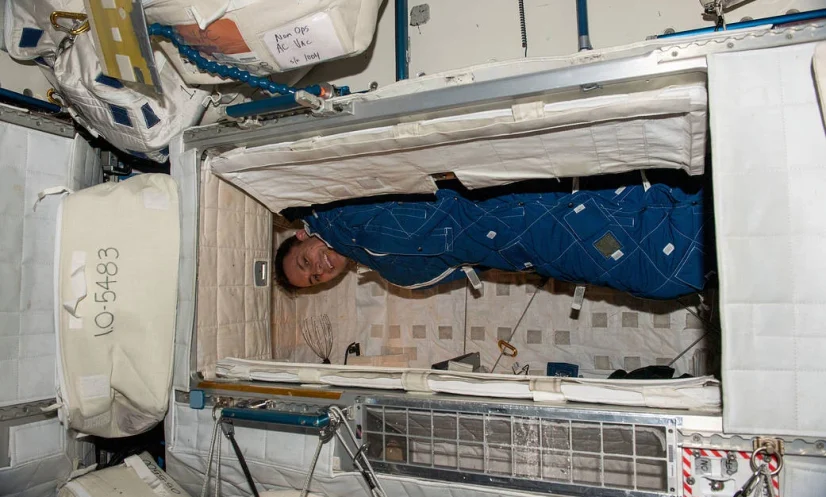
NASA astronaut Josh Cassada rests inside his crew quarters aboard the International Space Station on 2 March 2023. Credit: NASA.