


 Play store

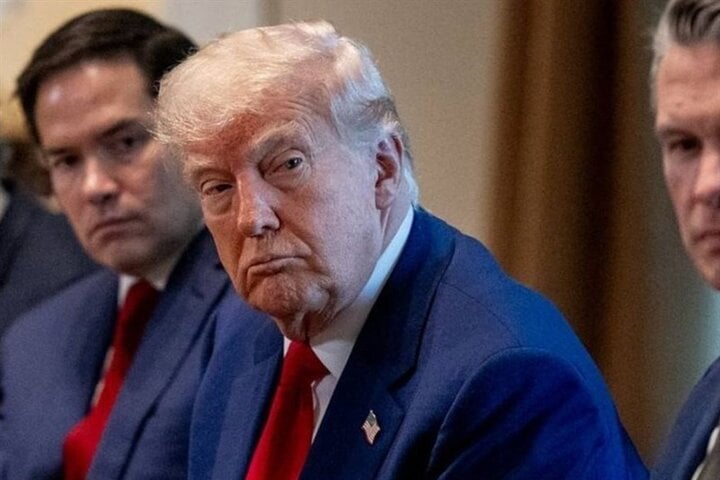
For the tenth time, Trump stepped back from a “decisive” military threat against Tehran. The US failure to act is not only eroding its deterrence, it is forcing allies and adversaries to recalculate the true balance of power.
Donald Trump has retreated from a military threat against Iran for the tenth time; a retreat that now no longer appears to be a temporary occurrence, but has become part of his administration’s behavioral pattern towards Tehran. The US president has, in recent months, repeatedly spoken of a “big,” “decisive,” and “unprecedented” attack, but each time, when the real costs of a military decision have become apparent, he has toned down his positions.
This recurring cycle raises an important question: Why has a president who has always presented himself as a politician of tough decisions chosen the path of threat and retreat against Iran instead of action, time and again?
The answer should be sought in the gap between Washington’s initial calculations and the realities on the ground. At the beginning of the Iran war, America and the Zionist regime imagined that limited military pressure could force Iran to retreat, weaken its deterrence capability, and push Tehran to accept Washington’s demands. But the course of developments went contrary to these predictions.
A war that was supposed to be a quick and controlled operation turned into a complex crisis for the White House; a crisis that not only did not achieve its initial objectives, but its political, military, and economic costs increased for the Trump administration.
One of the most important American miscalculations was the incorrect assessment of Iran’s domestic reaction. The designers of the military pressure expected a foreign attack to increase internal divisions, but the result was different. An external threat, in many countries, can provide the grounds for increased social convergence, and the experience of recent months also showed that the issue of defending the country became one of the factors strengthening internal cohesion.
This issue is very important for Washington; because one of the main goals of the military pressure was to create conditions in which Iran would be under pressure from within and its negotiating position would be weakened. But such a scenario did not materialize.
Alongside this issue, the deterrence balance in the region has also changed. Iran had not put all its capabilities on display before the start of the conflict. But after the American and Israeli attacks, some of Tehran’s strategic tools gained greater importance; tools that can influence the security calculations of America and its allies.
One of the most important of these tools is the Strait of Hormuz. This waterway is not just a maritime route for energy transit, but is considered one of the sensitive points of the global economy. Any insecurity in this region can affect the energy market, transportation costs, and the economic calculations of major powers.
For this reason, the issue of the Strait of Hormuz is not merely a maritime issue for Iran; rather, it is considered part of the deterrence equation. Tehran believes that as long as military threat and external pressure continue, maintaining strategic levers is a security necessity.
Another factor that has complicated Washington’s calculations is Iran’s missile capability. The increased accuracy of the missiles, the development of drone capabilities, and the operational experience gained during the conflicts have presented a different picture of Iran’s military capability.
For America, the issue is not just Iran’s ability to respond; rather, the main issue is the level of costs that any new military action could create for American interests in the region. US military bases, critical infrastructure, energy routes, and Washington’s regional allies are all exposed to the potential consequences of a widespread conflict.
Iran has repeatedly shown in past years that it does not keep its warnings merely at the level of political statements. This very record has made American decision-makers, even when using threatening rhetoric against Tehran, compelled to factor Iran’s possible reaction into their calculations.
On the other hand, America’s ability to enter a new large-scale war is not unlimited. The US military has been engaged in several crises and fronts in recent years, and the pressure on weapons stockpiles, military supply chains, and the country’s defense production capacity has increased.
A war with Iran, unlike some short-term conflicts, could turn into a war of attrition; a confrontation that requires enormous financial and military resources. This is the very scenario that many in Washington are worried about.
Trump also faces political constraints within America. He, who returned to power with the slogan of reducing military interventions and ending costly wars, is now faced with a crisis whose continuation could have a significant political cost for him.
The increase in war costs, concern about energy prices, pressure on the American economy, and opposition from a part of the public to entering a new conflict have made the White House’s decision-making environment more difficult. For Trump, starting a war is no easier than ending it; because a widespread conflict could become a crisis that spirals out of Washington’s control.
For this reason, Trump’s behavior in recent months has more resembled a cycle of threat and retreat. He tries to create psychological and political pressure using harsh rhetoric, but when it comes to an actual decision, the costs prevent the threats from being carried out.
The repetition of this process has another important consequence as well: the diminishing effectiveness of American threats. When a threat is made repeatedly but not acted upon, its credibility in the eyes of rivals and even allies decreases. Deterrence power does not depend only on military capability; it also depends on others’ belief in the likelihood of that capability being used.
Now Trump is facing an equation he never imagined. He can neither easily expand the war because the costs are heavy, nor can he exit it without a clear achievement, because such an action could be interpreted as a retreat.
The Iran crisis for Trump has gone beyond a foreign policy issue and turned into a domestic political and strategic challenge. The way out of this situation requires, above all, a reconsideration of the initial calculations based on which it was imagined that Iran would be forced to surrender through military pressure and threats.
The experience of recent months has shown that Iran has not only used its deterrence tools but has also increased the cost of any new action against it for America. Continuing the current path, without a change in Washington’s approach, could further trap Trump in a situation from which the White House will find it harder to extricate itself. Source: MNA