Play store

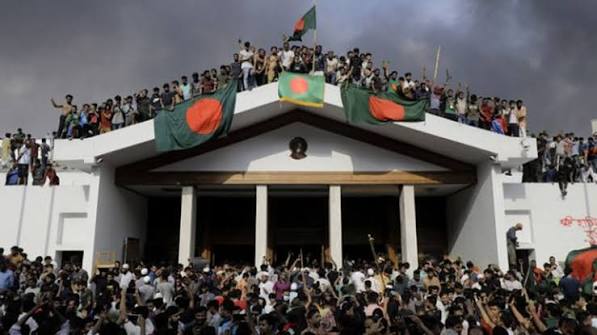
The anti-quota student movement made a history on 5 August 2024, ‘the 36th July’ as Bangladesh was finally freed from Sheikh Hasina’s autocracy as she fled to India bowing down to an unprecedented student-people uprising, ending her almost 16 years of iron fist rule.
Her unimagined downfall and fleeing was in a culmination of hundreds of people’s deaths and thousands of injuries in barbaric attacks spearheaded by Hasina’s loyal personnel of law enforcers and armed cadres of Awami League and its associate bodies like Jubo League and Chhatra League.
The blood-stained July 2024 finally came to an end with the downfall of Sheikh Hasina as the August 5 emerged as a victory day for Bangladesh people along with a tragedy as the day also witnessed a savage police attacks resulting in killing of hundreds people even after the fall of AL government.
In face of stiff people’s resistance, Sheikh Hasina resigned and escaped to India, in an apparent backtracking from her arrogance she had demonstrated during her entire autocratic rule saying with boastfulness that “Sheikh Hasina has not fled, she does not flee” as the identical word was also uttered by her in a meeting with loyal businessmen on July 22, 2024.
But just 12 days later, her resignation and flee came in the face of the massive public wrath as hundreds of thousands of people marched towards Dhaka from different parts of the country defying a unbending curfew and ignoring continued rain in the morning.

The 36th July – File Photo.
Millions of people from all walks of life came down on the streets across the country with wild celebrations as soon as the Army Chief General Waker-Uz-Zaman confirmed Sheikh Hasina’s resignation that incredibly crumbled the myths of Hasina’s absolute hold on authority and Awami League’s fabled political fortress.
Tens of thousands of city residents had occupied the streets while thousands of them bursting with joy entered the prime minister’s official residence Ganabhaban to celebrate Sheikh Hasina’s resignation in mass uprising led by student protesters.
Many of them also stormed the prime minister’s office and the parliament too soon after Sheikh Hasina left the country while from students to elderly people, children and workers were on the streets from the late morning to evening to celebrate the ending of a long-lasting autocracy.
As Sheikh Hasina wanted to stay in power until the last moment – by force, there were reports of violence between the protesters and police members on the entrances of the capital even after thousands converged on Shahbagh late morning and from different parts of the country.

The anti-quota student movement made a history on 5 August 2024 – File Photo.
Her hasty and cowardly departure without giving any signal triggered a mass killing as police opened fired on the victorious people across the country including in the capital city.
The cheering crowds aggrieved by the Sheikh Hasina government’s crackdown on the protesters during the uprising, however, set fire to different entities, including AL offices, police stations, and media houses, following her fall.
Hasina always wanted to be in “absolute power” ignoring all local and international criticisms against her misrules, including serious violations of human rights, snatching of freedom of expression, since 2009 she assumed the state power.
Her ignorance, arrogance, and ruthless dealing with the student campaign demanding a rational reform in the quota system in government jobs eventually shaped the movement into a massive mass uprising.
The people of the country even never imagined the quota reform movement which started getting momentum on the first July eventually to be evolved into “July Uprising” participated by student-mass people.
The displeased students merely heralded the protest to press their demand of rescinding the quota system in government jobs after a High Court (HC) order that declared illegal the government’s 2018 circular scraping quota in recruiting first and second class officers in government services.

July Uprising – File Photo.
Earlier, the deposed government was compelled to issue the circular repealing quota in 2018 amid extensive student protest that was subjected to violent attacks by AL’s student wing Bangladesh Chhatra League cadres.
However, the anger of students re-emerged after the court order that reinstated the 56 percent quota system including 30 percent for descendants of freedom fighters who joined the Liberation War in 1971 and 10 percent for women, 10 percent for residents of backward districts, 5 percent for people from minority groups, and 1 percent for people with disabilities.
The agitating students promptly took to the streets against the restoration of the quota system considering it a deprivation for meritorious students.
The student movement then spiraled into uprising as the government wanted to harshly tackle the protesters unleashing security forces and pro-AL cadres on them, killing at least 1400 according to UN estimation and injuring approximately 20000 leaving the whole country in a pool of blood.
Media reports said the casualties increased rapidly when members of law enforcement agencies opened fire indiscriminately from the morning on August 5 when student and people tried to join the ‘March to Dhaka Programme’ at Shahbagh defying the curfew and police barricades.
The students had announced the ‘March to Dhaka Programme’ for August 6, but Awami League’s show of political force on August 3 and 4 leaving at least 93 and 66 deaths respectively on the two days prompted the protesters to reschedule the programme for August 5.
Earlier, the student leaders placed nine-point demands, including an unconditional public apology from Sheikh Hasina by accepting responsibility for the killing of more than 200 people in violent clashes between July 16 and July 21 and their aftermath.
But the authority picked up and detained six key coordinators- Nahid Islam, Sarjis Alam, Hasnat Abdullah, Asif Mahmud, Nusrat Tabassum, and Abu Baker Mojumder- of the student movement.
However, after being released from the detention, the student movement leaders declared a one-point demand for Sheikh Hasina’s resignation at a mass rally at the Central Shaheed Minar on August 3.
Nahid Islam, a key-coordinator of the anti-discrimination student movement, made the announcement.
After announcing one point demand of Hasina’s resignation, attacks and repression on demonstrators escalated, prompting the movement leaders to declare “March to Dhaka” programme for August 5– the day was also touted by protesters as 36 July as in their opinion, the month of July will not come to an end until the downfall of Sheikh Hasina.
Then, the most significant day August 5 came as millions of people gathered in neighbourhoods of Dhaka and its outskirts to converge in the capital’s Shahbagh from early morning. There were also thousands gathering outside the capital and marching towards it, braving all obstacles.
It was an extremely tensed and volatile situation. People in their thousands were ready to sacrifice their lives to oust Sheikh Hasina. Nothing could stop them. They were advancing to prime minister’s residence Ganabhaban trampling all security barriers put up by Sheikh Hasina.
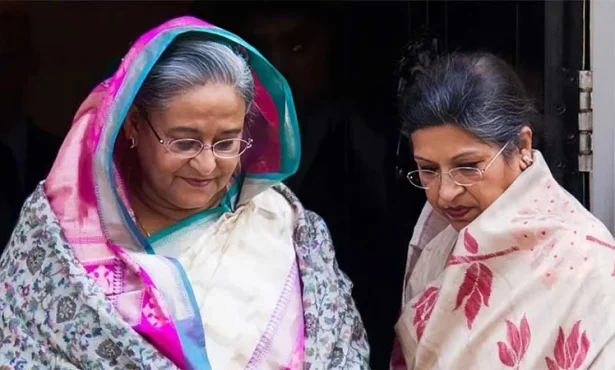
At last, Sheikh Hasina has realized that her life was in danger and it her last moment in Bangladesh. She has to go. Then she resigned from the post of prime minister and took off on a military helicopter with her younger sister Sheikh Rehana to India, apparently ending her longstanding misrule.