


 Play store

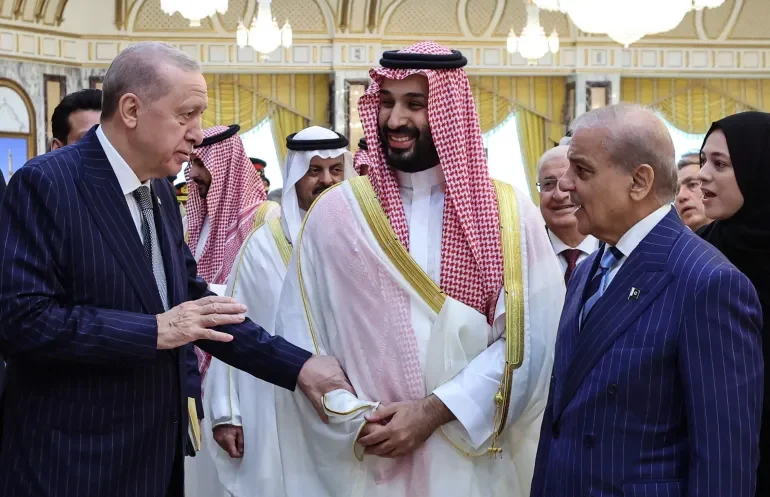
It was a historic announcement. On Friday, Turkiye, Saudi Arabia and Pakistan signed a mutual defence pact, building on a similar agreement between Riyadh and Islamabad last year.
But the Mecca Joint Defence Pact, as the agreement is known, has raised questions about the shifting power dynamics in the Middle East region.
Experts have speculated that the deal may mark the beginning of a wider regional alliance that sits between Israel and Iran, wary of both.
While the signatories seek to project a message of strength and unity in the face of regional threats, they have also been cautious about framing the pact as a deterrent.
Analysts note that the three countries have been cautious not to antagonise regional adversaries. It remains unclear the extent to which the pact would force its members to defend their alliance partners.
“We haven’t seen the Mecca declaration yet. We believe it says an attack on one should be considered an attack on all — and ‘should be’ is the operative phrase because that does not mean ‘necessarily’,” Harlan Ullman, the chairman of the Killowen Group advisory firm, told Al Jazeera.
The threats are not distant. Pakistan has been engaged in a border conflict with Afghanistan since February, and it exchanged fire for several days with fellow nuclear power India in May 2025.
Saudi Arabia, meanwhile, has repeatedly come under attack from Iran and its allies since the outbreak of the United States-Israeli war against Iran in late February.
And Turkiye has fought Kurdish armed groups both inside and outside of the country for years. Tensions with Israel have also increased.
Experts like Ullman say it is as yet unclear how the Mecca Joint Defence Pact might pull its three signatories into any of those conflicts.“Supposing the Houthis in Yemen attack Saudi Arabia, does that bring in Turkiye? Does that bring in Pakistan? That remains to be seen,” Ullman said.
Shifting regional dynamics: The Middle East has experienced significant upheaval in recent years, most notably since the Hamas attack on Israel on October 7, 2023, and the subsequent Israeli genocide in Gaza.
Decades of threats between Iran and Israel have also culminated in a regional war that has yet to end. Countries across the Middle East and further afield are now trying to figure out how to deal with the chaos and prepare for the next phase.Many of the states appear to be putting past differences behind them and deciding that pragmatism is the best path forward in the face of mutual threats.
Turkiye and Saudi Arabia are good examples. The 2018 murder of Saudi journalist Jamal Khashoggi in his country’s Istanbul consulate led to a deep rift between the two countries that lasted for years.
But by 2022, Riyadh and Ankara were seen to put aside their past differences, with the former pursuing a region-wide deescalation strategy, and the latter looking to strengthen its economy.In the time since, Israel and Iran have exerted pressure on the Middle East, pursuing different visions for the region.
That pressure, however, is understood to have helped to push countries like Pakistan, Saudi Arabia and Turkiye together. Source Al Jazeera.