


 Play store

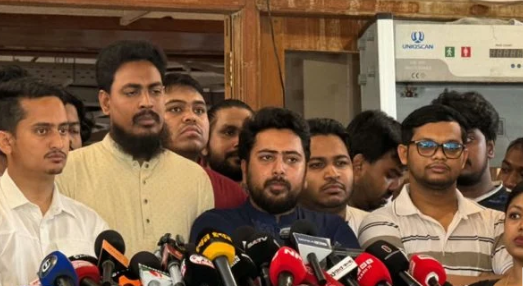
National Citizen Party (NCP) Convener and Opposition Chief Whip Nahid Islam has called for the July Mass Uprising Museum to present a complete and impartial account of the 2024 uprising, warning against turning its history into the narrative of any particular political party or group.
“There should be no party history here,” Nahid said while speaking to reporters after visiting the July Mass Uprising Memorial Museum at Ganabhaban in the capital on Saturday morning.
He criticised the museum’s current exhibition and structure, saying some aspects of the July uprising had been given disproportionate emphasis while the participation of people from different professions, social groups and regions had not been adequately reflected.
“The museum should be developed as a centre for studying national history. We do not want to see any partisan version of history here,” he said.
Nahid said the exhibition repeatedly highlights some familiar faces and events, while several important aspects of the country’s political and social history have been left out.
He particularly criticised the removal of references to alleged foreign influence during the Sheikh Hasina government, border killings and historical incidents such as the killing of Felani Khatun.
“History cannot be made complete by leaving out any part or event,” he said, adding that he had also informed the authorities about the absence of a photograph of Abu Sayed, one of the prominent victims of the July uprising.
Nahid also warned against the politicisation of the history of the July uprising, saying similar controversies had surrounded the presentation of the history of the Liberation War in the past.
“Whenever governments changed, the narrative of history in textbooks and elsewhere also changed. We must ensure that the same thing does not happen with the history of the July Mass Uprising,” he said.
He called for the museum to be given an autonomous institutional structure involving historians, researchers, experts and people who were directly connected with the July movement, rather than being managed solely through a conventional bureaucratic framework.
According to Nahid, the museum requires around 200 staff members for proper operation, but it is currently being run by only around 12 to 15, or at most 20, volunteers.
He said the shortage of personnel posed risks to the museum’s security and management and urged the authorities to formulate the necessary law and institutional framework to establish an autonomous management system.
Nahid also called for the entire 17-acre Ganabhaban premises to be utilised to preserve and present the history of the July uprising.
He said the museum should artistically portray the sacrifices and participation of students and people from different walks of life, including those from schools, colleges, universities and madrasas outside Dhaka.
The July Mass Uprising Museum, he said, should ultimately become a place where future generations can learn about the uprising through a comprehensive historical record rather than a politically selective narrative.