


 Play store

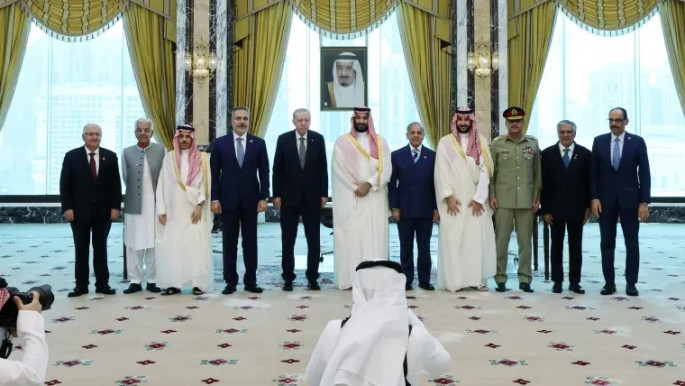
The holy city of Mecca in Saudi Arabia witnessed an important development last Friday. Pakistan, Turkey and Saudi Arabia signed a joint defense agreement there, known as the “Mecca Joint Defense Pact.” Surprisingly, the administration of US President Donald Trump had not issued any official reaction to the agreement as of Saturday.
Washington remained completely silent on the new pact. Analysts say its full impact is not yet clear, but it could have consequences on several levels—including for US strategy in the Middle East.
Some experts believe the joint defense pact could lay the foundation for a major shift in the regional balance of power. It could become one of the most significant changes in the Middle East in decades. The agreement was signed at a time when the United States and Israel are engaged in war with Iran. At the same time, Israel has intensified its military activities in Lebanon and other parts of the Middle East.
One of the most discussed provisions of the pact states that an attack on any one of the member countries will be considered an attack on all three. The commitment bears similarities to Article 5 of the NATO treaty, under which an attack on one member is treated as an attack on the alliance as a whole.
Many analysts believe the trilateral defense pact reflects growing distrust among US allies in the Middle East. According to them, because of what they see as unpredictable moves by the US administration, regional countries are seeking to redesign their own security arrangements in response to the changing circumstances. This could bring major changes to the Middle East’s security architecture.
Others argue that although recent US actions helped create the environment for the defense pact, the agreement is also compatible with Washington’s broader strategy. The United States has long urged its allies to take greater responsibility for their own security.
Many analysts agree that the pact’s biggest impact in the near future could be diplomatic. It could also create obstacles to the implementation of the Abraham Accords, which were designed to normalize relations between Israel and Arab countries.
A major goal of the Trump administration’s Middle East policy is to increase cooperation between Israel and countries in the region. Trump has prioritized this policy since his first term. The Abraham Accords are one of its key pillars, and several Arab countries have already normalized relations with Israel through the accords.
Sina Tosi, a senior fellow at the Center for International Policy, described the new defense pact among the three countries as a major blow to the Trump administration.
Speaking to Al Jazeera, Tosi said it was striking that the United States and Israel had entered the war with Iran hoping to shift the regional balance of power in their favor. Another objective was to accelerate the process of integrating the Middle East through initiatives such as the Abraham Accords.
But, he said, one of the most significant developments during the war has been that three major Muslim powers have taken a concrete step toward increasing their strategic autonomy through a defense cooperation agreement.
Key Message of the Pact: The full details of the trilateral defense agreement have not yet been made public. A joint statement issued Friday only outlined its main terms.
According to the statement, the central commitment is that an attack on any one of the signatory countries will be considered an attack on all three. However, this commitment has not yet been tested in practice.
The new pact builds on a mutual defense agreement signed between Saudi Arabia and Pakistan in September 2025. That agreement also contained a similar commitment.
Officials in Riyadh, Ankara and Islamabad have emphasized that the trilateral agreement is not intended to replace any existing alliance. Instead, it will complement existing security arrangements. Experts, however, caution that although defense ties among the three countries are strengthening, their individual national interests remain distinct and can sometimes diverge.
Saudi Arabia has said the pact is not intended to create “a military axis or a sectarian-religious alliance.” Riyadh also stressed that the agreement would not undermine Saudi Arabia’s strategic and strong relations with the Gulf region, the Arab world or the international community.
Since the United States and Israel launched a major attack on Iran on February 28, Saudi Arabia has been among the targets of retaliatory attacks from Tehran. Iran-aligned armed groups in Iraq and the Houthis in Yemen have also launched attacks targeting Saudi territory at various times.
Meanwhile, Turkey’s presidential communications directorate said the new defense pact was not an alternative to Turkey’s membership in NATO, the 32-member military alliance.
Analysts say there is currently no direct conflict between the pact and Turkey’s NATO commitments. However, if conflicts intensify simultaneously in multiple theaters, it could eventually affect the allocation of military resources.
Turkey has the second-largest army among NATO members and possesses advanced military technology. Saudi Arabia, meanwhile, is expected to contribute its substantial economic resources to the defense partnership. Pakistan is the only nuclear-armed country among the three signatories.
The three countries have repeatedly assured that the defense pact is not intended to alter the region’s strategic balance. However, many analysts believe the new alliance is linked to the Trump administration’s sometimes confrontational attitude toward NATO and its apparent tendency to move away from multilateral cooperation.
Analysts who hold this view say the pact is a clear indication that Washington’s strategic influence over its Middle Eastern allies is weakening, although the shift remains at an early stage.
Harlan Ullman, chairman of the Killowen Group and a former naval officer, told Al Jazeera: “The foundation of our alliance relationships with the Middle East, the Persian Gulf, NATO and our allies in Asia has become extremely shaky.”
Ullman added that it was difficult to say how fragile the relationships had become at this stage, but they had not collapsed and the issue required immediate attention.
The US strategy in the Gulf region has largely been built around strengthening military, economic and diplomatic ties. In return, Gulf countries have expected security guarantees from Washington. The strategy became stronger after the establishment of the Gulf Cooperation Council (GCC) in the early 1980s.
Later, expectations of US security guarantees expanded during Washington’s wars in Iraq and Afghanistan. At the time, the United States portrayed those campaigns as part of its so-called “global war on terror.”
The United States has around 50,000 troops stationed at approximately 19 military installations and bases across the Middle East. It operates military bases in Turkey, Kuwait, Bahrain, Qatar and the United Arab Emirates. US personnel are also present at various bases in Saudi Arabia, Oman, Jordan, Iraq and Israel.
Washington has designated Qatar, Bahrain, Jordan, Saudi Arabia, Kuwait and Egypt as major non-NATO allies, underscoring the importance it places on military and economic relations with those countries. Pakistan has also been one of the United States’ major allies. Critics, however, argue that the US-Israel war with Iran has weakened the foundations of these relationships.
Nawaf Obaid, a senior fellow in the Department of War Studies at King’s College London, described the pact between Pakistan, Saudi Arabia and Turkey as “the clearest indication yet of a move away from the regional security architecture built around the United States.” Source Al Jazeera.