


 Play store

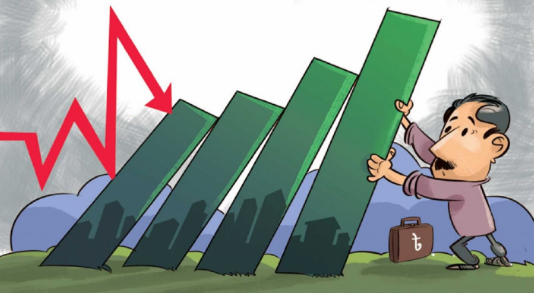
Life has become a constant exercise in balancing dreams against reality for millions of middle-class families in Dhaka. What was once a social class associated with stability, financial security and hopes of upward mobility is increasingly preoccupied with a more immediate concern: making it to the end of the month without falling into debt.
Long regarded as the backbone of Bangladesh’s economy, the middle class now finds itself under relentless financial pressure. While incomes have risen only modestly for many salaried workers, the cost of everyday living continues to climb. Food, rent, healthcare, education and transport consume an ever-larger share of household incomes, leaving little room for savings or unexpected expenses.
The struggle begins before sunrise. Office workers leave home early to avoid Dhaka’s notorious traffic congestion, hoping to reach work on time without spending more than necessary on transport. Parents prepare breakfast while mentally calculating the day’s expenses. Children are reminded to spend their lunch money carefully because every taka matters.
For many households, budgeting is no longer a monthly exercise but a daily necessity. Consider a typical middle-class family in the capital. The husband works for a private company and earns around Tk 45,000 a month, while his wife teaches at a coaching centre for another Tk 18,000. Although their combined income appears respectable, much of it disappears before the month is halfway through.
Rent alone can consume nearly half of the family’s earnings. Electricity, gas, internet, water bills and service charges take another sizeable portion, while grocery shopping has become a careful exercise in comparing prices across different markets.
Food habits have changed quietly but noticeably. Beef, river fish and seasonal fruits, once regular items on the family menu, are now bought only occasionally. Many households rely more on eggs, lentils and vegetables to keep expenses under control, while restaurant outings have become rare treats rather than weekend routines.
Education, traditionally viewed as the most important investment in a child’s future, has become another source of financial strain. Rising school fees, coaching expenses, books, uniforms and transport costs leave parents with difficult choices. Many continue to prioritise education but cut back on extracurricular activities such as music lessons, sports coaching and other enrichment programmes.
Healthcare presents an even greater challenge. A single hospital visit or diagnostic test can upset an entire month’s financial planning. Routine medical check-ups are often postponed in the hope that minor illnesses will pass on their own. Without widespread health insurance, unexpected medical bills frequently force families to dip into savings or borrow money.
Transportation has become another unavoidable burden. Whether commuting by bus, rickshaw, ride-sharing services or private motorcycle, travel costs continue to rise. Hours spent stuck in traffic not only increase expenses but also reduce the time people can spend with their families, leaving many parents returning home exhausted long after sunset.
The financial pressure extends well beyond household budgets. Conversations over dinner increasingly revolve around rising prices, unpaid bills and uncertainty about the future instead of family holidays or long-term plans. Parents worry about financing higher education for their children, while many young professionals question whether owning an apartment in Dhaka will ever become a realistic possibility.
For newly married couples, starting a family has become less a personal decision than an economic one. Many choose to delay having children until they achieve greater financial stability, a goal that appears increasingly difficult as living costs continue to rise.
Savings, once considered the hallmark of middle-class security, are steadily shrinking. A medical emergency, household repair or family obligation can wipe out months of careful planning. Increasingly, families rely on personal loans, credit cards or financial support from relatives simply to manage unforeseen expenses.
Yet despite these challenges, Dhaka’s middle class continues to adapt with remarkable resilience. Many households supplement their incomes through private tuition, freelance work or small online businesses. Homemakers sell homemade food, clothing and handicrafts through social media, while university students tutor younger pupils to support themselves and contribute to household expenses.
Daily lifestyles have also changed. Families buy fewer new clothes, postpone replacing electronic devices and put holiday plans on hold. Entertainment has shifted from restaurants and shopping malls to neighbourhood parks, streaming platforms and evenings spent at home.
Technology has become both an opportunity and a source of pressure.
Digital platforms have opened new avenues for earning income, but social media also exposes families to lifestyles that often seem increasingly out of reach, quietly adding to the emotional strain many already experience.
Housing remains one of the greatest obstacles. For many middle-income earners, owning an apartment in Dhaka has become a distant dream as property prices continue to rise much faster than incomes. Even dual-income households often struggle to save enough for a down payment, making long-term renting the only practical option.
Despite the mounting pressures, optimism has not disappeared entirely. Parents continue to invest in their children’s education, believing it offers the best path to a brighter future. Young professionals pursue higher education and new skills in the hope of improving their career prospects and financial security.
Economists say a strong middle class is essential to sustaining economic growth. It drives consumption, supports businesses, pays taxes and invests in education and innovation. When middle-income households lose purchasing power, the consequences ripple across the wider economy through weaker consumer confidence and reduced spending.
Addressing these challenges will require more than wage increases. Stable inflation, affordable healthcare, improved public transport, quality education and better employment opportunities will all be critical to easing the burden on middle-income families.
Until then, the story of Dhaka’s middle class will remain one of quiet perseverance. Behind the crowded buses, busy office buildings and bustling markets are families constantly recalculating their budgets, postponing personal dreams and making countless sacrifices to maintain a decent standard of living. Their struggles may rarely make headlines, but they define the everyday reality of millions of Bangladeshis striving not simply to get ahead, but to stay afloat.