


 Play store

The government has taken a series of initiatives to modernise Rajshahi’s traditional silk industry and restore its position in domestic and international markets, State Minister for Textiles and Jute Shariful Alam said Tuesday.
The initiatives include introducing modern technology, strengthening research and training, improving sericulture practices, expanding mulberry cultivation and enhancing the quality of silk yarn.
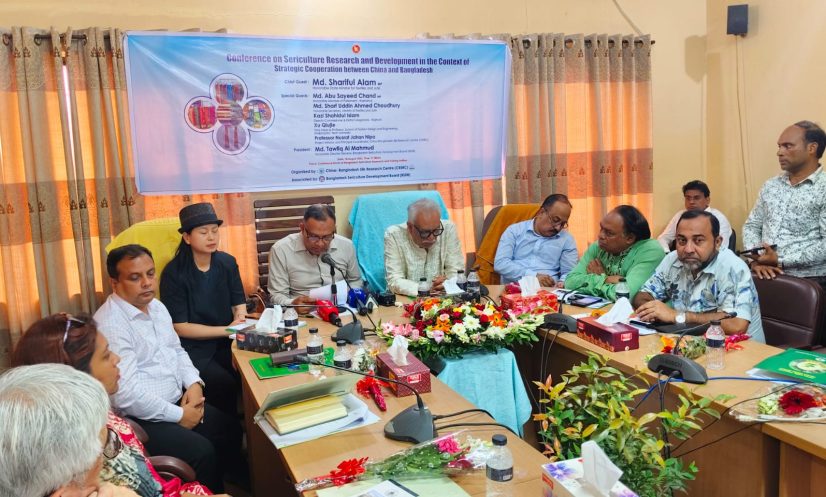
The state minister made the remarks while addressing a conference titled “Sericulture Research and Development in the Context of Strategic Cooperation between China and Bangladesh” in Rajshahi.
The event was organised by the China-Bangladesh Silk Research Center in cooperation with the Bangladesh Sericulture Development Board (BSDB) at the Bangladesh Sericulture Research and Training Institute (BSRTI).
Earlier, Shariful Alam visited the Bangladesh Sericulture Factory and BSRTI.
Recalling Rajshahi silk’s historic significance, he said the industry was once a symbol of elegance, heritage and Bengali culture but had lost much of its prominence over the years due to various challenges.
“Rajshahi silk is not just an industry; it is part of the country’s heritage and pride. The government is working to revive this sector through modern technology, research and training,” he said.
The state minister said greater research, technological development and international cooperation could help the sector regain its position, particularly by opening access to China’s vast silk market.
He said the government was also working, in line with its election manifesto, to reopen closed state-owned factories and mills, expand markets and attract domestic and foreign investment.
A dedicated marketing policy for the development of Rajshahi’s silk industry is also being formulated, he said.

Shariful Alam noted that China, one of the world’s largest producers and consumers of silk, could offer significant opportunities for Bangladeshi silk producers. Expanding into the Chinese market could directly benefit silk farmers, weavers and entrepreneurs in Rajshahi, he added.
He also stressed the importance of producing high-quality silk yarn and fabrics while adopting modern designs, packaging, branding and marketing strategies to establish “Rajshahi Silk” as a recognised international brand.
Among others, Abu Sayeed Chand, Secretary of the Ministry of Textiles and Jute Sharaf Uddin Ahmed Chowdhury, Professor Xu Qiuji of Zhejiang Sci-Tech University, and Professor Nusrat Jahan Nipa, project initiator and chief coordinator of the China-Bangladesh Silk Research Center, attended the conference.
BSDB Director General Toufiq Al Mahmud chaired the event, while BSRTI Senior Scientific Officer Dr Shakhawat Hossain presented the keynote paper.
The conference highlighted both the historical importance of Bangladesh’s silk industry and its potential for future growth through research, innovation and international cooperation.