


 Play store

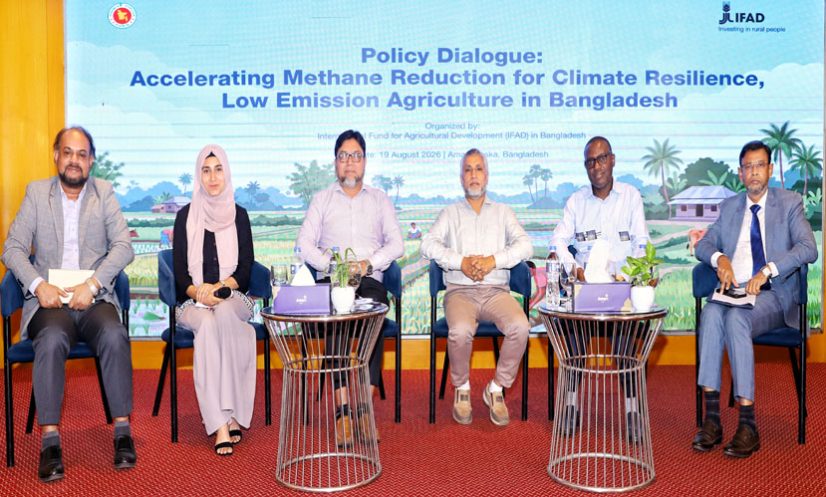
The International Fund for Agricultural Development (IFAD) has urged the Bangladesh government to step up leadership and convert growing research on agricultural methane reduction into policy, scaled investment, and concrete action.
Speaking at the Policy Dialogue: Accelerating Methane Reduction for Climate Resilience and Low-Emission Agriculture in Bangladesh at Amari Dhaka, IFAD Country Director Valantine Achancho warned against fragmented efforts.
“Government must lead, partners must coordinate around that leadership,” Achancho stated. “Our collective objective should be one coherent national pathway, not a collection of disconnected pilots. The evidence is growing, technologies are available, and partners are present. What is needed now is alignment, policy commitment, and investment at scale.”
Chief Guest Mostafa Kamal, Additional Secretary to the Ministry of Agriculture, welcomed IFAD’s global expertise and emphasised balancing ecological limits with practical farming needs. “We need to draw on this knowledge and translate it into interventions that provide a solid foundation for the development of our country,” Kamal noted, highlighting the deep links between land, livelihoods, and climate resilience.
The dialogue convened researchers, development partners, private sector leaders, and farmers to evaluate scalable interventions, including:
Field Practices: Alternate wetting and drying (AWD), urea deep placement, and livestock methane mitigation.
Modernization Tools: Smart, IoT-enabled irrigation, digital agriculture, and climate finance models.
Systemic Support: Credible Measurement, Reporting, and Verification (MRV) systems, carbon markets, and strengthened extension networks.
Specialists from the FAO, the Department of Environment, Bangladesh Agricultural University, and the Bangladesh Rice Research Institute further explored how to align methane reduction with national food security and Bangladesh’s Nationally Determined Contributions (NDCs).
Building on IFAD’s Reducing Agricultural Methane Programme (RAMP), the event concluded with a call for a clear, government-led roadmap to turn field-tested climate solutions into nationwide agricultural policy.