


 Play store

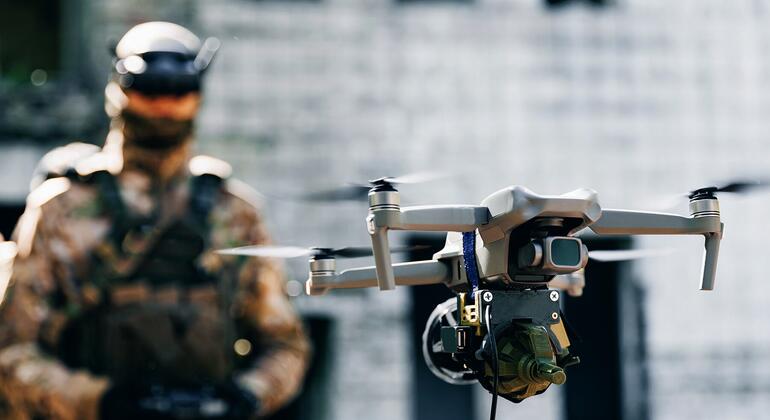
UN Secretary-General António Guterres and International Committee of the Red Cross (ICRC) President Mirjana Spoljaric Egger have renewed their urgent call for legally binding international rules to prohibit and restrict autonomous weapons capable of making life-and-death decisions without meaningful human control.
The appeal comes amid growing concerns that increasingly sophisticated, AI-enabled weapons are being developed and deployed on battlefields at unprecedented speed and scale. Although reports of fully autonomous and AI-guided drones being used in combat remain unconfirmed, the rapid development of such systems has intensified calls for governments to establish clear legal limits before the technology advances beyond effective human oversight.
“We are now dangerously close to crossing a moral red line: the autonomous targeting of humans by machines,” Guterres said in a joint appeal with Spoljaric Egger.
The UN and ICRC warned that autonomous weapons are no longer a matter of distant speculation. The race to develop weapons with increasing levels of autonomy is already underway, raising serious humanitarian, legal and ethical concerns.
Under international humanitarian law, attacks against civilians and civilian infrastructure are prohibited. But identifying civilians and combatants in a rapidly changing conflict environment can be extremely difficult, particularly when fighters surrender, are wounded or civilians unexpectedly enter an area of military operations.
The concern is that machines operating without adequate human judgement may be unable to respond appropriately to such changes.
Mélanie Régimbal, head of disarmament affairs at the UN Office at Geneva, reiterated the UN secretary-general’s position that weapons systems capable of selecting or engaging targets and taking human lives without human control and judgement are “politically unacceptable, morally repugnant” and should be prohibited under international law.
ICRC’s Laurent Gisel, head of its Arms and Conduct of Hostilities Unit, said modern warfare was not simply a matter of precision and restraint, warning that civilians continue to be killed and displaced while hospitals, schools and homes are destroyed at increasing speed and scale.
He stressed that conditions on a battlefield can change rapidly.
“A combatant can surrender or be wounded and therefore be protected from attack; civilians can enter the area of operations of the autonomous weapons systems; the weapons may encounter a situation that would not have been anticipated,” Gisel explained.
Such circumstances, the ICRC argues, demonstrate why human judgement must remain central to decisions over the use of lethal force.
The UN and ICRC are urging governments to move beyond years of discussions and begin negotiations on a legally binding international instrument establishing clear prohibitions and restrictions on autonomous weapons.
“States must show political courage and move beyond incremental discussions towards decisive action,” Guterres and Spoljaric Egger said, warning that failure to act could leave future generations facing a world in which responsibility for lethal decisions becomes increasingly difficult to establish.
Push for treaty gains urgency
The appeal comes ahead of the seventh Review Conference of the Convention on Certain Conventional Weapons (CCW), scheduled to take place in Geneva in November.
The UN and ICRC leaders described the conference as the “clearest path available” for states to agree to move towards negotiations on a legally binding instrument.
They said important groundwork has already been laid through discussions at the UN General Assembly and within the CCW’s Group of Governmental Experts. Those discussions have included efforts to establish what level of human control and judgement is necessary to ensure that the use of autonomous weapons complies with international humanitarian law.
The UN and ICRC first issued a joint appeal on autonomous weapons in 2023, calling on governments to negotiate a legally binding instrument by 2026.
Their earlier appeal stressed that humans must retain control over life-and-death decisions and that machines capable of taking human lives without human involvement should be prohibited under international law.
Tuesday’s renewed appeal reflects growing concern that the 2026 deadline is approaching while technological development is moving rapidly.
The two organisations said the work undertaken over recent years must now translate into concrete political action.
“We urge States to seize this moment,” they said. “Innovation must serve humanity, not endanger it.”
Two categories face calls for prohibition
The UN and ICRC are specifically calling for prohibitions on two categories of autonomous weapons.
The first is unpredictable autonomous weapons, where the operator cannot reliably predict or anticipate the outcome of the use of force, either because of the weapon’s design or because of how it behaves during deployment.
Gisel questioned how such weapons could be used lawfully if their effects cannot be adequately anticipated.
“If it’s not possible to predict it, then how is it possible to limit it?” he asked.
The second category is autonomous anti-personnel weapons, which can deliberately select and attack human beings without meaningful human intervention.
The ICRC says concerns are particularly acute in relation to weapons that autonomously target people because they risk reducing human life to data processed through algorithms, sensors and machines.
The debate comes as artificial intelligence is increasingly being integrated into military systems, including surveillance, target identification, navigation and decision-support technologies. Supporters argue that greater autonomy could improve military precision and reduce risks to soldiers. Humanitarian organisations, however, warn that delegating lethal decisions to machines creates profound problems of accountability, discrimination and proportionality.
At the heart of the debate is a basic question: who is responsible when a machine makes a lethal decision?
The UN and ICRC argue that international rules must answer that question before autonomous weapons become more widespread.
For the organisations, maintaining meaningful human control is not simply a matter of technological design. It is essential to ensuring that the fundamental principles of international humanitarian law continue to apply in an era of increasingly autonomous warfare. Source: UN News