


 Play store

Since August 2017, we have been closely involved in the Rohingya response in Ukhiya and Teknaf. Over the years, I have been deeply impressed by the attitude, organisational capacity, dignity and respect for Bangladesh and its local communities demonstrated by Rohingya people, particularly their young generation.
One experience has stayed with me. Whenever I told Rohingya people that I wanted to assist them in any way I could, they often declined to accept help from me or our organisation. Rather than seeing themselves merely as recipients of assistance, many of them showed a remarkable sense of self-respect and dignity.
I remember that in the early days of the crisis, in August 2017, I was travelling along the main road between Ukhiya and Teknaf when I saw a woman in a burqa standing by the roadside. I wanted to give her some money, but she politely refused. It was one of the first occasions when I realised how strong the sense of self-esteem among the Rohingya could be, even amid such extreme hardship.
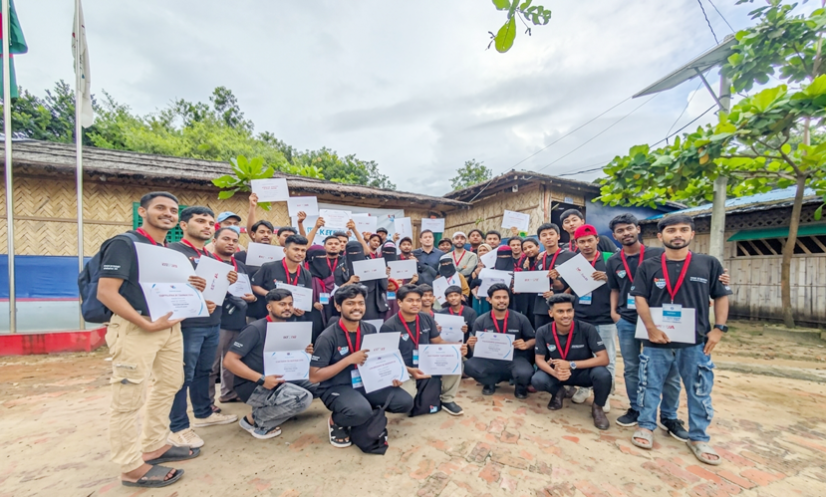
Since then, I have seen this quality repeatedly, especially among Rohingya youths. Around 200 Rohingya young people worked in our UNICEF-supported education project. I found them highly conscious of their dignity, rights and responsibilities. They were eager to learn, communicate and organise, and many demonstrated a strong understanding of the challenges facing their community.
Their English proficiency and ability to communicate internationally have particularly impressed me. Recently, a group of Rohingya youths organised an international seminar virtually from the camps. Around 50 young people sat together for nearly four hours in a small, modest hall, while prominent civil society leaders from the UK, the US, Malaysia and Thailand joined the discussion virtually. I helped connect some of the participants from Dhaka.
The international funding cuts, particularly the reduction in US funding, forced us to close our education project. We are still running some education and technical training initiatives with our own resources. Yet what has impressed me most is how Rohingya youths have responded to these challenges themselves.
They have organised their own education initiatives, developed a curriculum board, printed textbooks, followed the Myanmar curriculum and established schools around the camps. These efforts demonstrate not only their determination to educate themselves but also their capacity to organise and take responsibility for their community.
Their aspirations extend beyond the camps. Rohingya youths are increasingly connecting with people and institutions around the world in pursuit of higher education and opportunities to develop their skills. Today, they are studying, working and building networks in different parts of the world.
I remember that during a visit abroad in early 2018, I urged members of the Rohingya diaspora to come forward and establish stronger connections with people in the camps. What was then a limited engagement has now become much broader, continuous and, in many respects, institutionalised.
Unfortunately, public perceptions of the Rohingya are often shaped by negative reports and stereotypes. Some of these claims deserve closer scrutiny.
For example, the claim that Rohingya people are generally disrespectful towards women and girls does not reflect what I have observed. Such incidents may occur, as they do in any large and vulnerable population, but they should not be used to characterise an entire community.
Similarly, the portrayal of Rohingyas as drug peddlers is, in my view, deeply misleading. Drug trafficking has historically affected border communities in this region and involves people from different backgrounds. It is unfair to place collective blame on the Rohingya population.
The same applies to allegations that Rohingyas are responsible for robbery and banditry. While criminal activities certainly exist, it is wrong to portray an entire community as criminal. In many cases, local criminal networks recruit vulnerable Rohingyas for their own purposes.
We should also remember the extraordinary density and vulnerability of the camps. Around 50,000 Rohingyas may live within a single square kilometre in some parts of the settlements. They live amid severe insecurity, poverty and uncertainty. Yet, despite these enormous pressures, the camps have largely remained peaceful and there has been no widespread pattern of attacks on host communities.
I have also closely followed the cultural activities of Rohingya youths, together with my colleague Shahin Abrar. We have seen them use music and other forms of cultural expression to preserve their identity and keep alive their connection to Arakan. They have even composed inspirational songs about their homeland.
All these experiences have convinced me of one thing: Rohingya youths are not merely beneficiaries of humanitarian assistance; they are one of the greatest assets of the Rohingya community.
They possess resilience, dignity, organisational ability, communication skills and an increasingly strong connection with the international community. With appropriate opportunities, education and support, they can become powerful agents of positive change.
One day, many of these young people may return to their motherland. When that day comes, they will need the knowledge, skills, leadership and networks they are building today. They can play a vital role in rebuilding their communities and seeking justice and accountability for the atrocities committed against the Rohingya.
We should therefore look beyond the image of the Rohingya as refugees dependent on humanitarian assistance. We should see their young people for what they truly are: a generation preparing itself for a future beyond the camps.
The views expressed in this article are the author’s own and do not necessarily reflect Sarabangla English Edition’s editorial stance.