


 Play store

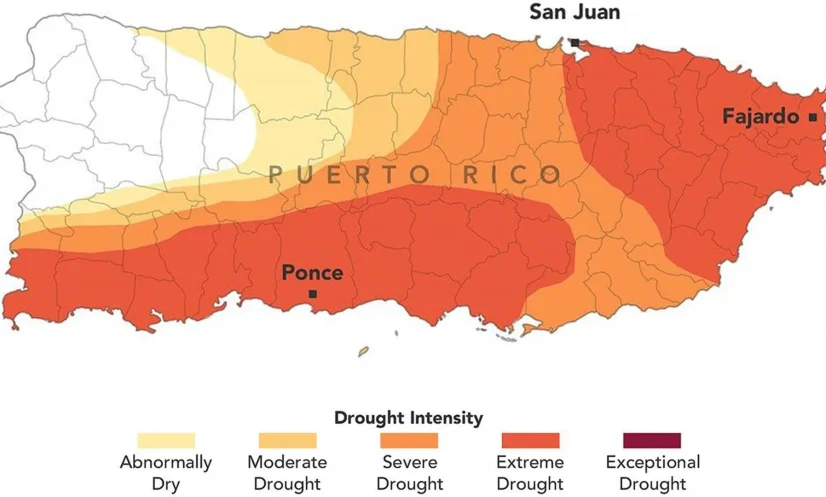
Puerto Rico is facing a rapidly worsening drought after rainfall remained far below normal during what is typically the U.S. territory’s wet season.
By late August, the lack of rain had spread drought conditions across much of Puerto Rico, contributing to water shortages and rationing in some communities. Governor Pedro Pierluisi declared a state of emergency in late July, while the US government in late August issued a drought disaster declaration covering more than two dozen municipalities.
According to the US Drought Monitor, about three-quarters of Puerto Rico was experiencing at least moderate drought as of August 25. Extreme drought had expanded across eastern and southwestern parts of the main island, covering about 44 percent of the territory.
The deterioration has been swift. Three months earlier, no part of Puerto Rico was classified as being in drought, while less than 20 percent was considered abnormally dry.
The territory had experienced wetter-than-normal conditions during late winter and early spring, according to the National Integrated Drought Information System (NIDIS). Conditions then shifted sharply toward dryness.
From mid-May through mid-July, most of Puerto Rico received less than 60 percent of its normal precipitation. Southern and southwestern areas received less than 20 percent of normal rainfall, leaving a deficit of about 3 to 6 inches (76 to 152 millimetres).
NASA scientists said the unusually hot and dry conditions were evident in satellite and ground-based observations used to assess drought conditions.
David Mocko, a senior research scientist at NASA’s Goddard Space Flight Center, said satellite estimates of soil moisture, weather measurements, streamflow data and well conditions were particularly important in assessing recent conditions in Puerto Rico.
Mocko prepared the Drought Monitor update for August 18, becoming one of the first two NASA scientists to produce the weekly drought assessments alongside Jonathan Case of NASA’s Marshall Space Flight Center.
The US Drought Monitor is a joint effort involving the National Drought Mitigation Center at the University of Nebraska-Lincoln, the US Department of Agriculture, the National Oceanic and Atmospheric Administration and NASA.