


 Play store

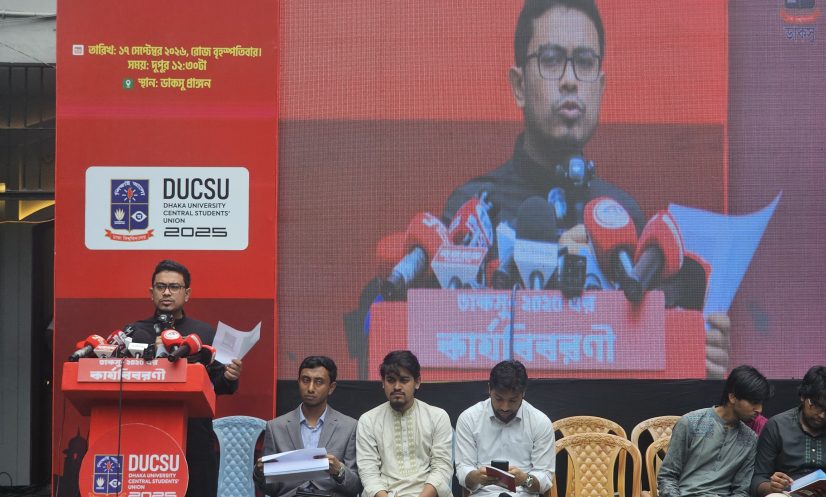
The Dhaka University Central Students’ Union (DUCSU) on Thursday presented a report on its activities and accountability during its first year in office, highlighting initiatives in transport, accommodation, healthcare, education, research, sports, culture and legal assistance for students.
However, DUCSU leaders said several initiatives promised in their election manifesto could not be implemented despite efforts to launch them, blaming what they described as a lack of cooperation from the university administration and the government.
DUCSU Vice-President (VP) Abu Sadiq Kayem and General Secretary (GS) S M Farhad presented various aspects of the report at a programme in front of the DUCSU building on Thursday. Other elected leaders were also present.
Kayem said DUCSU had taken initiatives to modernise the university’s transport system and expand services. These included plans for five new residential halls and 10 buildings, the introduction of shuttle services, and modernisation of the medical centre and Central Mosque.
The union also organised higher education and skills-development programmes and arranged driving training for students. More than 400 students received legal assistance during the year, while cleanliness drives and mosquito and bedbug-control programmes were conducted in residential halls.
Kayem said budgets had been secured for hall renovation and that reading rooms in all 13 residential halls had been equipped with air-conditioning and modernised.
DUCSU also proposed making its elections part of the university’s academic calendar to ensure regular student representation. The proposal is awaiting implementation, he said.
Other initiatives included maternity leave, daycare facilities and gymnasiums, as well as efforts to secure funding for breastfeeding rooms and daycare centres.
DUCSU leaders said they had taken various initiatives to address problems in female students’ residential halls.
Kayem said proposals had been submitted to the Dhaka Metropolitan Police commissioner on measures to prevent sexual harassment and cyberbullying. More than 100 students affected by sexual harassment and cyberbullying were also provided legal assistance, he claimed.
The union said it had modernised common rooms and undertaken programmes to encourage research and higher education. It also highlighted initiatives involving the medical centre, mental health and other healthcare services.
In the culture and publication sector, DUCSU said subject-based literature, periodicals and books had been published.
The union also took initiatives to remove a risky footbridge and a passenger shelter near Begum Sufia Kamal Hall and renovate another passenger shelter. It said steps had been taken to make the campus free from unauthorised external control.
The union also worked on preparing lists of drivers operating vehicles on campus, along with designated uniforms and fare charts.
DUCSU said it had proposed coordination with the DMP to provide traffic assistance at eight campus gates. The project, however, was suspended following the change in government, according to the union.
On sports and food services, DUCSU said it had taken steps to modernise the Physical Education Centre and organised various sporting events.
It also undertook initiatives to improve food safety and the quality of cafeterias and canteens. While low-cost food had been introduced at the Teachers-Students Centre (TSC), some other initiatives, including the sale of subsidised TCB products, remain pending.
The union also said it had taken measures to promote a green campus, including installing dustbins and working on environmental and ecological conservation and noise-pollution control.
On introducing a teacher-evaluation system, DUCSU leaders said the proposal had received approval from the SMT and Academic Council before being placed before the Syndicate.
They alleged that the university administration had yet to implement the system. DUCSU subsequently launched an online platform of its own for teacher evaluation in the interests of students.
The leaders also highlighted initiatives to simplify services at the Registrar Building, expand the Central Library and improve facilities at other libraries.
Other reported initiatives included involving alumni in welfare activities, renovating mosques and other places of worship, providing scholarships to meritorious students and training hall sick-bay staff and employees through first-aid boot camps.
DUCSU also organised programmes marking the anniversary of the July uprising and took positions on international human rights issues. It coordinated activities of hall unions and social organisations and observed national and other important days.
The union said its representatives also met ambassadors and international delegations for discussions on various issues.
On its representation in the university Senate, DUCSU leaders said they had walked out of Senate sessions demanding the removal of names of historically controversial figures from various university installations.
They also said all DUCSU and hall-union members had met twice during the year to review and present their activities.
DUCSU leaders claimed that no classes or examinations were suspended for even a single day because of campus instability during their tenure. They also said renovation work on the DUCSU building had been completed.
Despite the activities reported as completed or ongoing, several initiatives remain pending, according to the DUCSU leadership.
These include establishing computer labs in all residential halls, AI and programming training, internship opportunities, certification support, an innovation hub and job fairs. A field renovation project and a digital survey have also remained stalled, they said.
Five projects under the Local Government Division and Dhaka South City Corporation—including work on the entrance of A F Rahman Hall, renovation of the DUCSU cafeteria, pond-bank development, walkways, lighting and beautification—are also awaiting implementation, according to the union.
Other pending initiatives include introducing registered rickshaws, appointing police personnel on campus and purchasing two minibuses and two microbuses by auctioning old vehicles.
DUCSU leaders said these initiatives had received approval but had not been implemented, and alleged that lack of cooperation from the university administration and the government had hindered their implementation.