


 Play store

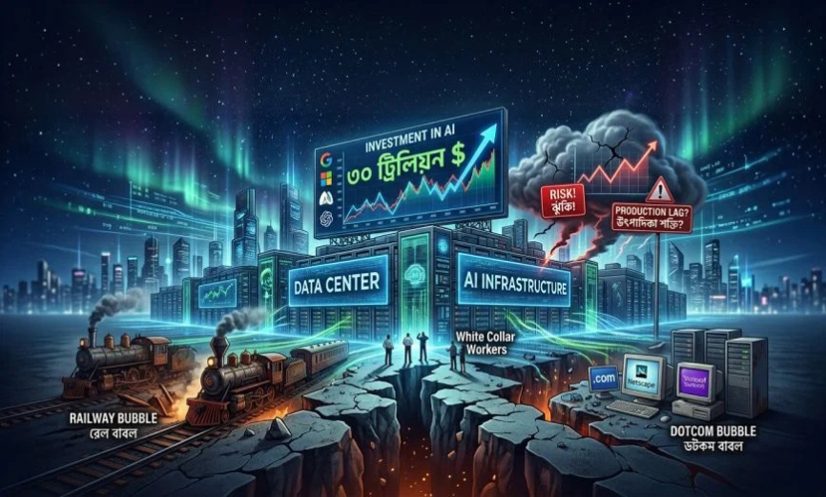
A massive global investment race is underway around artificial intelligence (AI), with technology companies pouring unprecedented amounts of money into data centres, advanced chips and AI infrastructure.
The scale of spending is already surpassing many previous major technology investment waves. According to a forecast by PwC, global spending on data centres alone could reach $30 trillion by 2050.
AI company Anthropic is also reportedly planning to invest around $518 billion over the coming years. The amount is nearly 100 times its potential annual revenue, raising questions among economists about whether such massive investment can generate sufficient economic returns.
According to an analysis by JPMorgan, the expected boost to productivity from AI investment has yet to become clearly visible even in the United States, which has attracted the largest AI investments.
This has also created uncertainty over whether AI companies can sustain their high valuations.
Bain & Company estimates that major technology companies will need to generate an additional $4.2 trillion in revenue over the next five years to cover their AI infrastructure investments.
Economists, however, remain uncertain whether such a large increase in revenue can be achieved.
History shows that major technologies do not always produce immediate economic gains. The steam engine and the internet, for example, took years to translate into significant productivity improvements. Their full economic impact took between 10 and 50 years to emerge.
AI could follow a similar path, analysts say.
While the broader economic benefits of AI remain uncertain, its impact on the labour market is already becoming visible.
A Stanford University study found that hiring of young workers in occupations vulnerable to AI, including accounting and legal assistance, had fallen by around 19 per cent.
At the same time, some technology executives believe AI could accelerate technological progress through so-called recursive self-improvement, in which AI systems improve their own capabilities.
If achieved, such advances could accelerate innovation and economic growth.
Economists have also warned of the risk of a new financial bubble as investment in AI continues to surge.
If revenues fail to keep pace with spending, technology companies could face growing financial pressure. The risks could be particularly high if investments in data centres, electricity supply and computing infrastructure fail to generate the expected returns.
However, analysts say the long-term importance of AI infrastructure should not be dismissed despite questions over its immediate financial returns.
Previous waves of investment in railways and the internet also involved major financial risks. Ultimately, those infrastructure networks became important foundations of the global economy.
AI infrastructure could follow a similar path, becoming a key pillar of future economic growth even if its full economic benefits take years to materialise.