


 Play store

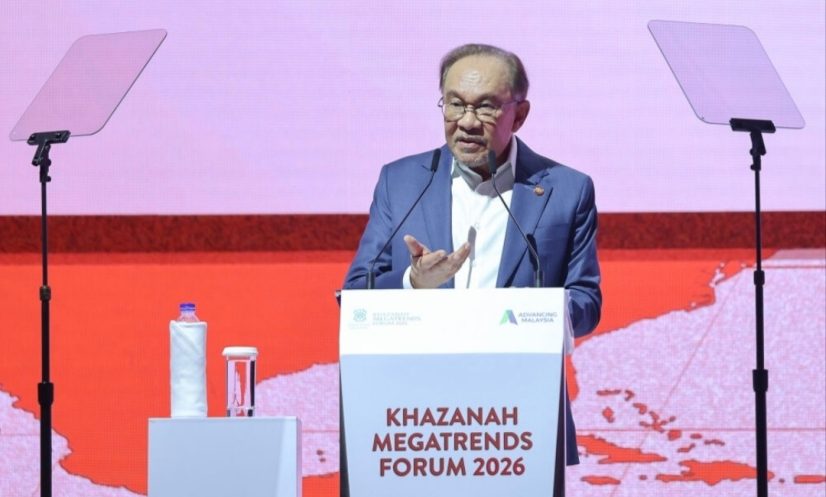
Ahmadul Kobir, Malaysia: Malaysia must navigate rising geopolitical tensions and economic pressures to maintain its strong position in global supply chains, while carefully managing the impact of shifting global power dynamics on trade, technology and geopolitics, Prime Minister Datuk Seri Anwar Ibrahim has said.
He said such challenges were not merely theoretical for Malaysia, a trading nation deeply integrated into the global economy and supply chains. The country also hosts manufacturing facilities that form an important part of the global semiconductor supply chain.
Anwar, who is also Finance Minister, made the remarks in his opening speech at the Khazanah Nasional Bhd Megatrends Forum 2026.
“For a trading nation, and Malaysia is such a nation with factories at the heart of the global chip supply chain, this is not merely a theoretical consideration.
“A trading nation that is naive about these matters will not remain a trading nation for very long,” he said.
Anwar said Malaysia had so far managed to navigate the challenging global environment by maintaining strong economic ties with a wide range of international partners.
He said Malaysia had recorded significant growth in investment and trade with the United States and Europe, while continuing to regard China, South Korea, Japan and India as close friends.
“We are fortunate to be able to navigate this challenging environment by focusing on the economy and international trade, maintaining good relations with countries in both the West and the East, and benefiting from remarkable growth in our investment and trade with the United States and Europe, while regarding China, South Korea, Japan and India as close friends,” he said.
The Prime Minister said Malaysia’s position within ASEAN provided a degree of stability, but stressed that regional cooperation must go beyond symbolism.
“I am not naive enough to assume that this will be an easy path. We are fortunate to be in ASEAN, where we collectively uphold the principle of ASEAN centrality.
“But it must mean having the capability or power to influence developments, rather than merely hosting meetings,” he said.
Stronger global governance and accountability
Anwar also stressed the need to strengthen governance and accountability at the global level as centres of power shift rapidly and evolve faster than the institutions created to regulate them.
He said the lack of meaningful accountability at both national and international levels remained a fundamental weakness in modern governance, contributing to rising geopolitical tensions, unilateral trade actions and systemic imbalances.
“Power is moving faster than the institutions created to govern it,” Anwar said.
He added that democratic accountability should go beyond periodic elections and be implemented in a meaningful and substantive manner, with effective mechanisms to ensure accountability to the people at various levels of governance.