


 Play store

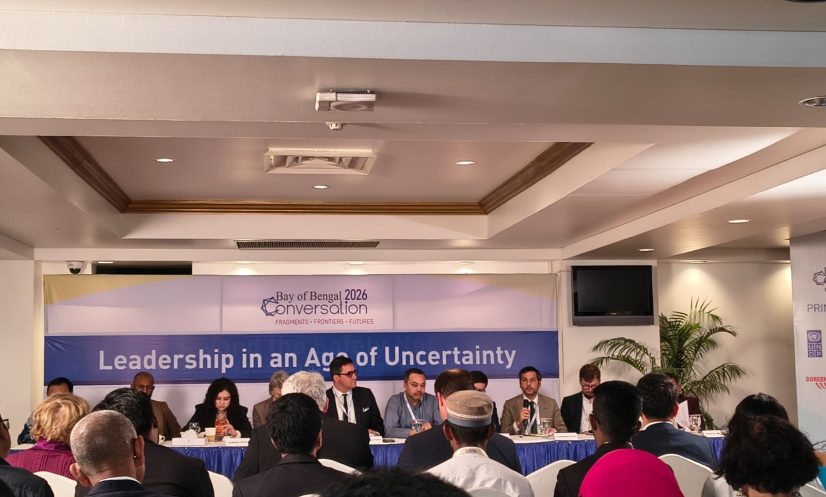
Prime Minister’s Adviser and PMO spokesperson Mahdi Amin has said political, geopolitical and economic uncertainties are inevitable, but proper policies, planning and preparedness can help countries overcome emerging challenges.
“Uncertainty is inevitable. But with the right values, policies, plans and programmes, it is possible to face any challenge,” he said while speaking at a discussion titled “The Inner Forum: Leadership in an Age of Uncertainty” at the Bay of Bengal Conversation 2026 at a city hotel on Monday.
Mahdi said Bangladesh and other countries in the region could collectively address challenges and advance development by building relations based on regional cooperation and mutual benefits.
On the Rohingya crisis, he said international funding for the displaced people should continue, while Bangladesh needed to work with global and regional stakeholders to ensure their safe, voluntary and dignified repatriation.
“We can build bilateral and multilateral relations with every country on the basis of equality, fairness and justice,” he said.
He also stressed greater cooperation in education, healthcare, communications, connectivity, technology and maritime security.
On technological transformation, Mahdi said some jobs could disappear because of artificial intelligence, robotics and the Fourth Industrial Revolution.
“However, new employment opportunities can be created through training, skills development and modernising curricula,” he said.
Highlighting government plans to address climate and environmental risks, he said Bangladesh planned to plant 25 crore trees over the next five years, excavate 20,000 canals and rivers, construct the Padma Barrage for water conservation and undertake the Teesta Barrage Master Plan.
He said people’s living standards could be improved through appropriate policies even amid concerns over a possible economic crisis.
In this regard, he mentioned plans to introduce Family Cards, Farmers’ Cards and Health Cards. The government has previously said it is pursuing a five-year programme to plant 25 crore trees and has begun rolling out various social and sector-specific card initiatives.
Other speakers at the discussion included Aamna Khan, Non-Resident Fellow at the London Dialogue, Qatar; Constantino Xavier, Senior Fellow at the Centre for Social and Economic Progress, India; Hadza Min Fadhli Robby, Director of the Institute for Global and Strategic Studies at the Islamic University of Indonesia; Julia Roknifard, Senior Lecturer at Taylor’s University, Malaysia; Krzysztof Marcin Zalewski, President of the Boym Institute, Poland; Hallelujah Lulie Wondimu, PhD Researcher at the University of Oxford, United Kingdom; Mehmet Ozkan, Professor of International Relations at the Turkish National Defence University, Turkey; and Petr Topyckanov, Associate Senior Researcher at the Stockholm International Peace Research Institute, Russia.
Kamal Dev Bhattarai, Editor-in-Chief of The Annapurna Express, Nepal, moderated the discussion.
The Bay of Bengal Conversation, organised by the Centre for Governance Studies (CGS), brought together around 200 speakers, 300 delegates and 1,000 participants from more than 100 countries.
Former heads of state and government, ministers, diplomats, researchers, journalists, business leaders, security experts, civil society representatives, innovators and young leaders took part in the three-day international conference, which concluded on Monday.