


 Play store


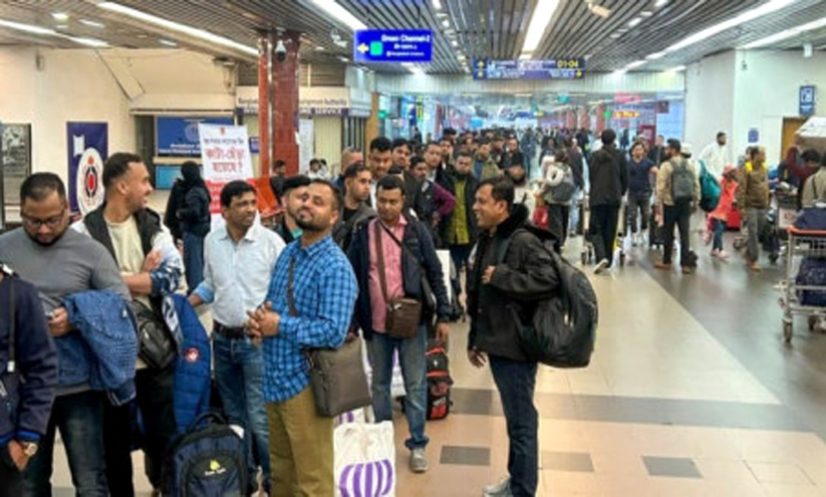
A controversy has erupted recently following an unpleasant incident at the airport. Major (Retd.) Akhtaruzzaman has always been known for speaking his mind bluntly. This personal characteristic of his is perhaps more prominent than his relatively brief current political identity. This time, he became angry with airport officials over the lack of luggage trolleys, delays in receiving baggage and other problems.
This is nothing new. Every day, at least a dozen videos or reels go viral on social media highlighting irregularities at the airport, delays in receiving luggage, luggage theft, baggage being tampered with, long immigration queues, corruption among customs officials and misconduct by airport employees.
In some of these videos, angry members of the public can be seen behaving even more aggressively than Akhtaruzzaman. Yet this time, the government actually filed a case against him for allegedly obstructing airport officials, disrupting their duties and humiliating them.
What benefit does the BNP gain by protecting these incompetent, inefficient and allegedly corrupt airport officials? They have consistently damaged the image of both the country and the government. There is a common saying that when you visit a country for the first time, your experience at the airport gives you an overall impression of how the country is being run.
During the past few years, on the three or four occasions I have travelled through this airport, I have encountered such irregularities and disorder that I could hardly believe that any administration was actually functioning there. A foreign visitor would have little reason to feel that they had entered a properly functioning, civilised country. It is worth mentioning that the experience at Ethiopia’s current airport, despite Ethiopia once being regarded as one of Africa’s poorest and most troubled countries, may well be a hundred times better than this.
Only recently, a huge quantity of goods worth tens of billions of taka was burned to ashes in a fire in the cargo area of the same airport. The firefighting arrangements there are practically non-existent. Even if you never use the airport, you can simply look at Google Maps and see that millions upon millions of taka worth of cargo is scattered in the open air in the cargo area of this international airport.
In a country that receives around 2,300 millimetres of rainfall every year, it is difficult to imagine another place in the world where cargo would be left exposed to the elements in this manner.
Even more astonishing is the fact that there is no ATM in the departure lounge of this international airport. I discovered this last year. I had a flight to Mexico on the night of Eid-ul-Adha. I rushed to the airport without withdrawing any cash, assuming that I could simply withdraw money from an ATM and convert it into dollars.
Later, I learned that I either had to leave the airport or go to the arrival lounge, where there was an ATM operated by a relatively obscure bank. Interestingly, without encountering any security barriers, I simply followed the directions given by airport employees and walked from the departure lounge to the arrival lounge, withdrew the money and returned. In fact, the airport did not appear to have any meaningful standard security protocol at all.
The much-discussed shortage of luggage trolleys at the airport did not suddenly begin that day. About three years ago, while leaving the airport, I saw a huge queue of nearly 200 people. I asked what the queue was for. An employee told me that it was a queue for trolleys. In other words, after collecting their luggage from the baggage belt, passengers were expected to use a trolley to carry their bags outside. But there were no trolleys.
This essentially means that you have to carry two pieces of luggage weighing 23 kilograms each, or even more, on your shoulders and walk nearly half a kilometre to get out of the airport. Alternatively, even after getting off the aircraft and collecting your luggage, you may have to stand for nearly two hours waiting for a trolley.
For those brothers working in the Middle East, the so-called “remittance warriors”, this is an especially unbearable experience because many of them return home only once every four or five years. Their loved ones are waiting outside. As the saying goes, “death is preferable to waiting.”
Nearly three years later, I saw exactly the same situation again. A long queue for trolleys! The previous government was considered by many to be a fascist regime, but why does the same problem still exist? Even at what might be considered the worst airport in the world, there would presumably be no shortage of luggage trolleys.
A trolley may cost only around ten thousand taka. Let us assume that, after all the corruption and inflated purchasing costs, the price of a trolley reaches 20,000 taka. Then 1,000 trolleys would cost only 20 million taka, just two crore taka. Think about this for a moment. At this airport, the daily expenditure on fuel for vehicles used by officials travelling to and from their offices alone may well exceed a crore taka. I would not be surprised if a similar amount were spent on tea and snacks.
At the same time, Boeing aircraft worth approximately 800 billion taka are being purchased, the justification for which has been questioned. Yet there is supposedly no money for trolleys to help the expatriate workers who work tirelessly every day carry their luggage! Or is there money, but has it already been eaten up after being distributed among those involved?
In the video of the latest incident, passengers can be heard shouting and protesting that there was not even enough space for hundreds of waiting passengers to stand, let alone sit. Whenever a large aircraft lands, I have often felt that the entire airport, from immigration to baggage collection, turns into something resembling a fish market. There is simply no room to stand!
In the recent incident, during the argument, the incompetent Executive Director repeatedly said that there was a process underway to purchase trolleys. Just think about it: three years to purchase 1,000 trolleys! Three years is based on my own experience.
According to people who have suffered from the problem, the airport has been without sufficient trolleys for approximately four or five years. In other words, even after five years, they have been unable to complete the process of purchasing trolleys. Perhaps the reason is that the amount of money involved is too small. There is more profit in purchasing Boeing aircraft.
At one point, a newspaper reported that aircraft spare parts were being purchased at prices nearly one hundred times higher than their market value. I am quite certain that, during his tenure, this official may also have spent several crore taka on unnecessary foreign trips in connection with government work.
In reality, many people come to government agencies primarily to secure their own personal interests. Public service becomes a secondary concern.
A new airport is being built to replace this old airport, and it is certainly an impressive structure. But unless there is an improvement in the efficiency and integrity of the people running these institutions, I doubt that the new infrastructure alone will achieve much.
The most ridiculous development of all was the arrest of Akhtaruzzaman for allegedly obstructing government officials. What is the actual work of government offices supposed to be? Corruption and theft? In such cases, a government job almost becomes a licence for bribery and embezzlement. And when have these people actually provided proper public service?
Today, I saw the concerned minister defending the airport authorities. Instead, he should have issued a show-cause notice to the Executive Director, asking why there were not enough trolleys at the airport and why passengers had to wait so long to receive their luggage.
Instead of doing that, what has happened is simply a repetition of the past. It was precisely because of these overacting government officials that the Hasina government once suffered a downfall. Just to remind you, I hope the present government will not follow the same path.
The views expressed in this article are the author’s own and do not necessarily reflect Sarabangla English Edition’s editorial stance.