Play store


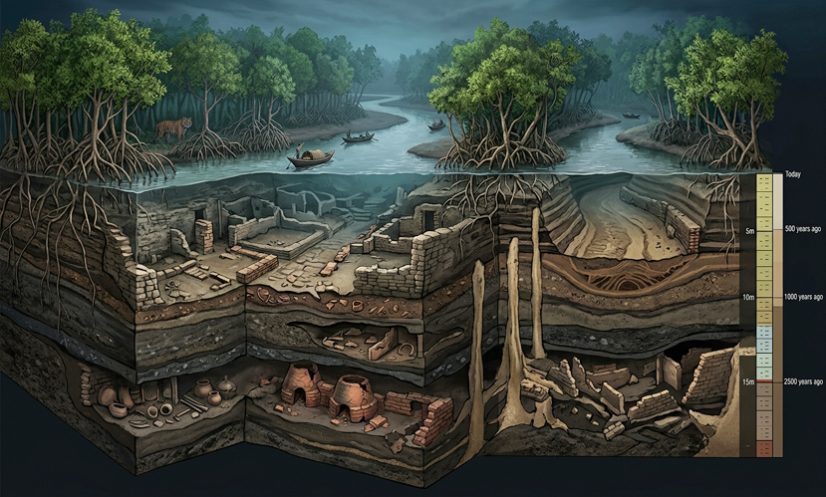
The Sundarbans is usually imagined as a vast green kingdom of mangrove forests, Royal Bengal tigers, creeks, rivers and tides. But beneath this seemingly timeless landscape may lie another story, one that reaches deep into the history of Bengal and perhaps as far back as 2,500 years.
Could an ancient settlement, trading centre or even a lost town be buried beneath the layers of silt and sediment of the Sundarbans?
The question may sound like the beginning of an archaeological adventure. Yet it is increasingly becoming a legitimate subject of scientific inquiry. Geological studies, archaeological discoveries and evidence of dramatic changes in the Ganges-Brahmaputra delta suggest that the landscape we know today as the Sundarbans is very different from what it was thousands of years ago.
For generations, the deep wetlands and forests of the Sundarbans were widely assumed to have been unsuitable for permanent human settlement. But that assumption is becoming increasingly difficult to sustain.
Archaeological discoveries from both the Indian and Bangladeshi sides of the Sundarbans have revealed traces of human activity, settlements, structures and production sites. Along rivers and waterways in areas such as Kejurdananga, Arpangashia, Shekhertek, Katka and Kholpetua, researchers have reported ancient brick structures and remains that point to human occupation and economic activity.
Some of the evidence dates back roughly 1,000 to 1,500 years, while other discoveries suggest that the wider delta supported human activity much earlier.
There are also indications that parts of the region were connected to riverine and maritime trade. Some researchers have suggested that certain archaeological remains could represent old trading settlements or port-related sites. Historical and heritage studies of the Bengal delta likewise indicate that agriculture, permanent settlement and river- and sea-based commerce existed in parts of what is now the Sundarbans.
Then there are the salt-making sites. More than a hundred ancient salt-production furnaces have reportedly been identified in different parts of the Sundarbans, with estimated dates ranging from around the eighth to the eighteenth centuries. Coastal erosion has exposed some of these structures from beneath layers of sediment.
These discoveries do not, by themselves, prove that a major ancient city once stood beneath the Sundarbans. But they establish something equally important: the landscape was not always the untouched wilderness we see today.
The most fascinating clue, however, comes from geology rather than archaeology.
A 2024 study published in Nature Communications identified compelling evidence of a major earthquake in the Ganges delta about 2,500 years ago. Scientists found sand dykes several metres beneath the ground. These vertical columns of sand are characteristic geological evidence of liquefaction, a process in which water-saturated soil behaves almost like a liquid during a powerful earthquake.
The estimated magnitude of the earthquake was around 7 to 8. That was not an ordinary tremor. It would have been a massive geological event capable of transforming the landscape of a huge part of the delta.
Researchers found evidence that around the same period a major section of the Ganges suddenly shifted its course. Geologists call this process avulsion. In a delta, an avulsion can rapidly redirect a river into a new channel, abandoning an older one.
The abandoned ancient river channel identified in the research was reportedly about 1.5 kilometres wide. Evidence of a broadly contemporaneous river-course change was also found at a location roughly 85 kilometres away.
This is where geology begins to intersect with the mystery of the Sundarbans.
The Bengal delta has never been a fixed landscape. Rivers have shifted, channels have disappeared, new chars have emerged, land has subsided and fresh sediment has accumulated. Areas that are forest or wetland today may once have been rivers, agricultural land, settlements or even important trading routes.
Research on the delta indicates that the river and wetland systems of south-western Bangladesh have undergone repeated transformations over the past 5,000 to 6,000 years. That makes one possibility particularly intriguing.
If people lived, farmed and traded in parts of this wider delta thousands of years ago, some of their settlements could have been overwhelmed or buried as rivers changed course, land subsided and sediment accumulated. Nature may have preserved the evidence while simultaneously hiding it.
The archaeological history of the Indian Sundarbans also deserves attention in this context. Researchers and collectors in West Bengal have played an important role in documenting the ancient history of the region.
Among them, Kalidas Dutta made a notable contribution during the first half of the twentieth century. He travelled through different parts of what is now South 24 Parganas and collected ancient artefacts and architectural remains discovered during the excavation of ponds, canals and water bodies.
His research later contributed to broader historical works, including Dineshchandra Sen’s Brhat Banga and subsequent compilations dealing with the history of South 24 Parganas. These works remain important sources for understanding the region’s archaeological past.
More recent research has expanded that body of knowledge. Multi-volume works such as Prasanga Sundarban, edited by Umeshankar Mondal and Sanat Kumar Purokaystha, have examined the geography, history and environmental evolution of the Sundarbans.
Archaeological surveys in West Bengal have also reported artefacts associated with different periods, including the Mauryan, Kushan and Gupta eras.
All this raises a tantalising question: could there have been a major settlement in the Sundarbans around 2,500 years ago?
The scientifically responsible answer is that it cannot be ruled out, but there is not yet enough evidence to declare it an established fact. This distinction is important.
We already know that sophisticated settlements existed elsewhere in Bengal during roughly the same broad period. Wari-Bateshwar in Narsingdi provides particularly important evidence. Archaeological remains there indicate an urban settlement dating back to around the fourth century BC, with evidence of links to wider Indian Ocean trading networks. But Wari-Bateshwar is not in the Sundarbans.
Therefore, its existence cannot be used as direct proof of a contemporary city beneath the mangrove forests. What it does establish is that the Bengal region was capable of supporting complex settlements, production and long-distance trade more than two millennia ago. The geological evidence then gives us another piece of the puzzle.
A major earthquake around 2,500 years ago could have disrupted rivers, settlements, agriculture and trade routes across a large part of the delta. If settlements existed in vulnerable areas, they could have been abandoned, destroyed, buried or gradually swallowed by changing waterways. But here again, caution is essential.
One of the most tempting theories is that the earthquake may have triggered a tsunami that destroyed an ancient settlement in the Sundarbans. Large tsunamis have occurred in the Bay of Bengal, and geological studies have identified evidence of prehistoric tsunami events in the northern Bay and the Andaman region.
There is evidence of several major tsunami events during the past 2,000 years. But there is currently no direct evidence establishing that the specific earthquake that struck the Ganges delta around 2,500 years ago generated a tsunami that destroyed a city in the Sundarbans.
That distinction matters. A compelling hypothesis is not the same as a proven historical event.
The ancient tsunami history of the Bay of Bengal remains incomplete, and researchers have called for wider palaeotsunami investigations. More geological sampling, sediment analysis and archaeological exploration will be necessary before any firm conclusion can be reached.
There is another reason why discovering such a settlement would be extraordinarily difficult. The Sundarbans itself may have become a giant archaeological burial ground.
For thousands of years, rivers have changed course. Sediment has accumulated. Land has subsided. Tides have reshaped the coastline. Erosion has removed some areas while depositing new layers elsewhere. Mangrove forests have expanded across land that may once have been used by people.
In such an environment, an ancient settlement does not necessarily disappear. It may simply become buried.
A brick structure that once stood beside a river could now lie several metres beneath sediment. A former agricultural field could have become a wetland. A trading settlement could have been cut off from its original river after an avulsion. A harbour could have disappeared as the river shifted elsewhere.
In fact, geological research has also identified evidence of gradual land subsidence in parts of the Sundarbans and surrounding delta over much later periods, including evidence associated with earthquake-related changes from around the eighth century onwards.
This makes the central mystery even more compelling. Perhaps the most important question is no longer simply whether there was a lost city beneath the Sundarbans.
The more scientific question is this: what kinds of settlements existed in the Sundarbans region before and after the great earthquake 2,500 years ago, and what happened to them as the rivers and landscape changed?
Answering that question could transform our understanding of the ancient history of Bengal. It would also challenge the conventional image of the Sundarbans as a landscape that has always been dominated by mangrove forest and wilderness.
The modern Sundarbans is undoubtedly one of the world’s great natural ecosystems. But nature and human history are not mutually exclusive. Forests can grow over old settlements. Rivers can bury roads and houses. Tides can erase traces of human activity. Sediment can preserve what erosion destroys.
The region may therefore hold a rare combination of archaeological and geological evidence: human settlements preserved beneath a landscape repeatedly transformed by rivers, earthquakes, subsidence and the sea.
What lies beneath the Sundarbans cannot be established through speculation alone. It requires systematic archaeological surveys, satellite and remote-sensing studies, sediment coring, radiocarbon dating, palaeochannel mapping and underwater or sub-surface investigation where appropriate.
Most importantly, research should cross political and disciplinary boundaries. The Sundarbans is divided between Bangladesh and India, but the geological system that shaped it does not recognise an international border. The history of the delta must therefore be studied as an interconnected geographical and cultural system.
The possibility of an ancient settlement beneath the Sundarbans should neither be sensationalised nor dismissed. The evidence available today supports a more measured conclusion.
About 2,500 years ago, a powerful earthquake shook the Ganges delta, probably with a magnitude of 7 to 8. Around the same period, major changes occurred in river courses. Archaeological evidence demonstrates that the wider Bengal delta supported human settlements, agriculture and trade during ancient times. Later archaeological discoveries show that the Sundarbans itself was not always an uninhabited wilderness.
What we do not yet know is whether a major settlement existed in the present-day Sundarbans at the time of the earthquake, whether it was severely affected by the geological upheaval, and whether traces of such a settlement remain buried beneath today’s forests and sediments. That is the real mystery.
And perhaps the greatest archaeological discovery in the Sundarbans will not be a spectacular ruined city rising suddenly from beneath the mangroves. It may instead be a small fragment of pottery, a buried brick wall, an ancient furnace, a grain deposit or an old river channel containing the evidence needed to reconstruct a lost chapter of Bengal’s past.
The Sundarbans has spent thousands of years hiding its secrets beneath mud, water, roots and sediment. Modern science is now beginning to ask the right questions. The answer may be waiting beneath our feet.