


 Play store


SAVAR, Dhaka: Prime Minister Tarique Rahman today said safeguarding Bangladesh’s national interests, sovereignty and dignity would remain the country’s foremost commitment, as the government seeks to strengthen friendship and cooperation with all nations based on mutual respect and equality.
“Bangladesh wants to strengthen friendship and cooperation with all countries on the basis of mutual respect and equality,” he said while addressing a National Standard Awarding Ceremony at Savar Cantonment this morning.
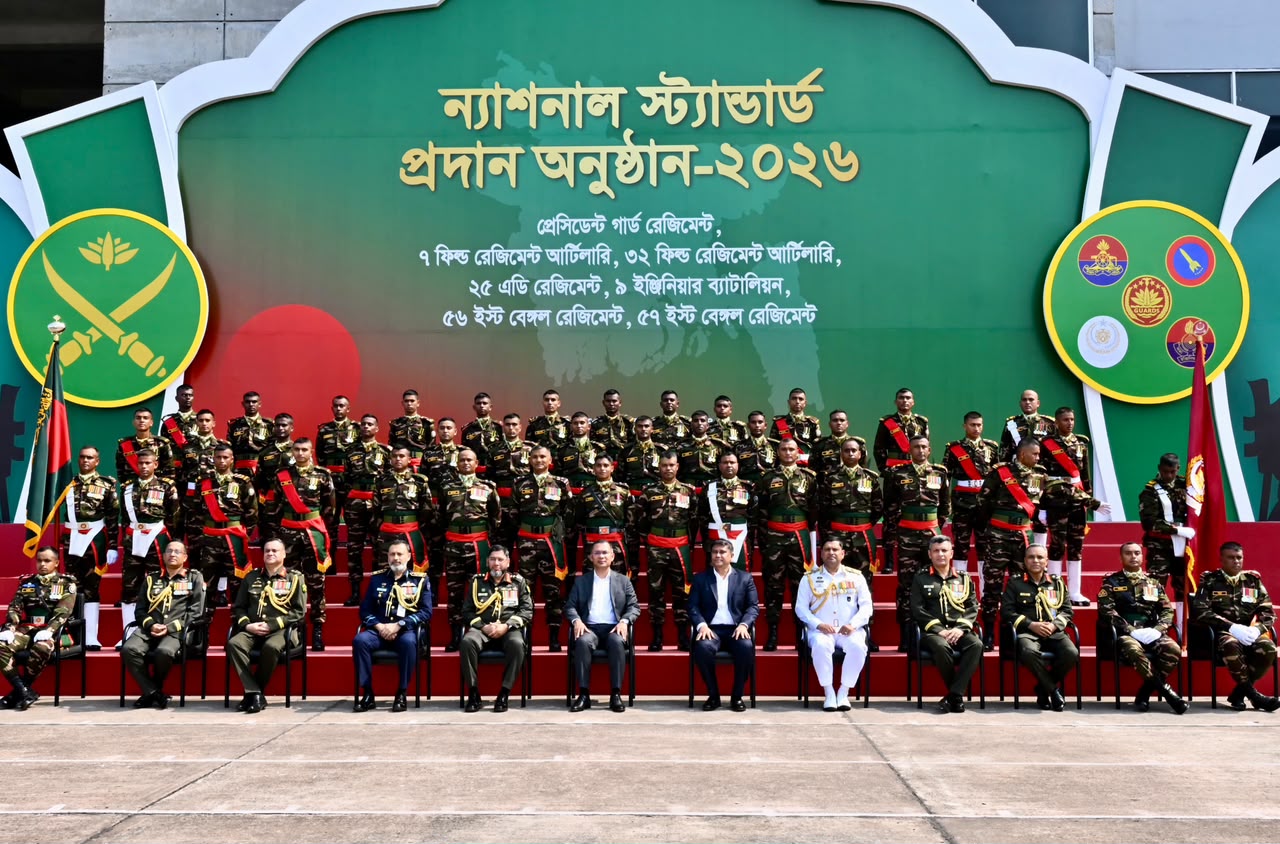
Several battalions and regiments received the National Standard at the ceremony in recognition of their professional excellence. The programme was organised by the 9th Infantry Division.
Emphasising the significance of the honour, the prime minister said the National Standard was much more than a flag, representing a unit’s history, heritage, discipline, sacrifice, professionalism and commitment to the country.
“The glorious hoisting of the national flag constantly reminds us of our independence, sovereignty and the sacrifices of countless people,” he said, adding that receiving the standard renewed a unit’s pledge to perform its responsibilities with greater dedication.
“Safeguarding the honour of the flag is a sacred duty of every soldier,” he added.
Tarique Rahman said the strength of a modern armed force could not be measured solely by its weapons, equipment or manpower. Rather, its true strength lay in discipline, competence, leadership, integrity, training, public trust and, above all, an effective chain of command.
He said the government was continuing its efforts to transform the armed forces into a more technology-driven, capable, disciplined, professional and modern force.
The public expected officers and soldiers at every level to uphold the Constitution, laws, military regulations and humanitarian values while carrying out their duties, he added.
Highlighting the rapidly changing global security environment, the prime minister said the nature and strategies of warfare were evolving at an unprecedented pace.
Alongside capabilities on land, at sea and in the air, cyberspace, outer space, drones, artificial intelligence, electronic warfare and information-based operations had become increasingly important elements of national security.
“In this reality, work is underway to advance our defence preparedness in keeping with the changing times,” he said.
The government also attached importance to developing a domestic defence industry capable of manufacturing essential weapons, ammunition and military equipment, he said, stressing that local production should complement the modernisation of the army.
However, technology alone could not replace people, he noted. Bangladesh needed an integrated defence capability that would allow the army, navy and air force to operate in coordination when necessary, supported by enhanced technological capacity.
Recalling the country’s Liberation War, Tarique Rahman said the history of the Bangladesh Army was inseparably linked with the birth of the nation through the 1971 war.
He said that when Pakistani forces launched a brutal crackdown on the people of Bangladesh on the night of March 25, 1971, Major Ziaur Rahman, then deputy commander of the Eighth East Bengal Regiment in Chattogram, declared, “We revolt.”
The prime minister said Ziaur Rahman subsequently assembled Bengali-speaking officers and soldiers of the regiment and instructed them to join the armed struggle for independence.
Quoting Ziaur Rahman’s article “The Birth of a Nation”, Tarique Rahman recalled that he had described calling together the battalion’s officers, junior commissioned officers and soldiers and directing them to take part in the armed struggle at 2:15am on March 26, 1971.
The prime minister also said Bengali-speaking members of the 1st, 2nd, 3rd, 4th and 8th East Bengal regiments mounted armed resistance against Pakistani occupation forces following the crackdown.
He recalled Ziaur Rahman’s subsequent declaration of independence from Kalurghat Radio Centre on March 27, saying his role in the Liberation War remained an inspiring chapter in the history of the armed forces.
The courageous contribution of an army officer to the country’s independence struggle, he said, continued to be a source of pride and inspiration for military personnel.
“That is why patriotic people who cherish independence consider any success of the army a success for Bangladesh,” he added.
The prime minister said the armed forces played a role beyond defending the country’s sovereignty and territorial integrity. They also provided vital support during natural disasters, fires and other national emergencies and served with distinction in international peacekeeping missions.
He said the government was giving due importance to the welfare of armed forces personnel, including housing, healthcare, education, training, career development and social security after retirement.
According to the prime minister, salaries and allowances of armed forces members had already been increased by between 100 and 138 per cent under the national pay scale.
The government was also processing the implementation of the “One Rank, One Pension” system to further improve the living standards of army personnel, he added.
Cabinet members and advisers, the army chief, members of the diplomatic corps, former and serving armed forces officers, and military personnel of various ranks attended the ceremony.