


 Play store

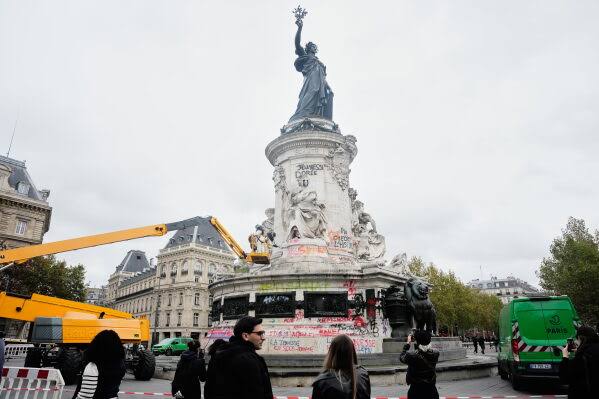
PARIS: Dozens of protesters took to the streets of Paris on Thursday despite restrictions on demonstrations imposed in several French cities following a weekend of violent clashes, looting and arson that marked some of the country’s worst unrest in years.
Organisers of the Paris demonstration said an administrative court had overturned a police ban on the protest. The ruling was not immediately made public.
The Paris police prefecture had defended the restriction, citing the risk of further violence after groups of masked youths clashed with police, looted shops and set cars on fire over the weekend.
More restrictions were expected in the coming days as the government sought to prevent further unrest. French President Emmanuel Macron said the measures were intended to protect city centres, businesses and public buildings.
The right to demonstrate is protected under the French Constitution, and the planned bans in Paris, Lyon, Lille and Grenoble drew criticism from those who viewed them as an infringement on the public’s right to protest.
High school and university student groups said they would continue their mobilisation despite the start of the autumn school holidays this week.
Speaking after a special security meeting at the Elysée Palace, Macron said authorities would prohibit demonstrations requested by “individuals or groups with no legitimate authority”.
He said requests from trade unions would be considered by local authorities in accordance with the law, but alternative routes could be proposed to reduce disruption and protect sensitive locations.
“Where trade unions submit requests to hold demonstrations, prefects will examine them in accordance with the law, but alternative routes will be proposed” to protect city centres, businesses and public buildings, Macron said.
“The general recommendation is that there should be no demonstrations in the coming days,” he added, while indicating that trade unions wishing to protest could be offered alternative routes.
Macron blamed the weekend’s violence on what he described as actions by radical far-left groups seeking to undermine the Republic, alongside criminals who took advantage of the disorder to loot shops.
The unrest has prompted a strong security response across Paris and other French cities. Night-time curfews have been imposed in some areas, while authorities in several locations said calm had been restored.
In Paris, the restrictions covered areas around the Elysée presidential palace, both houses of parliament and the city’s main railway stations. Central districts badly affected by looting were also included.
Authorities are now preparing for another major day of demonstrations on Saturday, when activists from the Yellow Vest movement and the CGT labour union are expected to join protests.
The Yellow Vest movement shook France in 2018 and 2019 with demonstrations initially driven by anger over fuel prices and later expanded to encompass wider grievances over living costs and economic inequality.
Local authorities said some Saturday demonstrations, including marches in Lyon, would also be prohibited.
Prime Minister Sébastien Lecornu, who met trade union representatives on Wednesday, said a “massive” security operation was planned for Saturday to prevent a repeat of the violence. The weekend’s clashes, involving relatively small groups of rioters, had exposed shortcomings in existing security arrangements, he said.
Union representatives said their meeting with Lecornu had produced no concrete proposals. They are now preparing for another day of action scheduled for November 5 and have called on employees in both the public and private sectors to participate.
The unrest began last month at a high school in Créteil, southeast of Paris, where students protested over staff shortages. The demonstrations subsequently spread to other suburbs of the capital and then nationwide, with strikes, school blockades and marches reported in smaller towns as well.
Students have raised concerns about underfunded schools, deteriorating facilities and a lack of teachers and other staff, particularly in lower-income neighbourhoods. Some have also demanded reforms to the university admissions system, which many consider complicated and unfair.
As the government struggles to address the students’ grievances, the school protests and blockades have developed into a broader movement fuelled by concerns over the rising cost of living.
The unrest comes just months before next year’s presidential election, in which voters will choose Macron’s successor. The growing protests present a challenge for the government as it attempts to balance public order with the constitutional right to demonstrate.