


 Play store

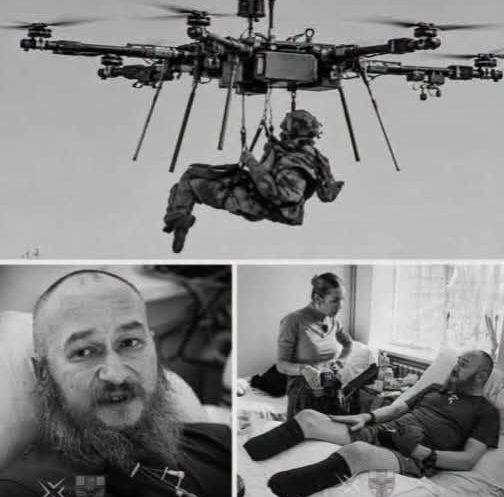
A Ukrainian infantryman who spent months trapped in a bombed-out school after losing one leg in a Russian drone attack amputated part of his remaining leg himself in a desperate bid to survive.
He was eventually rescued by a heavy-lift drone in what Ukrainian military officials described as the first known aerial evacuation of a soldier using a drone in the ongoing war.
Kostiantyn Vlasenko, 49, was injured in a Russian drone strike in February. The attack severed his left leg and severely fractured his right one, leaving him almost unable to move. He took shelter in a hole beneath a metal boiler in the basement of a destroyed school in Ukraine’s northeastern Kharkiv region.
After months without access to proper medical care, Vlasenko decided to amputate the remaining damaged portion of his right leg. He said the exposed bone made it increasingly difficult to drag himself along the ground. Using a knife, he cut off the injured portion and applied a tourniquet to control the bleeding.
Vlasenko was eventually evacuated on October 4 after spending nearly eight months in the boiler room and a total of 491 days on the battlefield. He is now receiving treatment at a hospital in Kharkiv.
“I had already buried myself. I knew there was no hope left,” Vlasenko told Reuters from his hospital bed. Reuters said it could not independently verify all details of his account.
Trapped in a Deadly Combat Zone
Vlasenko served with Ukraine’s 30th Mechanised Brigade in the Kharkiv region. He was sent to the area in May last year to join a fellow soldier known as “Basky”.
The position was part of what soldiers call a “kill zone”, where constant drone surveillance and attacks make even small movements potentially fatal. Supplies were delivered by drone, while soldiers often remained confined to underground bunkers for months.
In mid-February, Vlasenko and Basky were forced to leave their bunker after it flooded. They took shelter in a ruined school building. When they later ventured outside to collect dry clothes and food left by their comrades, a Russian surveillance drone spotted them. Another drone dropped a bomb, killing Basky on his 50th birthday and severely injuring Vlasenko.
The explosion destroyed Vlasenko’s left leg and caused serious damage to his right leg. Unable to move normally, he found a small hole beneath the school’s heating boiler and remained there, struggling to survive.
High-Risk Drone Rescue
With Russian drones making evacuation by vehicle or armoured transport almost impossible, Vlasenko’s commanders began looking for an alternative. Two unmanned ground vehicles sent to reach him were destroyed in Russian drone attacks.
The rescue team then turned to a heavy-lift drone made by Ukrainian manufacturer Gurzuf Defence. The six-rotor aircraft could carry up to 90kg over a distance of 25km, enough to transport Vlasenko, who weighed around 70kg, to safety approximately 15km away.
In early October, a supply package sent to Vlasenko included a special harness and a phone containing an instructional video explaining how to attach himself to the drone.
On October 4, the drone reached his position. Vlasenko secured himself to a suspended harness before the aircraft lifted him to an altitude of around 70 metres. Three smaller drones accompanied the heavy-lift aircraft, while Ukrainian FPV drones and artillery units worked to counter the Russian drone threat.
After a tense 15-minute journey, the drone landed at a safe location. The Ukrainian military withheld the exact location for security reasons.
Vlasenko said he feared falling into water during the flight because he could not swim.
His rescue highlights the expanding role of drones in modern warfare, not only for surveillance and attacks but also for evacuating wounded soldiers from areas too dangerous for conventional rescue operations.