


 Play store

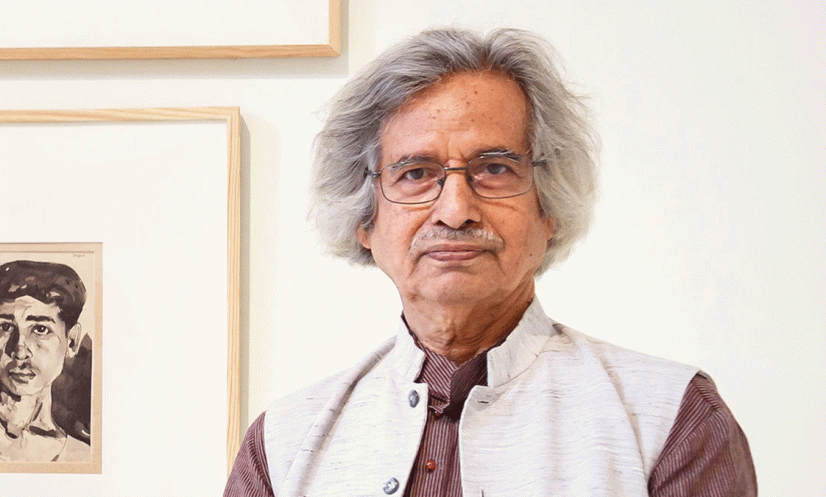
Renowned Indian painter and former Rajya Sabha member Jogen Chowdhury has died at the age of 87 while undergoing treatment at a private hospital in Kolkata on Sunday morning.
Chowdhury had been suffering from a rare blood cancer, myeloproliferative neoplasm, for around 14 months and was receiving chemotherapy, hospital sources said. He was admitted on the day of Durga Puja’s Shashthi after falling ill.
A urinary tract infection and other complications further worsened his condition. He was placed on ventilator support on Saturday after developing symptoms of sepsis, but doctors could not save him.
His death has cast a pall of grief over India’s art and cultural community.
Born on February 16, 1939, in Daharpara village in Faridpur, then part of undivided Bengal, Chowdhury moved to Kolkata with his family during Partition. He received formal training at the Government College of Art and Craft in Kolkata and later worked as a teacher and textile designer.
In 1965, he went to Paris for higher studies, where exposure to European art enriched his artistic vision. He developed a distinctive style by blending Indian and European artistic traditions.
His paintings were widely admired for their expressive lines and unconventional depictions of the human body and face. His work often explored loneliness, social inequality and power struggles. He also served as curator of the art gallery at Rashtrapati Bhavan, the Indian president’s official residence.
Beyond gallery art, Chowdhury contributed to the artistic design of Durga Puja celebrations in Kolkata, including the design of idols and decorative backdrops at various pandals. His work helped bring art to a wider public.
In 2014, he was elected to the Rajya Sabha as a Trinamool Congress candidate and represented West Bengal in the upper house of Parliament until 2020.
West Bengal Chief Minister Suvendu Adhikari expressed grief over his death, describing Chowdhury as a legendary artist whose distinctive brushwork had enriched modern Indian painting. He said the artist’s creations would continue to inspire future generations.
Source : The Indian Express