Play store

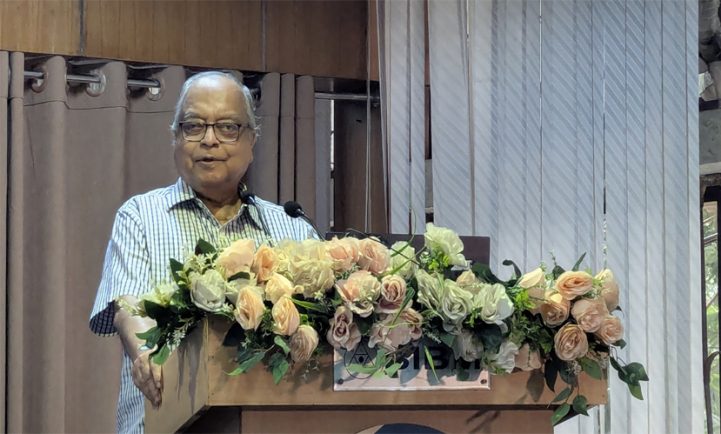
National Professor Dr Mahbub Ullah has warned that Bangladesh’s banking sector has become increasingly government-oriented because of a large fiscal deficit and a weak tax-to-GDP ratio, leaving private businesses struggling to access credit.
As the government borrows heavily from banks every month to finance state operations, the banking sector is diverting funds towards public borrowing, creating a crowding-out effect on private investment, he said.
He made the remarks at the opening session of the second day of the 11th annual banking conference at the Bangladesh Institute of Bank Management (BIBM) in Mirpur, Dhaka, on Thursday.
The two-day conference is being held under the theme “Restructuring the Banking Sector to Accelerate Economic Growth”, with Bonik Barta as its media partner.
Mahbub Ullah said the government’s persistent borrowing and uncertainty over its ability to repay future interest and principal were major warning signs for the economy. Public confidence in the banking sector had also fallen to nearly zero, he added, although some sound banks and honest professionals remained who could serve as examples for reform.
He argued that widespread defaulted loans and the banking sector’s poor condition were symptoms of a broader institutional crisis affecting administration, business, education and healthcare.
According to him, the country’s state institutions and politics had increasingly been used to serve the interests of a small group of wealthy and influential oligarchs, contributing to the crisis.
He said good governance alone would not be enough without adequate investment and institutional commitment. What initially appeared to be a problem of knowing customers had evolved into a dangerous nexus involving bankers, dishonest businesses and corrupt politicians.
Unless the influence of such networks was curbed, he warned, the economy could face even deeper trouble.
Mahbub Ullah described Bangladesh as an “extractive state”, arguing that those in power had treated the state as personal property and distributed undue benefits to relatives and close associates rather than serving the public interest.
He said lasting progress in any sector would remain difficult unless the state was transformed into one focused on public welfare.
The economist also cautioned that the country’s problems would not be resolved overnight. Meaningful change would require time, strong political commitment, fundamental reforms to the political system and an end to unethical links among bankers, politicians and businesses.
Presenting the keynote paper, former Dhaka University economics professor Dr Barkat-e-Khuda identified non-performing loans, weak governance, capital shortages, liquidity problems, money laundering and low productivity among bankers as major obstacles to the banking sector’s contribution to economic growth.
He said political interference, lenient policies, repeated loan restructuring and sluggish private-sector credit growth had worsened the problem of defaulted loans.
Family dominance in bank ownership and the limited expertise of independent directors had also weakened governance, he said, adding that provisioning shortfalls had increased while capital adequacy ratios had deteriorated.
Barkat-e-Khuda said the sector had become divided, with around 10 banks performing relatively well while many others faced severe difficulties.
He also highlighted a liquidity imbalance: weaker and Shariah-based banks were facing acute cash shortages even as excess liquidity across the banking sector had risen substantially.
He estimated that around Tk5 lakh crore had been misappropriated through fraudulent lending and corruption, while influential political and business groups had siphoned an estimated Tk2.5 lakh crore to Tk3 lakh crore abroad.
To address the crisis, he called for structural reforms, consolidation of the banking sector and the merger of state-owned and specialised banks into more manageable institutions.
He said Bangladesh Bank was pursuing a major financial-sector restructuring programme to protect depositors’ interests.
The session was chaired by BIBM Director General Dr Md Ejazul Islam, while BIBM Professor Dr Shah Md Ahsan Habib delivered the welcome address.
On the final day of the conference, seven plenary sessions will feature 56 research papers.Borrowing crowds out private sector, says economist.