Play store


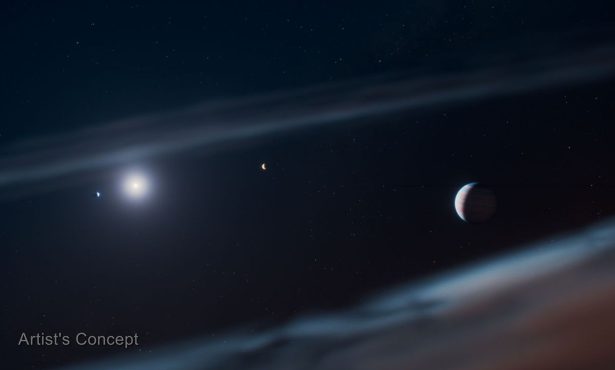
A scorching super-Earth located 280 light-years from Earth has surprised astronomers by retaining an atmosphere despite surface temperatures exceeding 1,800 degrees Celsius, according to observations by NASA’s James Webb Space Telescope (JWST).
The planet, known as TOI-561 b, completes an orbit around its host star every 11 hours, meaning a year on the distant world lasts less than half a day on Earth.
Discovered in 2020 by NASA’s Transiting Exoplanet Survey Satellite (TESS), the rocky planet is so close to its star that astronomers previously believed its extreme temperatures would make it impossible to retain an atmosphere.
However, a team of researchers has found evidence of a highly reflective atmosphere containing clouds of vaporised silicate minerals, the same family of compounds found in quartz and sand.
The discovery is based on 37 hours of JWST observations covering nearly four complete orbits of the planet.
“We measured how the planet’s brightness and heat changed throughout its orbit,” said Lisa Dang of the University of Waterloo, a member of the research team.
The observations revealed that TOI-561 b reflects a significant amount of incoming starlight and redistributes heat around the planet rather than retaining it entirely on the side facing its star.
Together, these findings point to the presence of an atmosphere, the researchers said.
A world of permanent day and night
Because of its extremely close orbit, TOI-561 b is tidally locked, meaning the same hemisphere always faces its star while the opposite side remains permanently in darkness.
This creates a blisteringly hot dayside and a comparatively cooler nightside.
Astronomers had previously noticed that the planet’s rocky surface appeared cooler than expected, raising questions about where the missing heat was going.
By observing nearly four complete orbits, JWST allowed researchers to examine the nightside for the first time. They found that it was not warm enough to account for all the heat missing from the dayside.
The team concluded that the planet reflects approximately three-quarters of the starlight falling on it, making it one of the most reflective rocky worlds studied.
This reflectivity is comparable to Venus, which reflects around 75 per cent of incoming sunlight, compared with roughly 30 per cent for Earth.
Researchers believe clouds of silicate minerals, including silicon dioxide and magnesium silicate, form on the planet’s dayside and reflect much of the incoming radiation.
These clouds may also help the planet retain its atmosphere despite the extreme heat.
What is the atmosphere made of?
Scientists have yet to determine the precise composition of the atmosphere. One possibility is a dense carbon dioxide haze similar to Venus, while another is a sulphur dioxide-rich atmosphere resembling that of Jupiter’s highly volcanic moon Io.
If the latter is the case, ongoing volcanic activity could be replenishing the atmosphere, as happens on Io.
“The next big question we will seek to answer is whether TOI-561 b’s atmosphere resembles Venus or an extreme version of Io,” Dang said.
She added that further JWST observations at longer wavelengths could help scientists understand how such an extraordinarily hot planet has managed to retain an atmosphere for billions of years.
The findings offer new insights into the atmospheric behaviour of rocky planets orbiting extremely close to their stars and could help scientists better understand the diversity of worlds beyond our solar system.