


 Play store

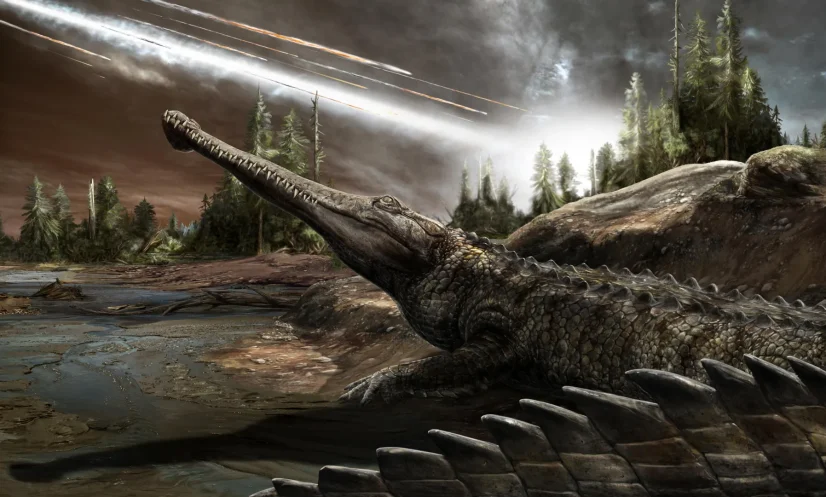
Crocodiles may have survived the asteroid impact that wiped out the dinosaurs 66 million years ago because their long-standing preference for warm climates allowed them to find suitable habitats near the equator, according to new research.
Scientists led by University College London (UCL) found that crocodiles and their ancient relatives consistently favoured warm environments throughout their 250-million-year evolutionary history, giving them a potential advantage during major climate disruptions.
Published in the journal Science Advances, the study analysed more than 7,000 fossils and records from over 400 living and extinct species. Researchers combined the evidence with computer models reconstructing Earth’s climate and geography over approximately 245 million years.
The findings suggest that tropical and subtropical regions remained suitable for crocodile relatives after the asteroid struck, even as habitats available to many dinosaur species deteriorated.
Only the most extreme climate simulations eliminated these potential refuges.
“The asteroid did not make the whole planet equally hostile to every group,” said lead author Dr Alfio Alessandro Chiarenza of UCL Earth Sciences.
“Crocodiles’ long-standing preference for warm environments may have placed survivors exactly where suitable climates held up best, like around the equator. These refuges could have sheltered populations that later recovered and radiated out,” he added.
Previous research modelling by members of the same team found that suitable habitats for non-avian dinosaurs contracted much more severely following the asteroid impact.
Ancient crocodile relatives were remarkably diverse
Although modern crocodiles share many familiar physical features, their evolutionary ancestors displayed an extraordinary range of body shapes, sizes and lifestyles.
The broader crocodile lineage, known as pseudosuchians, included heavily armoured plant-eaters, land-based predators and enormous animals weighing more than a tonne.
One of the most remarkable was Sarcosuchus, nicknamed the “super croc”, which could grow up to 12 metres long. Another ancient relative, Postosuchus, was a land-dwelling predator capable of walking on either two or four legs.
“Crocodiles are often called living fossils, but their ancestors and relatives changed enormously throughout their history, ranging from giants the size of a bus that could have devoured a T. rex, to small, cute animals with the face of a pug,” Chiarenza said.
Despite this diversity, their relationship with climate remained remarkably consistent, he added.
Fossils reveal changing habitats over millions of years
To understand the relationship between crocodile evolution and climate, researchers reconstructed the temperature and rainfall preferences of more than 400 species using fossil evidence, evolutionary family trees and the geographic distribution of living crocodiles.
They then compared these findings with reconstructions of ancient climates and continental geography to identify suitable habitats at different stages of Earth’s history.
The analysis revealed that crocodile relatives generally followed warmer conditions, expanding into new regions during hot periods and retreating towards the tropics as temperatures declined.
Around 50 million years ago, during the particularly warm early Eocene epoch, global temperatures were approximately 10 degrees Celsius higher than today. The polar regions had no permanent ice, allowing crocodile relatives to inhabit high-latitude areas across North America, Europe and even Antarctica.
As the planet gradually cooled over millions of years, their geographic range contracted towards warmer tropical regions.
The researchers also identified two notable exceptions to this long-standing climate preference, suggesting that crocodile evolution involved some periods of adaptation to different environmental conditions.
The study provides fresh insight into how climate preferences and the availability of suitable habitats may have helped crocodiles survive two of Earth’s five major mass extinction events.