


 Play store

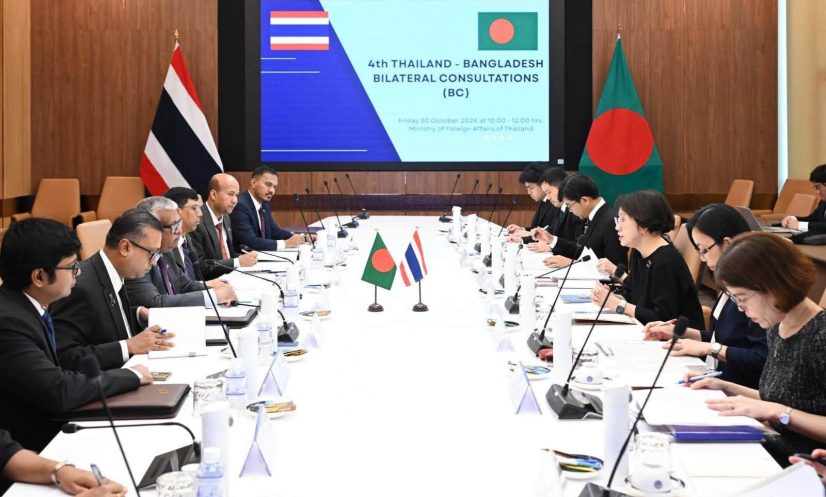
DHAKA: Bangladesh has urged Thailand to increase imports of Bangladeshi pharmaceuticals, jute and jute products and reduce tariffs on Bangladeshi goods to narrow the bilateral trade deficit and improve their competitiveness in the Thai market.
The proposals were raised at the fourth Foreign Office Consultations (FOC) between Bangladesh and Thailand, held at the Thai Ministry of Foreign Affairs, according to a press release issued by Bangladesh’s Ministry of Foreign Affairs.
Foreign Secretary Asad Alam Siam led the Bangladesh delegation, while Permanent Secretary of the Thai Ministry of Foreign Affairs Eksiri Pintaruchi headed the Thai side.
Thailand expressed willingness to consider the proposals and explore ways to expand bilateral trade and investment. The Thai delegation also requested the early initiation of discussions on a bilateral free trade agreement (FTA).
The consultations reviewed cooperation in a wide range of areas, including trade, investment, connectivity, labour migration, energy, agriculture, culture, education, training, defence and climate change.
Both sides welcomed the launch of the first direct shipping service between Chattogram and Thailand’s Ranong port in September this year.
The service is expected to reduce transportation time between the two countries from around 15 days to four days, lowering logistics costs and facilitating bilateral trade.
Bangladesh also sought Thai technical assistance and investment in processing locally produced fruits and vegetables, along with technology transfer to help the country tap into the growing global halal food market.
Under the Thailand International Cooperation Agency (TICA) programme, Bangladesh requested professional training in hospitality, nursing, germplasm management and food processing.
Thailand expressed interest in sharing its experience of the ‘One Village One Product’ programme, which promotes locally produced goods and supports rural entrepreneurship.
The two countries also agreed to consider several memorandums of understanding (MoUs) under discussion, including those relating to rice imports and labour migration.
On energy cooperation, Bangladesh expressed satisfaction with existing collaboration and sought Thai expertise in generating electricity from agricultural residues and agro-industrial waste.
The Bangladesh delegation highlighted the government’s target of generating at least 20 per cent of the country’s electricity from renewable sources by 2030, underscoring the need for technology and investment to accelerate the transition.
As Bangladesh and Thailand prepare to celebrate 55 years of diplomatic relations next year, both sides stressed the importance of high-level political exchanges and expressed hope that visits by their respective heads of government could mark the anniversary.
They also agreed to undertake joint initiatives to promote cultural and sporting exchanges. Bangladesh offered to share its expertise in cricket and provide training, while Thailand offered training opportunities in taekwondo.
On regional cooperation, Bangladesh appreciated Thailand’s continued support for its aspiration to become an ASEAN Sectoral Dialogue Partner and join the Regional Comprehensive Economic Partnership (RCEP).
Dhaka also sought Bangkok’s support for the repatriation of displaced Rohingyas to their places of origin in Myanmar’s Rakhine State.
Both sides expressed concern over the growing threats posed by cross-border crimes, including human and arms trafficking, online scams and narcotics smuggling.
They agreed to strengthen cooperation to tackle these challenges and consider establishing a joint committee under their respective home ministries.
The consultations concluded with both sides reaffirming their commitment to strengthening bilateral relations and expanding cooperation at regional and international levels.