


 Play store


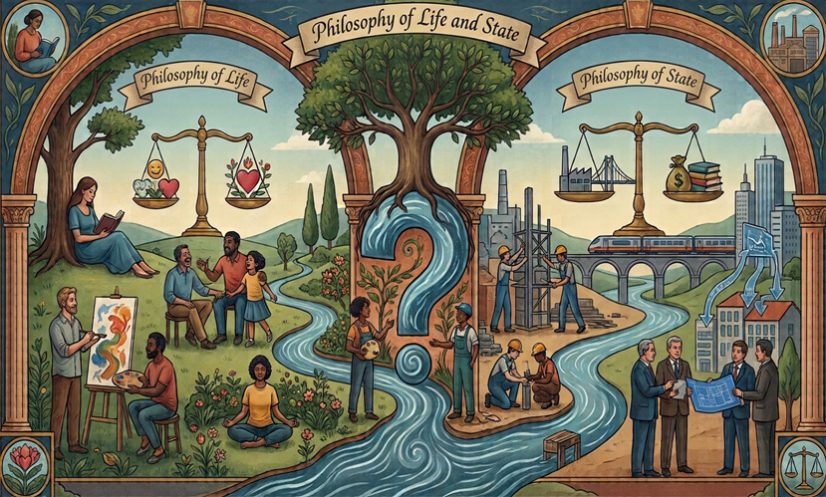
A Saturday afternoon gradually gives way to evening. The intensity of the autumn sun softens, while clouds drift across the sky, allowing nature to alternate between light and shadow. Watching this changing landscape brings to mind a timeless truth: to understand light, we must also acknowledge darkness. Human life, society and the state are similarly shaped by the coexistence of hope and hardship, achievement and failure, possibility and crisis.
This reflection is particularly relevant to Bangladesh today. On the one hand, we aspire to modern technology, mega infrastructure, nuclear power, foreign investment and economic prosperity. On the other, many people continue to struggle for basic security, healthcare, employment and justice. We speak of ambitious development plans, yet fail to prevent deaths from avoidable diseases such as dengue. We celebrate industrialisation but cannot always ensure safe working conditions for labourers. Our media outlets are becoming more technologically capable, yet questions remain about whether journalists can report the truth freely and without fear.
This contradiction calls for a fresh examination of what we mean by development. Are we measuring progress by the size of our infrastructure and the scale of our investments, or by the quality of life we can guarantee for our people?
A fundamental lesson of political science is that the success of a state cannot be measured solely by its power, wealth or physical infrastructure. Its primary responsibility is to protect the lives, freedoms, security and dignity of its citizens.
Max Weber’s concept of legitimate authority and John Rawls’s philosophy of justice offer important perspectives on the responsibilities of the state. Rawls, in particular, reminds us that the position of the most disadvantaged members of society should be central to judging whether a system is just.
Economist Amartya Sen takes this argument further by linking development to the expansion of human capabilities and freedoms. From his perspective, access to education, healthcare and employment, personal security, and the freedom to make choices about one’s own life are essential measures of genuine progress.
Viewed in this light, an expressway that improves economic connectivity is important, but so is a reliable healthcare system that ensures a poor patient can receive treatment. Foreign investment can stimulate economic activity, but safe working conditions for labourers are equally important in protecting productivity and human dignity.
Development loses much of its meaning when its benefits remain concentrated in the hands of a limited section of society. Economic growth figures may look impressive, but they cannot tell the whole story if ordinary people are excluded from the opportunities and benefits that growth creates. This is the central challenge of inclusive development.
Another important lesson from sociology is that state institutions do not function in isolation. Weakness in one sector can undermine progress in others.
An inadequate healthcare system reduces people’s ability to work and live productive lives. Poor-quality education prevents the development of a skilled workforce. A lack of confidence in the justice system discourages investment and weakens social stability. When the media cannot operate independently, the state itself loses access to information about its mistakes, irregularities and failures.
Good governance, economic growth, human rights and social security are therefore closely interconnected. The failure of one institution can weaken the achievements of another. Development planning must consequently go beyond launching projects. It must also strengthen institutions, improve transparency and establish effective accountability.
The Holy Qur’an provides a profound ethical foundation for the governance of society and the state, placing justice, responsibility and human dignity at its centre.
In Surah An-Nisa (4:135), believers are instructed to stand firmly for justice, even when doing so goes against themselves, their parents or their relatives. Surah Al-Hashr (59:7) emphasises that wealth should not circulate exclusively among the rich. Surah At-Tin (95:4), meanwhile, reminds us that human beings have been created in the best of forms.
The implications of these teachings are significant. Power must never stand above justice. Wealth cannot justify depriving people of their rights. And no development achievement can excuse the neglect of human dignity.
A state may build impressive infrastructure and accumulate considerable wealth, but without justice and ethical responsibility, its outward prosperity will eventually lose its deeper meaning. The moral strength of a state is reflected in how it treats its citizens, particularly those who are poor, vulnerable and disadvantaged.
Bangladesh stands at a time of new possibilities and rising expectations. The younger generation, in particular, wants a state that creates employment, reduces inequality and ensures accountability. Turning these expectations into reality will require a shift in development priorities.
Healthcare must be affordable and accessible. Education must be relevant to the needs of the labour market. Workers must be protected from unsafe conditions. The investment climate must improve, while the media and civil society must have the freedom to perform their roles independently.
Public administration should be built around the principle that government institutions exist to serve citizens. Corruption and abuse of power must be addressed without favouring or targeting anyone on the basis of political affiliation or personal connections.
The state must also recognise that economic opportunity and social justice cannot be separated. Investment should create decent employment, industrial growth should not come at the expense of workers’ safety, and public spending should produce benefits that reach people across society.
Ultimately, the strength of a state is measured not by the influence of its powerful people but by the trust of its ordinary citizens. A country becomes truly strong when a poor person can expect justice, a worker can earn a living in a safe workplace, and a citizen can express an opinion without fear.
Yet life should not be consumed entirely by calculations about the state, politics and the economy. At the end of the day, people also need time for themselves. There is a certain wisdom in pausing to observe nature as afternoon gradually turns into evening.
The warmth of a cup of tea, the company of familiar faces or simply a moment of quiet reflection can remind us that life is not merely a race for achievement. It is also something to be experienced, appreciated and shared.
The autumn afternoon offers two important lessons. In our personal lives, we must understand the value of time. In the life of the state, we must recognise the value of human dignity. Just as light and shadow coexist in nature, crises and opportunities will always exist side by side in society. But we must never accept hardship and injustice as inevitable or normal. We must move towards a brighter future through wisdom, justice, responsibility and humanity.
Daylight eventually fades, but the light of human conscience must never go out. Our hope is that Bangladesh’s development will not remain confined to buildings, infrastructure and economic statistics. It must become visible in people’s security, rights, access to justice and everyday well-being.
Let the autumn evening be beautiful, and let people’s moments of rest be peaceful. Above all, may Bangladesh become a state where the greatest measure of development is reflected in the smiles of its people, the security of their lives and the assurance that justice is within everyone’s reach.
The views expressed in this article are the author’s own and do not necessarily reflect Sarabangla English Edition’s editorial stance.