Play store

The government believes attempts to create instability in Bangladesh may continue as long as Awami League President and former prime minister Sheikh Hasina remains alive, not just in December, Prime Minister’s Adviser on Information and Broadcasting Dr Zahed Ur Rahman has said.
“The government believes such attempts may continue throughout the period she remains alive, and we will resist them,” he said.
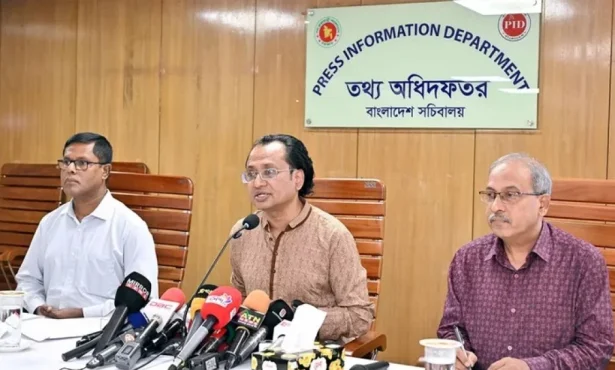
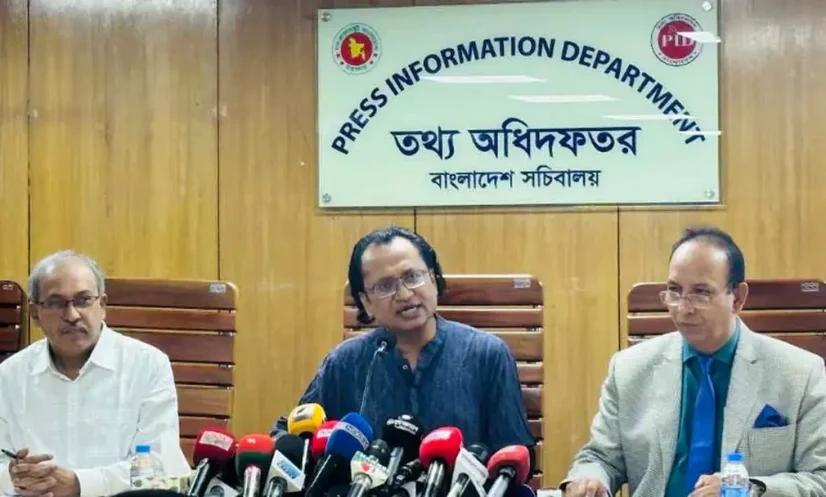
He made the remarks on Tuesday (November 3) while responding to questions from journalists at a press conference on the progress of various government activities. Chief Information Officer of the Department of Information Syed Abdal Ahmed was also present.
Speaking about the ongoing garment workers’ unrest, Zahed said workers’ wages were generally reviewed every five years. Wage revisions took place in 2006, 2010, 2013, 2018 and 2023. Accordingly, a new wage board was not due in 2026.
However, considering rising living costs, inflation and higher fuel prices, the government formed the wage board ahead of schedule as a gesture of sympathy towards workers, he said.
“We understand that the cost of living is rising and life is becoming increasingly difficult for garment workers,” he said, adding that the government had taken their concerns into account by forming the commission early.
The adviser alleged that acts of violence and sabotage during the workers’ movement could not be attributed to genuine garment workers. Referring to comments by the home minister based on intelligence reports, he said there might be links to elements across the border.
Although the Awami League might lack the capacity to become politically active, he said, it could use its substantial financial resources to foment unrest in different places.
Asked whether the unrest was being engineered to pave the way for Hasina’s return to Bangladesh in December, Zahed said the issue was not limited to that month.
He referred to a statement allegedly made by Hasina on the first day of parliament after the 1991 election, when she said she would not allow the government to remain in peace for even a single day. He said a similar political mindset might still be reflected in current developments.
Clarifying his earlier remarks about Hasina’s possible return, the adviser said he would revisit the issue after December. If she returned and proved his interpretation wrong, he would publicly apologise.
“If she comes back, there will certainly be a Tuesday. If I am alive and still hold this responsibility, I will come and apologise that my interpretation was wrong,” he said.
On reports of outsiders, teenagers and young people joining the garment workers’ protests and rumours spreading on social media, Zahed said the government did not want to follow the repression tactics of the previous administration.
He stressed that law enforcement agencies must operate within the law and use force proportionately, depending on the circumstances.
“Bangladesh’s police will never again be like Hasina’s police,” he said, adding that law enforcement agencies had the legal authority to use force, but only within the legal framework and in a proportionate manner.
He also expressed concern over incidents of disproportionate use of force circulating on social media, saying the government wanted to minimise fear, casualties and damage among ordinary people while restoring order.
Zahed expressed hope that the garment workers’ unrest would end soon. He said some of the workers’ initial demands were legitimate and that the formation of the new wage board would help the government address their concerns.
Once workers withdrew from the streets, he added, it would become more difficult for other groups to exploit the movement to create instability.