


 Play store

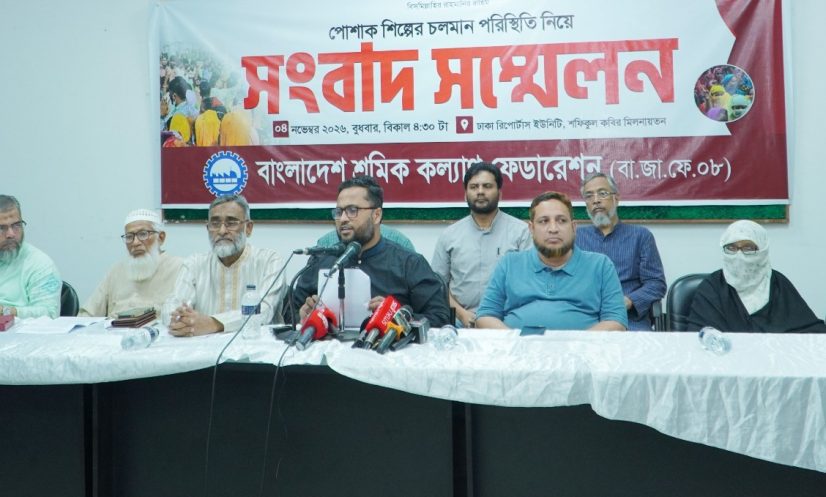
The Bangladesh Labour Welfare Federation has called on the government to take urgent steps to resolve ongoing unrest in the country’s readymade garment (RMG) sector, ensure fair wages for workers and prevent what it described as conspiracies to destroy industrial establishments.
The federation has demanded that the minimum wage for garment workers be revised in line with the cost of living and inflation, with the new wage structure coming into effect from January 2027.
The demands were raised at a press conference held at the Shafiqul Kabir Auditorium of the Dhaka Reporters Unity (DRU) in the capital on Wednesday (November 4).
Federation President Advocate Atikur Rahman read out the written statement, while its General Secretary Laskar Md Taslim moderated the event.
Among others, Vice-Presidents Harunur Rashid Khan and Kabir Ahmed, Joint Secretaries Abdus Salam and Maulana Mohibullah, Treasurer Azharul Islam, Trade Union Affairs Secretary Sohel Rana Mithu, Bangladesh Progressive Garment Workers Federation General Secretary Kamrun Nahar and Garments Tailors Workers Central President Sahida Sarkar were present.
In his written statement, Atikur Rahman said the country’s RMG sector was going through a serious crisis. Rising prices of essential commodities, fuel and electricity costs, house rents, medical expenses and education costs had made life increasingly difficult for workers.
With income failing to keep pace with expenditure, workers were struggling to maintain a decent standard of living for themselves and their families, he said.
Against this backdrop, workers have been staging protests in different industrial areas, including Dhaka, Gazipur, Savar, Ashulia, Mirpur and Narayanganj, demanding a minimum monthly wage of Tk 30,000 and other reasonable benefits.
He said the government formed a six-member wage board on November 1. The board must make impartial and acceptable recommendations by considering workers’ actual living costs, market prices and basic family needs.
He also called for ensuring effective representation of workers on the board and announcing the revised wage structure without delay.
Expressing concern over vandalism, arson, attacks on vehicles and disruptions to production at industrial establishments, Atikur Rahman said workers’ movements for legitimate rights and attempts to destroy industries were entirely different matters.
“We fully support workers’ legitimate demands. But neither workers nor owners will benefit from the destruction of factories and industrial establishments,” he said.
Such incidents would cost workers their jobs, cause owners to lose their investments and damage the national economy, he added.
He called for an impartial investigation to determine whether any banned authoritarian organisation or vested quarter was involved in vandalism and arson at industrial establishments.
He also urged the authorities to prevent attempts to undermine the country’s main export sector by exploiting labour unrest and bring those involved in violence and sabotage to justice.
Expressing deep sorrow over casualties during workers’ protests in Gazipur, he said garment worker Toufiq Sheikh, 21, was critically injured during a demonstration demanding higher wages on November 3 and later died while undergoing treatment.
He demanded that those responsible for the incident be identified and given exemplary punishment. He also called for proper medical treatment for injured workers.
At the same time, he urged the authorities to stop the arrest and harassment of innocent workers and labour leaders, as well as the filing of false cases against them in connection with the unrest.
According to information presented at the press conference, the ongoing labour unrest has caused extensive damage to the country’s RMG sector and created uncertainty over employment.
Citing Bangladesh Garment Manufacturers and Exporters Association (BGMEA) data, the federation said production had been disrupted or factories temporarily shut down at different times in 500 to 690 factories since the beginning of November.
As of 1pm on Wednesday, 306 factories remained closed. Of them, 161 were in Gazipur, 93 in Ashulia and 52 in Mirpur. Around 700,000 workers reportedly could not join work at these factories, according to sources concerned.
The press conference also cited data from the Centre for Policy Dialogue (CPD), saying 95 factories had permanently closed over the past six months, resulting in the loss of around 62,000 jobs.
Separately, around 457 garment and textile factories reportedly closed permanently between August 2024 and June 2026.
Atikur Rahman warned that if the situation continued, Bangladesh could face cancellations of foreign orders, failure to deliver products on time and damage to its image in international markets.
He said the crisis should be resolved through dialogue, mutual trust and understanding rather than creating confrontation between workers and factory owners.
Ensuring fair wages would improve workers’ living standards, increase productivity and restore stability in the sector, he added.
The Bangladesh Labour Welfare Federation placed a 14-point set of demands before the government.
The key demands include revising the minimum wage for garment workers in line with the cost of living and inflation and implementing the new wage structure from January 2027, conducting a fair investigation into the death of Toufiq Sheikh and ensuring exemplary punishment for those responsible and providing proper medical treatment to injured workers.
The federation also called on workers, factory owners and all concerned parties to act collectively and responsibly to protect the garment industry, safeguard employment and prevent the national economy from falling into crisis.
In his concluding remarks, Atikur Rahman said workers’ rights and the protection of industries were not contradictory.
“If workers survive, industries will survive. If industries survive, the national economy will survive,” he said.
He stressed that industrial stability could not be maintained by depriving workers of their legitimate dues, while workers’ rights could not be established through vandalism and arson either.
Calling on the government, garment factory owners, labour organisations and other stakeholders to play responsible roles, he said the federation would continue its efforts to establish workers’ rights, build a just labour system and maintain stability in the country’s industrial sector.