


 Play store

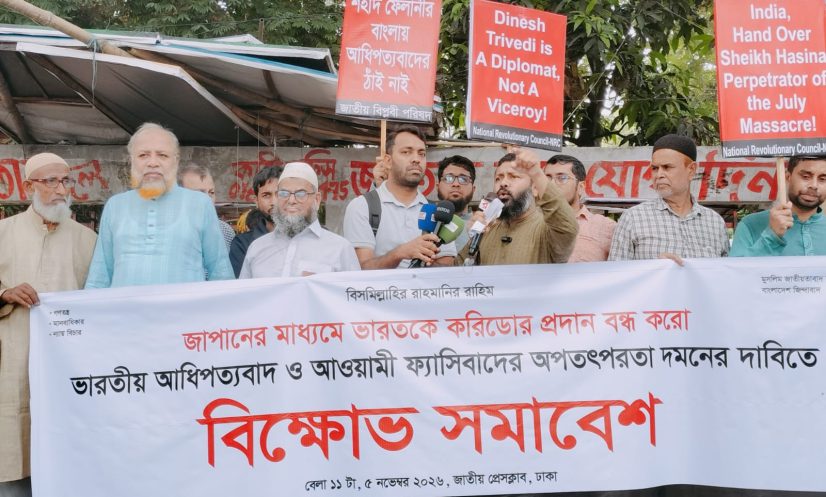
The National Revolutionary Council (Jatiya Biplobi Parishad) has alleged that a conspiracy, backed by India, is underway to destabilise the government and undermine the democratic system established through the July mass uprising.
The organisation claimed that various groups of people were being deliberately provoked into protests, while elements within the government were allegedly encouraging unrest and deploying ruling-party activists to suppress demonstrations, pushing the situation towards further instability.
It called on all patriotic and democratic forces, regardless of political affiliation, to unite to protect Bangladesh’s sovereignty and democracy.
The allegations were made at a protest rally organised in front of the National Press Club in Dhaka on Thursday. The rally was held to demand an end to what the organisation described as Indian hegemony and the activities of Awami League fascist forces, as well as the cancellation of plans to provide India with transit and corridor facilities through Japan.
Presided over by the council’s convener Khomeini Ehsan, the rally was addressed, among others, by ophthalmologist Dr Farid Uddin, Joint Convener Saiyed Qutub, Assistant Member Secretary Abdus Salam and Revolutionary Students Council Convener Abdul Wahed.
Other attendees included Abdul Jabbar, chairman of the Nawab Salimullah Academy; Advocate Main Uddin, convener of the Movement Against Aggression and Corruption; council leader Saidul Islam; and Revolutionary Students Council Assistant Member Secretary Ariful Islam.
Speakers said the campaign claiming that ousted prime minister Sheikh Hasina would return in December was intended to divert public attention. They alleged that the actual plan was to gradually paralyse the country by raising the prices of essential commodities and fuel, provoking public anger, infiltrating protests to trigger violence and eventually creating conditions for an unconstitutional takeover of power.
They also alleged that a pro-India faction within the government was involved in the ongoing garment workers’ unrest and that Awami League activists were exploiting the movement to carry out vandalism and sabotage.
Khomeini Ehsan said the council had warned the government in September that a conspiracy to topple it, allegedly backed by India, could emerge in November and December.
“Unfortunately, the government ignored our warning. Rather, its indecision and various policy failures have created opportunities for the conspiracy to advance,” he said.
He warned that the situation could lead to another political crisis similar to the 1/11 political changeover if the government continued to rely on party activists and force to suppress protests.
Ehsan said workers’ demands for fair wages and labour rights were legitimate. He proposed that the government announce a monthly cost-of-living allowance of Tk 2,000 for garment workers until the new minimum wage came into effect.
He argued that the allowance would reassure workers, help restore factory production and protect Bangladesh’s competitiveness in international markets.
He urged the government to stop the use of ruling-party activists and police against workers, warning that excessive force could turn the labour movement into a tool for political instability.
Questioning the government’s handling of alleged Indian interference, Ehsan asked what steps the Home Ministry had taken over the past nine months to prevent such activities. He also questioned the authorities’ role in preventing the regrouping of Awami League activists and bringing those accused of killings, enforced disappearances, looting and other crimes during the previous government to justice.
The council also alleged that India was expanding its influence in Bangladesh and that unequal agreements signed during Sheikh Hasina’s tenure remained in force.
It expressed concern over what it described as plans to use the Matarbari deep-sea port, built with Japanese assistance, to establish connectivity with India’s northeastern states. Such an arrangement, it argued, could draw Bangladesh into geopolitical rivalry between major powers, particularly because the region borders China.
“Bangladesh wants friendship and trade with all countries, but it does not want to become a military or strategic corridor for any country,” Ehsan said, adding that Matarbari should serve Bangladesh’s economic interests rather than another country’s geopolitical objectives.
He also demanded the expulsion of Indian High Commissioner Dinesh Trivedi, alleging that he was politically affiliated with India’s ruling Bharatiya Janata Party (BJP) and was interfering in Bangladesh’s internal affairs. The council had earlier demanded that the government declare him persona non grata, he said.
Ehsan further criticised the government for allegedly targeting Jamaat-e-Islami and its student wing over the garment workers’ unrest, saying there was no evidence of their involvement in violence or vandalism. He argued that blaming political opponents would only strengthen those seeking to destabilise the country.
He also called for national dialogue among all patriotic and democratic forces, saying the government’s failure to maintain constructive relations with opposition parties was undermining the unity needed to protect the country.
The council raised questions about the treatment of Awami League leaders accused of crimes during the July uprising and demanded an independent investigation into what it described as judicial killings of anti-India leaders through the International Crimes Tribunal.
Four-point demands and proposals including scrapping all agreements related to providing India with access to the Matarbari deep-sea port and corridor facilities through Japan, declaring Indian High Commissioner Dinesh Trivedi persona non grata and expel him and ensuring Bangladesh receives its fair share of water from all international rivers.
Alongside these demands, it placed four proposals before the government to address the ongoing crisis. These included announcing a monthly Tk 2,000 allowance for garment workers until the revised minimum wage takes effect, and immediately stopping the use of party activists and police force against workers.
It also called for publishing a white paper on all agreements and memorandums of understanding signed with India and reviewing them in parliament; prioritising national interests in negotiations to renew the Ganges Water Sharing Treaty, which is due to expire in December; and initiating national dialogue with all patriotic democratic forces while stopping campaigns against opposition parties.
The council, a Muslim nationalist political party, began its journey at Dhaka University on December 16, 2024. It says its objectives include protecting national sovereignty, establishing a just democratic state, promoting science- and research-based education and making Bangladesh a major centre of Muslim civilisation through economic development.