


 Play store

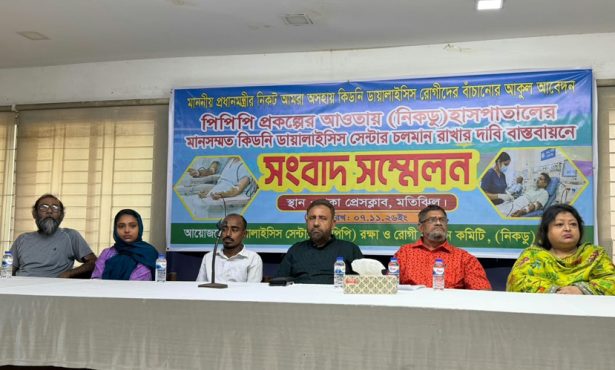
Dhaka: Dialysis services operated under the public-private partnership (PPP) arrangement at the National Institute of Kidney Diseases and Urology (NIKDU) in Dhaka and Chattogram Medical College Hospital may be suspended as the contract for running the centres is set to expire on November 29.
Without a contract renewal or an alternative arrangement, regular dialysis treatment for around 500 poor and financially disadvantaged kidney patients in Dhaka and Chattogram could become uncertain, putting their lives at risk.
Patients and their family members raised the concern at a press conference organised by the Dialysis Centre (PPP) Protection and Patient Welfare Committee at the Maulana Mohammad Akram Khan Hall of the National Press Club on Saturday (November 7).
They warned that shutting down the two centres without ensuring alternative arrangements would put the lives of patients dependent on regular dialysis in serious jeopardy.
They said dialysis facilities at government hospitals were limited, while patients also faced various problems regarding service quality, availability of essential medical supplies and treatment duration.
The patients and their relatives called for an extension of the PPP project or the engagement of another competent organisation to ensure uninterrupted services.
In a written statement, Md Lutfor Rahman Ripon, a kidney patient’s family member, said that although low-cost dialysis was available under the government system, patients had to face numerous difficulties in practice.
The actual cost of treatment was also higher than generally portrayed, he said, adding that a patient had to spend at least Tk 2,000 for each dialysis session, including indirect and incidental expenses.
At the press conference, patients’ relatives highlighted five major shortcomings in the government-run dialysis system.
They alleged that patients were required to deposit Tk 20,000 in advance to receive dialysis at government hospitals. The amount covered treatment for only six months, and if a patient died within that period, the unused portion of the money was not refunded.
They also said government hospitals generally provided dialysis twice a week, creating difficulties for patients who needed the treatment three times a week.
Another major concern was the limited supply of dialysers. According to the relatives, only two dialysers were allocated to each patient per month, forcing them to wash and reuse the same equipment repeatedly.
They alleged that inadequate sterilisation of reused dialysers increased the risk of infection among patients.
The relatives also complained of staff shortages and frequent malfunctions of dialysis machines and blood pressure monitoring devices.
As a result, they said, patients often received only two to three hours of dialysis instead of the prescribed four hours.
Moreover, patients were sometimes required to purchase essential medical supplies, including hand sanitiser, tape, gloves and saline, with their own money. In some cases, they also had to buy dialysate, they added.
The relatives further alleged that hepatitis screening was not conducted before new patients began dialysis. This, they feared, could expose patients who initially tested negative to the risk of infection.
Ripon said his family had been financially devastated over the past eight years while trying to bear the cost of dialysis for a family member.
Meeting the expenses of dialysis three times a week had become increasingly difficult, he said, adding that patients also faced harassment and additional costs when seeking treatment at government hospitals.
“With an earnest appeal to the Prime Minister and the Health Minister, we urge them to consider our lives and ensure that the centres remain operational either under the existing PPP arrangement or through another competent organisation,” he said.
Another patient’s relative, Moniruzzaman, said patients were dissatisfied with the quality of dialysis services at government hospitals despite the availability of machines. It was also difficult to obtain treatment slots according to patients’ needs.
In contrast, he said, the PPP centres provided relatively affordable dialysis services with greater care and attention.
Sharmin Mirza, another patient’s relative, said government-run facilities faced shortages of essential medical supplies. If the PPP centres were shut down, many patients would struggle to continue their regular treatment.
The organisers said access to healthcare was a fundamental right of citizens and that administrative or political complications could not justify the suspension of treatment for critically ill kidney patients.
They called for urgent intervention by the authorities concerned to ensure uninterrupted operation of the PPP dialysis centres at the two hospitals, including NIKDU, in the interest of patients’ lives and well-being.