


 Play store

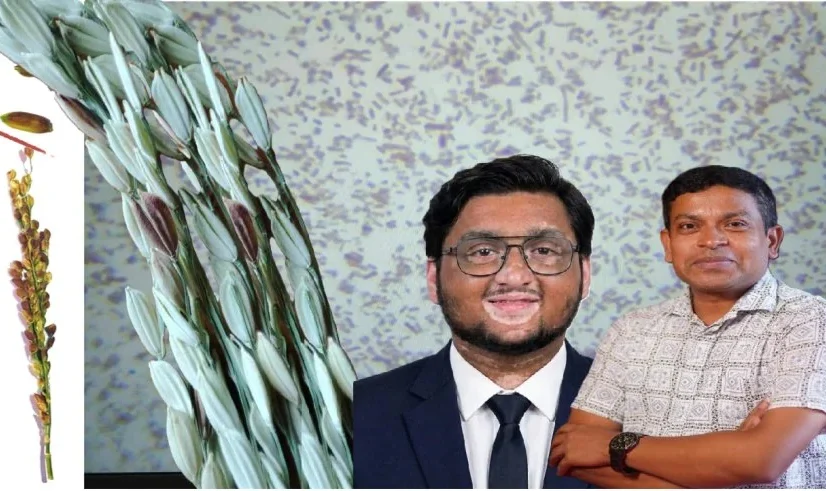
Researchers at Noakhali Science and Technology University (NSTU) have discovered a previously unknown bacterial species responsible for rice grain discolouration, a disease that damages rice grains and causes financial losses for farmers.
The bacterium has been named Pantoea bangladeshensis sp. nov. NSTU24 after Bangladesh. Identified as a new species through whole-genome analysis, the discovery could open new avenues for understanding rice diseases, developing management strategies and breeding disease-resistant varieties.
The research has been accepted for publication in Scientific Reports, a journal under the Nature Portfolio. Another paper by the research team on the prevention and management of the rice disease has already been published in the same journal.
A Facebook post leads to discovery
The research began in February 2023 when Arnab Goswami, then a final-year student in NSTU’s Department of Agriculture, was looking for a topic for his undergraduate thesis under the supervision of Professor Mehedi Hasan Rubel.
He came across a Facebook post by farmers in Tanore upazila of Rajshahi, showing rice panicles and grains turning black. The problem was damaging grain quality and causing financial losses for marginal farmers.
Interested in finding the scientific cause, Arnab collected samples from affected rice fields in Tanore with guidance from Professor Rubel and assistance from Assistant Professor Piyush Kanti Jha.
A previously unknown bacterial species
Initially, the researchers suspected that bacteria belonging to the genus Burkholderia were responsible for the disease. They isolated seven suspected bacterial colonies from the collected samples.
Further tests and genetic analysis, however, revealed that the bacteria did not match the characteristics of known species. Pathogenicity tests identified two bacterial isolates capable of producing symptoms similar to those observed in infected rice fields.
Partial genome sequencing subsequently established that the bacteria belonged to the genus Pantoea, rather than Burkholderia.
Ankan Dutta, a lecturer in the Department of Microbiology at Primeasia University, assisted Arnab during this stage.
The research continued after Arnab completed his undergraduate studies. With further support from Professor Rubel, the team carried out whole-genome sequencing and confirmed the identification of a new bacterial species.
Maksudur Rahman Nayeem of DNA Solution Limited and A B Z Naimur Rahman of NSTU’s Department of Microbiology joined the research team at this stage. Professor Toffazzal Islam, founding chairman of the Institute of Biotechnology and Genetic Engineering at Gazipur Agricultural University, also provided genomic guidance. NSTU microbiology student Mahmudul Hasan Shanto assisted in preparing the research paper.
International recognition
Securing international recognition for the new species involved meeting strict scientific requirements.
Several journals initially rejected the research paper, noting that international bacterial nomenclature rules require a newly identified species to be deposited in at least two recognised culture collection centres.
After obtaining the necessary government permissions, the researchers deposited the bacterium’s type strain in the ICMP collection in New Zealand and the BCCM/LMG collection in Belgium.
The deposits marked an important step towards establishing its international scientific recognition.
Research conducted without funding
Professor Rubel said the discovery was a major achievement for both Bangladesh and NSTU, as it would bring international attention to their research through scientific publications and citations.
However, he expressed disappointment over the lack of institutional funding. Although research proposals were submitted to the University Grants Commission (UGC) twice, the team received no financial allocation.
He said he had personally spent more than Tk3 lakh on the research, including genome sequencing and international courier charges through DHL.
Despite the financial challenges, he said, the opportunity to introduce a new bacterial species bearing Bangladesh’s name to the international scientific community made the effort worthwhile.
Arnab described the discovery as a major scientific milestone, saying the research had started with the aim of identifying the unknown pathogen behind rice grain discolouration.
He said confirming through genomic analysis that the bacterium was a previously unrecorded species was an extraordinary moment for the team.
The researchers believe the genomic data and findings could contribute to developing disease-resistant rice varieties and strengthening global food security.
Next step: Field-level research
The team now plans to expand the research beyond laboratory investigations and study the bacterium under field conditions.
The researchers said adequate funding and government support would be essential to take the work forward.
They expect that a better understanding of the pathogen and effective disease management strategies could help protect rice production, improve grain quality and reduce farmers’ financial losses.