


 Play store

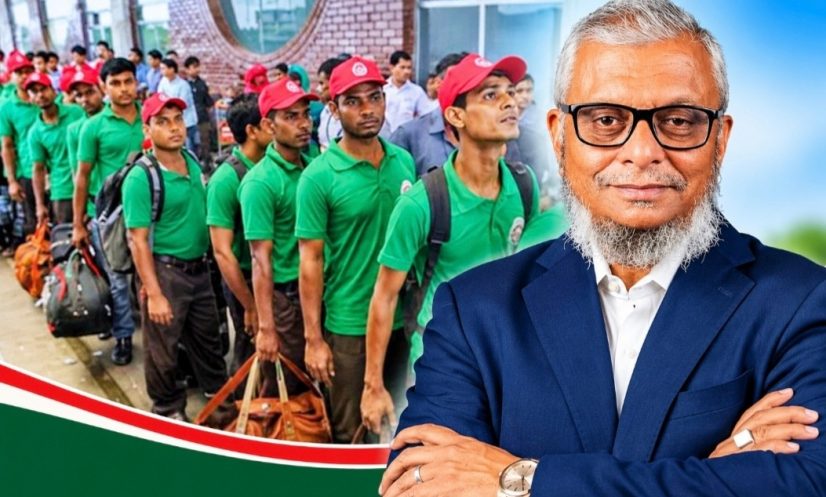
Ahmadul Kobir, Malaysia: For years, an invisible system of exploitation has shadowed the recruitment of Bangladeshi workers for overseas employment. At almost every stage of the process, jobseekers have faced the risk of falling victim to brokers, recruiting agencies, intermediaries and other actors.
Excessive recruitment fees, visa trading without guaranteed jobs, and broken promises about salaries and working conditions have turned the dream of working abroad into a financial nightmare for many Bangladeshi families.
Against this backdrop, Ariful Haque Chowdhury has taken charge of two crucial ministries, the Ministry of Labour and Employment and the Ministry of Expatriates’ Welfare and Overseas Employment. His responsibility extends far beyond routine administration. It involves protecting the interests of millions of workers at home and those who sell family assets or take on heavy debts in the hope of finding a better future abroad.
Since assuming office, the minister, who rose through grassroots politics, has repeatedly taken a firm position against excessive migration costs, recruitment fraud and other irregularities in the overseas employment sector. His message has been consistent: there can be no compromise with injustice and malpractice in the name of labour migration.
He has even publicly said that he would step down if he failed to fulfil his responsibilities.
For Bangladeshi workers, exploitation is not confined to the workplace. Those seeking jobs abroad often face an even more complex and costly system.
Many aspiring migrants are introduced to the overseas employment process by people they know personally, including relatives, local brokers and intermediaries. Some sell land, others borrow heavily, while many mortgage their family’s remaining assets to finance their journey.
Yet, after arriving in their destination countries, some workers find that the jobs, salaries or accommodation promised to them do not exist or differ significantly from what they were offered.
The protection and welfare services that migrant workers are entitled to often remain beyond their reach. Even after being cheated, many hesitate to file complaints because of lengthy procedures, uncertainty and fears of further harassment.
Protecting these vulnerable workers is now one of the central challenges facing Ariful Haque Chowdhury. If his stated commitments are translated into effective policies and sustained action, they could bring meaningful change to a recruitment sector that has long been plagued by allegations of irregularities.
Malaysia remains one of the most important overseas employment destinations for Bangladeshi workers. But the country’s recruitment process has also drawn widespread attention because of allegations of excessive migration costs and syndicate-controlled business practices.
Between 2022 and 2024, allegations emerged that Bangladeshi workers travelling to Malaysia were charged several times more than the government-approved migration costs.
An investigation by the Anti-Corruption Commission reportedly identified allegations involving more than Tk45.45 billion in excess payments linked to the recruitment of 267,276 workers. Following investigations and legal proceedings, the government cancelled the licences of 49 recruiting agencies in July 2026.
The cancellation was subsequently challenged in court. After a High Court order stayed the government’s decision, the Appellate Division’s Chamber Court upheld the cancellation.
The minister’s position on the issue has been straightforward: nobody is above the law. Agencies facing allegations have every right to seek legal remedies and establish their innocence through due judicial process. But no individual or organisation should enjoy immunity simply because of influence or connections. This is where the real challenge lies.
Reforming the manpower recruitment sector will not be easy. The industry involves complex commercial interests, influential business groups and longstanding networks of recruiting agencies and intermediaries.
Migration costs have now become a central issue in discussions surrounding the reopening and expansion of recruitment to Malaysia.
On November 5, the minister held an exchange of views in Dhaka with representatives of recruiting agencies listed under Malaysia’s foreign worker recruitment system.
At the meeting, representatives of private recruiting agencies reportedly agreed in principle to keep migration costs between Tk250,000 and Tk300,000 per worker.
However, the amount commonly paid by workers has reportedly ranged between Tk600,000 and Tk700,000. Allegations of visa trading, intermediary commissions and payments at different stages of the recruitment process have been cited as possible reasons for the wide gap.
The minister made it clear that recruiting agencies could not avoid responsibility for excessive charges by blaming syndicates or financial arrangements among themselves.
Poor workers, he argued, should not be made to bear the cost of business dealings between agencies and other parties involved in the recruitment chain.
At the same meeting, he said the government hoped to send workers to Malaysia at zero migration cost on the first two or three flights in December. He also stressed that recruitment costs under the private-sector system must remain within reasonable limits.
One of the most significant developments in the latest discussions with Malaysia is the in-principle agreement to recruit an initial 10,000 Bangladeshi workers without charging them migration fees.
The recruitment is expected to be facilitated through the state-owned Bangladesh Overseas Employment and Services Limited, or BOESL.
BOESL has already published a recruitment notice for 112 workers. The proposed basic monthly salary at the relevant Malaysian establishment is RM1,700, while the employer is expected to bear migration-related expenses.
This initiative is more than just another recruitment exercise. It represents an attempt to challenge the longstanding assumption that workers themselves must bear the entire financial burden of securing overseas employment.
The minister hopes that the zero-cost model will also encourage private recruiting agencies to move away from excessive charges.
But the success of the initiative will ultimately depend on implementation. Workers must genuinely be spared recruitment-related costs, and employers must honour their commitments to bear the agreed expenses.
Under Malaysia’s new recruitment framework, a total of 338 Bangladeshi organisations have been given the opportunity to participate.
They include 312 recruiting agencies, 25 processing or service agencies and the state-owned BOESL.
Compared with the previous arrangement, which relied on a limited number of agencies, the broader participation framework represents a significant change.
The minister has also called for effective monitoring to ensure transparency, prevent harassment and eliminate recruitment fraud, while seeking cooperation from all stakeholders.
Whether the expanded participation will create genuine competition, reduce migration costs and provide better protection for workers, however, remains to be seen.
The minister’s efforts to address irregularities are not confined to Malaysia. He has also moved to introduce stricter oversight of recruitment to other overseas employment destinations.
Recently, allegations of irregularities emerged in recruitment processes involving Serbia and several other countries.
According to the minister, some organisations allegedly collected substantial sums from jobseekers and promised to arrange visas without completing valid recruitment procedures or obtaining the necessary approvals. There were subsequently attempts, he said, to pressure the ministry into regularising those arrangements.
In response, the ministry has made prior approval mandatory for sending workers to 12 countries: Serbia, Moldova, Belarus, Kosovo, Bosnia and Herzegovina, Japan, Iraq, Laos, Vietnam, Cambodia, Ukraine and Libya.
The minister’s position is that no worker should be allowed to travel without proper verification of the employer, the nature of the job, salary and accommodation arrangements.
Possession of a visa alone, he has argued, does not automatically establish the right to receive recruitment approval.
At the same time, he has indicated that applications involving legitimate employers and satisfactory employment conditions should be approved without unnecessary delay.
The approach, therefore, is to maintain strict scrutiny of irregular recruitment while ensuring that genuine overseas employment opportunities are not obstructed.
Ariful Haque Chowdhury’s personal background may also have shaped his understanding of the issue. He has experience of living abroad in both the United States and the United Kingdom.
People close to him believe that this exposure has given him a better understanding of the realities of expatriate life, employment uncertainty and the emotional hardship of living far from one’s family.
As a politician who emerged from grassroots politics, he has also spoken about the sacrifices ordinary families make when sending a loved one overseas.
The money workers borrow, the assets they sell and the hopes their families place in them are realities that deserve a greater place in policymaking on labour migration.
Yet personal experience and political commitment alone cannot eliminate decades of irregularities.
Institutional cooperation, effective law enforcement, accountability among overseas diplomatic missions and responsible conduct by recruiting agencies will all be essential.
Nor should it be surprising if the government’s new policies clash with the commercial interests of some stakeholders in the manpower recruitment business.
Efforts to reduce migration costs, introduce zero-cost recruitment and strengthen verification of employers could challenge established business practices and financial interests.
Private recruiting agencies have an important role in facilitating overseas employment, particularly in a major labour market such as Malaysia. But their participation must never become a means of exploiting workers.
At the same time, fairness demands that no agency be declared guilty solely on the basis of allegations. Proper investigations and due legal process must be followed in every case.
Professional cooperation from ministry officials, transparency among relevant institutions, investigative journalism and oversight by civil society will be vital if the minister’s efforts are to produce lasting results.
Ultimately, reforms must become institutional practices rather than depend solely on the commitment of an individual minister.
The biggest question facing Ariful Haque Chowdhury is whether he can help transform the overseas employment sector into a system where workers no longer have to sell everything they own, take on crushing debts or leave the country fearing exploitation simply to secure a job abroad.
His declared commitments, the initiative to send 10,000 workers at zero migration cost, action against recruiting agencies accused of irregularities and the expanded participation of 338 organisations in Malaysia’s new recruitment framework are now facing the real test: implementation.
This is not simply a battle over a minister’s political standing or administrative authority. At its heart, it is a struggle to protect the rights and dignity of Bangladesh’s working people.
If the value of migrant workers’ sweat and sacrifice cannot be protected, no statistics celebrating overseas employment will be enough to conceal their suffering.
Workers’ interests must come first. Fairness must prevail.
That should be the ultimate benchmark in Bangladesh’s fight for ethical labour migration.