Play store

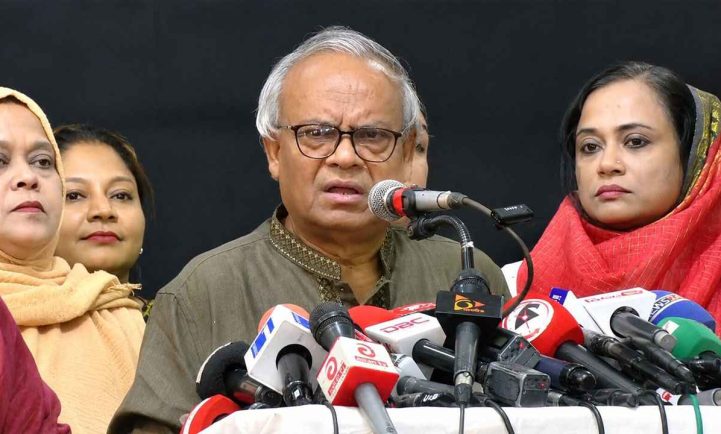
BNP Acting Secretary General Ruhul Kabir Rizvi has urged India to follow the existing extradition treaty with Bangladesh to bring back former prime minister Sheikh Hasina to face ongoing judicial proceedings.
He made the demand while addressing a discussion organised by the Jatiyatabadi Mohila Dal at the Kazi Nazrul Islam auditorium of the National Press Club in Dhaka on Friday, marking the National Revolution and Solidarity Day.
Expressing anger over discussions surrounding Hasina’s return, Rizvi said numerous people had been killed and several cases had been filed against her.
He criticised what he described as attempts to portray her return as an ordinary homecoming, saying she should not be welcomed with flowers as if she were returning from a family visit.
Rizvi also dismissed demands by Hasina’s lawyers for her passport, visa and national identity card as irrelevant to the matter.
He said bringing back an accused or convicted person involved in criminal proceedings was not a normal return but an extradition process governed by the legal arrangements between the two countries.
He called on the government to use the provisions of the extradition treaty with India to bring Hasina back and ensure that she faces the ongoing judicial process.
Recalling the victims of the July 2024 mass uprising, Rizvi alleged that Hasina was responsible for the deaths of around 1,400 people, including students, rickshaw pullers and workers. He mentioned the names of Abu Sayed, Ahnaf, Mugdha, Wasim Akram and Faiyaz among those killed during the uprising.
He further alleged that enforced disappearances, murders and secret killings had become part of the state machinery during Hasina’s rule.
Rizvi also credited BNP Acting Chairman Tarique Rahman with helping unite people during the 2024 uprising through his leadership from London using technology.
Highlighting the historical significance of November 7, 1975, Rizvi described the Sipahi-Janata Revolution as a national awakening against domination and a day associated with protecting Bangladesh’s independence and sovereignty.
He said the spirit of the uprising had been carried forward by then President Ziaur Rahman through the establishment of multiparty democracy. Later, BNP Chairperson Khaleda Zia led a nine-year movement against autocratic rule to restore democracy, he added.
Rizvi also alleged that Khaleda Zia had been imprisoned in politically motivated cases during the previous government and that poison had been mixed with her food.
Praising the role of women in the BNP’s political movements over the past 17 years, Rizvi particularly acknowledged the contributions of Jatiyatabadi Mohila Dal President Afroza Abbas and General Secretary Sultana Ahmed.
He urged the organisation to expand its activities beyond political movements and take an active role in preventing child marriage, promoting women’s education and ensuring women’s economic empowerment.
Rizvi said the current prime minister had plans to provide free education to women up to the honours level and allocate 25 per cent of collateral-free loans of up to Tk 1 million for women entrepreneurs.
He called on the Mohila Dal to play a leading role in implementing these initiatives.