


 Play store

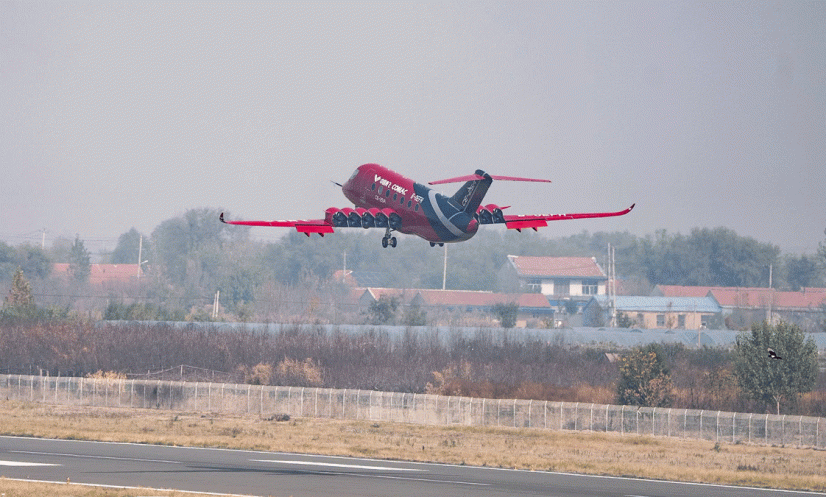
A Chinese electric aircraft has successfully taken to the skies carrying passengers, marking a significant step forward in the development of electric aviation and the country’s efforts to promote sustainable air travel.
China’s first domestically developed electric commercial aircraft, the CE-25A, successfully completed its maiden piloted flight on Saturday, November 14, marking a major milestone in the country’s efforts to develop electric aviation.
The aircraft, developed by the Commercial Aircraft Corporation of China (COMAC), carried two pilots and a flight-test engineer during the test flight in Binzhou, Shandong Province, eastern China.
According to COMAC, the aircraft operated normally throughout the flight, with all performance indicators meeting expectations.
It remained airborne for 16 minutes and 38 seconds, covering a distance of 60.4 kilometres.
The CE-25A is designed primarily for short-distance commercial flights between cities and can accommodate up to 19 passengers.
It has a maximum take-off weight of 10 tonnes, a cruising speed of 300 kilometres per hour and a maximum range of 400 kilometres. It can cruise at an altitude of 2,400 metres.
Unlike conventional aircraft powered by jet engines, the CE-25A uses an electric ducted-fan propulsion system, with electrically powered fans mounted along its wings.
The aircraft was jointly developed by COMAC, Chinese battery manufacturer Contemporary Amperex Technology Co Ltd (CATL), Shanghai Jiao Tong University and other domestic partners.
Before its first piloted flight, the aircraft completed its maiden unmanned autonomous flight on February 2 this year and underwent 19 unmanned flight tests to verify its performance and reliability.
The Civil Aviation Administration of China (CAAC) has accepted COMAC’s application for a type certificate, an essential step towards obtaining regulatory approval for commercial operations.
The successful test flight marks significant progress in China’s efforts to introduce electric aircraft for regional passenger transport.
However, the aircraft must complete the required certification process before entering commercial service.