


 Play store

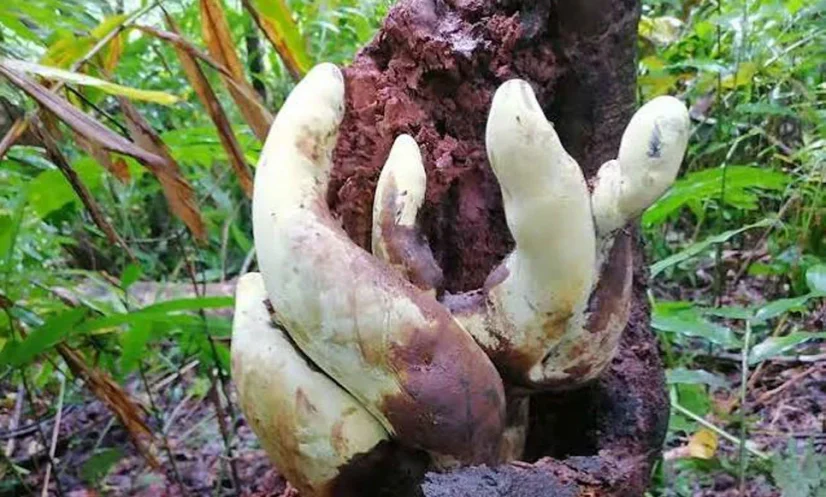
Scientists have discovered a bizarre giant fungus in the forests of China’s southwestern Yunnan province, with a shape resembling a human hand emerging from the ground.
The newly identified species, named Dianjunus rex and nicknamed “D-Rex”, can grow up to 20 inches (50 centimetres) tall and weigh around 5 pounds (2.2 kilogrammes).
Researchers believe its evolutionary lineage dates back approximately 65 million years, shortly after the extinction of the dinosaurs, according to a report by science magazine Wired.
Scientists from the Kunming Institute of Botany under the Chinese Academy of Sciences identified the unusual fungus and found that it represents not only a new species but also an entirely new fungal family.
The fungus belongs to the large group known as Ascomycetes, which includes more than 64,000 known species. Unlike ordinary mushrooms, these fungi do not develop conventional caps and stems. Instead, they produce specialised reproductive structures for generating spores. In Dianjunus rex, these structures have grown to an extraordinary size.
Researchers discovered the fungus while exploring the Nanban tropical rainforest in Yunnan. They noticed large white structures emerging from the soil near tree roots. The structures appeared in different shapes, including tubes, spinning-wheel-like forms and hand-like patterns.
As they mature, their branches spread out like fingers. The above-ground portions are initially covered in white, powdery fibres before gradually turning dark yellow. The underground parts, meanwhile, are black and smooth.
Laboratory examination showed that the reproductive structures dried quickly after collection. Their interiors were dense and spongy, with white or yellow colouring. Researchers found no particularly strong smell or taste in the samples.
DNA analysis and examination of their physical characteristics confirmed that the fungus did not belong to any previously known species or closely related group. Scientists therefore established a new genus, Dianjunus, and a new family, Dianjunaceae, for its classification.
An evolutionary history dating back 65 million years
One of the most intriguing aspects of the discovery is its ancient evolutionary history.
Using DNA analysis and a technique known as a molecular clock, researchers estimated that the ancestors of Dianjunus rex separated from other fungal lineages around 65 million years ago.
This period coincides with the end of the Cretaceous era, when a mass extinction wiped out non-avian dinosaurs and numerous other animal and plant species.
Researchers suggest that the enormous accumulation of dead plants and wood following the extinction may have created new ecological opportunities for fungi that feed on decaying organic matter. However, they cautioned that a direct link between the extinction event and the fungus’s evolution has not been established.
Scientists are still trying to understand why the fungus develops such enormous reproductive structures.
The study’s lead author, Indunil C Senanayake, an associate professor at the Kunming Institute of Botany, suggested that the fungus might live inside living trees and obtain nutrients from their organic matter after they die. This could allow it to accumulate energy over an extended period.
However, researchers have so far found its reproductive structures mainly around dying trees, making the explanation tentative.
Another possible explanation is that its unusual height helps disperse spores. In dense forests, spores released close to the ground by smaller fungi may become trapped among vegetation and fallen leaves. Taller reproductive structures could allow Dianjunus rex to release spores into the air, helping them travel greater distances.
Producing such enormous structures requires considerable energy, however. Researchers believe this characteristic would have evolved only if the reproductive advantage outweighed the energy cost.
Yunnan holds vast unexplored fungal diversity
The discovery has expanded scientific understanding of fungal diversity in East Asian forests.
Around 6,000 fungal species have so far been identified in Yunnan province, but mycologists estimate that the region may be home to as many as 100,000 species.
Remote forests, seasonal appearances and the tendency of many fungi to grow underground or hidden behind vegetation make them difficult to discover.
Research has also traditionally focused more heavily on fungi with commercial or practical value, leaving many species unexplored.
Senanayake believes East Asian forests still contain enormous amounts of undiscovered fungal diversity.
The discovery of Dianjunus rex highlights that potential, while offering new opportunities to understand biodiversity and the evolutionary history of life on Earth.
The research was published in the journal Frontiers in Fungal Biology.