


 Play store

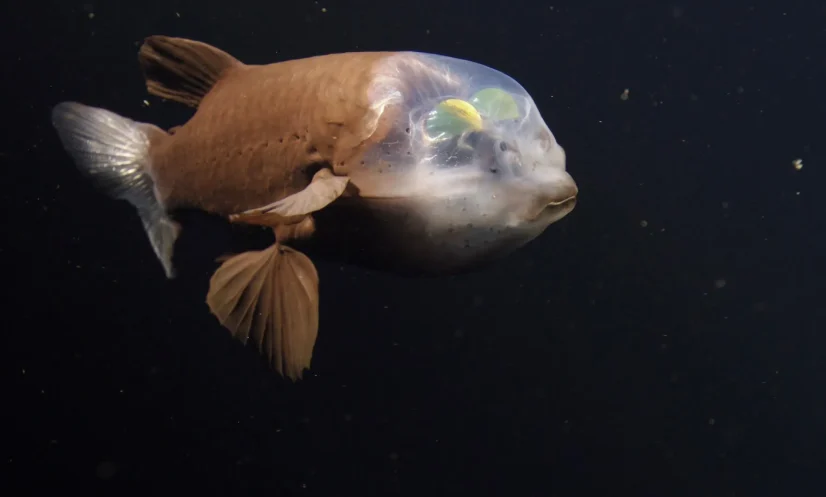
Scientists have captured rare footage of a mysterious deep-sea fish with a transparent head and rotating eyes during an underwater expedition in the Pacific Ocean, offering a remarkable glimpse into one of the ocean’s least-understood creatures.
Researchers from the Monterey Bay Aquarium Research Institute (MBARI) spotted the barreleye fish, scientifically known as Macropinna microstoma, at a depth of around 600 metres (1,970 feet), nearly 2,000 feet below the ocean surface.
The encounter was particularly significant as it marked only the 11th time MBARI scientists had observed the elusive species during nearly four decades of ocean exploration.
The discovery was made during an eight-day expedition aboard the research vessel David Packard, as researchers investigated marine life approximately 90 kilometres (55 miles) offshore.
Using a remotely operated vehicle (ROV) named Doc Ricketts, the team was filming and collecting deep-sea organisms when the unusual fish unexpectedly appeared.
The barreleye is among the most distinctive creatures of the deep ocean. Its transparent, fluid-filled head allows scientists to see its internal structures, while its distinctive tubular eyes can rotate to track prey and adjust their direction of vision.
Senior scientist Steven Haddock said seeing the fish was a rare and exciting experience for everyone aboard the research vessel.
“Seeing a barreleye fish is a rare treat,” Haddock said, adding that crew members from across the ship gathered in the control room to watch the remarkable animal.
He said deep-sea creatures could inspire curiosity and appreciation for the ocean, encouraging greater efforts to protect what he described as the largest living space on Earth.
An unexpected discovery
The expedition, titled Diving Deep for Delicate Drifters, was primarily focused on studying gelatinous marine organisms, including jellyfish, siphonophores and ctenophores, commonly known as comb jellies.
Haddock and his colleagues were investigating how these delicate creatures have evolved to survive in the open ocean at considerable depths.
To study marine life across different parts of the water column, the researchers combined blue-water scuba dives near the surface with surveys conducted by remotely operated vehicles hundreds of metres underwater.
The two approaches allowed the team to observe and collect organisms living in different ocean environments.
The barreleye appeared as the day’s underwater operations were coming to an end. The ROV pilots were bringing Doc Ricketts back towards the surface for recovery when research specialist Shannon Johnson noticed the unusual fish.
She immediately alerted the pilots and asked them to stop the vehicle so the team could observe and film the creature.
Most of the scientists had already moved to the vessel’s wet laboratory to catalogue specimens collected during the dive. After hearing about the sighting, they hurried back to the control room, joined by other crew members eager to witness the rare encounter.
The unexpected appearance of the barreleye became one of the highlights of the expedition, providing an extraordinary conclusion to a week of deep-sea exploration.
Scientists say encounters with such elusive marine species offer valuable opportunities to improve understanding of biodiversity and life in the largely unexplored deep ocean.