Play store


The fugitive and exiled leadership of the Awami League (AL) appears to be pursuing a familiar strategy of confrontation, seeking to destabilise the country through violence, sabotage, arson and organised unrest. Nearly two years after the July mass uprising ended Sheikh Hasina’s fascist rule, the party’s response suggests that its leadership has yet to accept Bangladesh’s changed political realities. Convicted AL leaders sheltering in India have failed to grasp the shift that has ushered in a new Bangladesh under a democratically elected government.
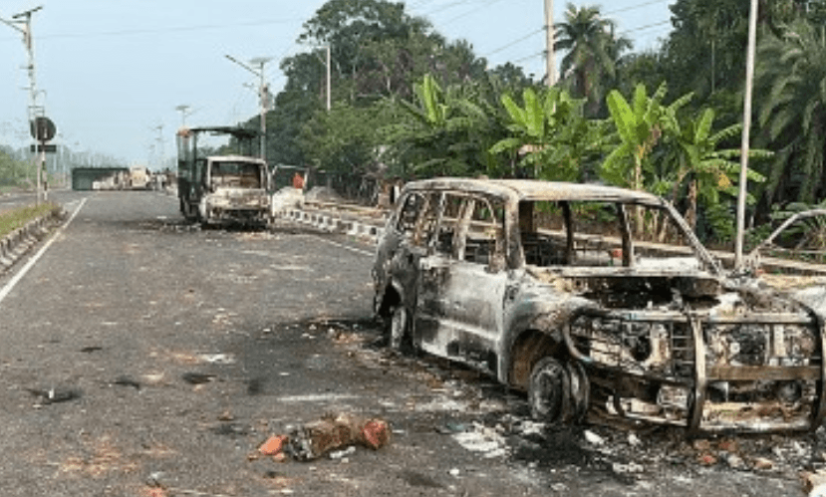
The fallen party’s recent acts of arson, vandalism, crude bomb explosions and attacks on law enforcement agencies across the country, particularly in Gopalganj, have raised serious concerns about an organised attempt to undermine public order and challenge the government.
Media reports and intelligence assessments suggest that elements linked to the banned party may be infiltrating movements, including garment workers’ protests, to provoke violence.
These developments warrant serious attention. A political organisation must be judged by its conduct as well as its public statements. When mobilisation involves attacks on police stations, arson, intimidation and destruction of public property, it becomes a threat to public safety and the rule of law.
The alleged strategy may extend beyond isolated violence. Security agencies suspect that elements of the former ruling party are coordinating disruptive activities targeting government installations, transport networks and law enforcement personnel. If established, such a campaign would seek to create insecurity and undermine confidence in the government’s ability to maintain law and order.
Gopalganj emerges as the centre of confrontation
Gopalganj, long an AL stronghold, has emerged as a centre of confrontation. From around November 15, hundreds of supporters of the activity-banned party and its affiliated Chhatra League reportedly demonstrated in Gopalganj Sadar and Tungipara ahead of the nationwide lockdown announced for November 19.
Armed with sticks, oars, machetes and locally made weapons, demonstrators allegedly confronted police barricades, blocked roads and set tyres and public property on fire. Reports of attacks on police armoured vehicles, vandalism of the July Memorial and reopening of the shuttered AL office heightened tensions.
The violence reportedly escalated with attacks on the homes and offices of rival Bangladesh Nationalist Party (BNP) leaders. The house of BNP lawmaker SM Zilani and several residences belonging to his relatives were also set ablaze.
Suspected AL activists also allegedly attacked Tungipara Police Station, vandalised its premises, set police vehicles and motorcycles on fire and freed several people detained over sabotage allegations. A law enforcement convoy reportedly came under attack, and BGB vehicles were set ablaze.
Such incidents go beyond political anger. Attacks on police stations, obstruction of security operations and the burning of public property challenge state authority, endanger citizens, disrupt economic activity and create fear.
The violence followed police operations and arrests of suspected AL activists, as well as the party’s announcement of nationwide blockade and protest programmes. Authorities must establish whether the incidents were spontaneous reactions or part of a coordinated strategy.
The politics behind the violence
The apparent objective of the exiled AL leadership is to pressure the government by showing that the party can still disrupt normal life despite being out of power and facing restrictions.
Media reports citing intelligence assessments have suggested that leaders operating from abroad may be organising sabotage committees to target public infrastructure, disrupt transport and create unrest in different parts of the country. There have also been concerns about attempts to isolate Gopalganj and neighbouring districts through road and waterway blockades.
Talk of Sheikh Hasina’s anticipated return in December may also factor into the party’s mobilisation strategy. However, the chain of command and any direct involvement by the exiled leadership remain to be established.
Another possible calculation is to provoke a disproportionate government response. Excessive force or indiscriminate arrests could then be portrayed as political persecution, attracting sympathy from civil society, human rights organisations and foreign political circles.
Such a strategy, if pursued, would be a dangerous gamble. It would put ordinary party supporters at risk while deepening political divisions. The government has so far largely avoided a sweeping crackdown, although pressure is mounting on it to protect public safety and prevent further attacks.
The authorities must distinguish between those involved in crime and ordinary supporters. Collective punishment, politically motivated arrests and excessive force could strengthen a narrative of persecution.
A party yet to accept the July uprising
Perhaps the most troubling aspect of the Awami League’s recent political conduct is its leadership’s apparent reluctance to acknowledge the reasons behind its downfall.
The July mass uprising followed years of public frustration over authoritarian governance, democratic backsliding, corruption allegations, political repression and weakened institutional accountability. The movement came at an enormous human cost, with more than 1,500 people reportedly killed during the uprising and subsequent violence, according to figures cited in public discussions.
The UN human rights office documented serious violations and the use of force against protesters, underscoring the need for accountability, institutional reform and political reconciliation.
Rather than acknowledging victims’ suffering, addressing the grievances behind the uprising or undertaking a credible political reckoning, the leadership appears focused on regaining power. Its failure to show remorse or begin internal reform has undermined its prospects of rebuilding public confidence.
Sheikh Hasina and many senior party leaders left the country following the mass movement. That political reality cannot be reversed through arson, intimidation or street violence. Nor can a party restore its lost legitimacy by creating insecurity for the people whose support it would need to regain a place in democratic politics.
The Awami League must recognise that Bangladesh has entered a new political chapter. The methods associated with its years in power, including coercion, confrontation and the suppression of dissent, cannot provide a sustainable path to political survival.
Government must remain firm but restrained
The government faces a critical test. Maintaining law and order is its constitutional responsibility, but its response must be guided by legality, proportionality and respect for human rights. Those responsible for arson, attacks on law enforcement agencies, bomb explosions and vandalism must be identified and brought to justice through transparent investigations and due process.
The authorities must strengthen intelligence gathering, coordinate security agencies and protect public installations without turning operations into political retaliation. They should also prevent individuals seeking to provoke violence from infiltrating legitimate labour movements and protests.
Political parties, civil society and human rights groups must condemn violence regardless of its source and reject attempts to justify criminal acts as political dissent.
Bangladesh cannot afford another cycle of political violence. The July uprising was driven, among other things, by demands for accountable governance, democratic institutions and the protection of fundamental rights. Those aspirations would be undermined if political competition once again descended into arson, intimidation and street confrontations.
The Awami League, like any other political organisation, must ultimately answer for its actions and choices. If it wishes to remain relevant in Bangladesh’s political landscape, it must abandon violence, acknowledge the country’s changed realities and demonstrate a genuine commitment to democratic principles.
The message from Gopalganj should be clear: old tactics cannot reverse a change in the political era. Bangladesh’s future must be determined through democratic participation, accountability and the rule of law—not through arson, vandalism or attempts to manufacture anarchy.