Play store

Rajshahi Correspondent: A farmer and agricultural researcher in Tanore upazila of Rajshahi has developed a new drought-tolerant rice variety through crossbreeding local rice varieties after seven years of dedicated research, offering fresh hope for agriculture in the drought-prone Barind region.
Nur Mohammad, who has no formal academic degree in agricultural science, developed the variety through his own research and efforts.
Explaining the characteristics and cultivation process, Nur Mohammad said groundwater levels in the Barind region were falling, intensifying irrigation shortages. Although traditional local rice varieties can withstand drought, their low yields discourage farmers from cultivating them.
To address this problem, he developed the new variety by crossbreeding indigenous rice varieties.
The rice has a growing period of 115 to 120 days and is highly resistant to diseases and pest attacks. Nur claimed that it could produce 21 to 22 maunds of rice per bigha (33 decimals) using only natural rainfall, without artificial irrigation, chemical fertilisers or pesticides.
He had previously drawn attention for developing two rice varieties named ‘Nur-1’ and ‘Nur-2’. However, the newly developed variety has not yet been named. He also said he planned to apply for government recognition of the variety.
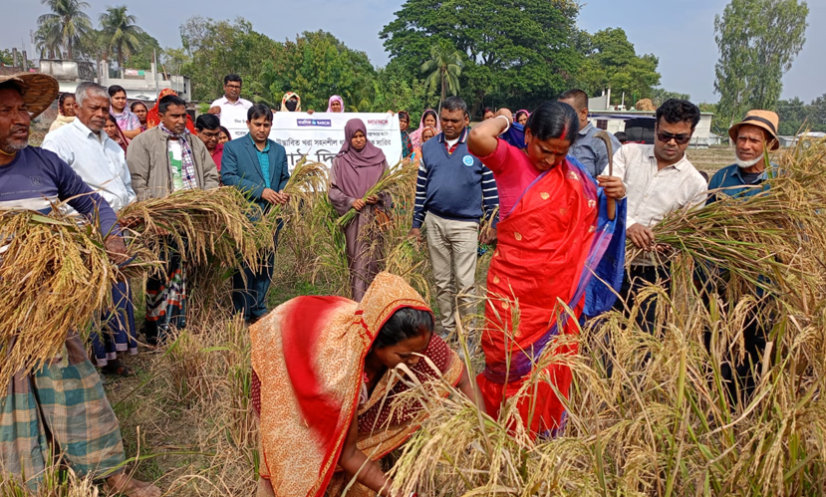
A field day and harvesting festival showcasing the new rice variety were held on Thursday (November 19) at a 15-decimal experimental plot owned by Nur Mohammad in Gollapara Purba field of Tanore upazila.
The event was jointly organised by development research organisation BARCIK (Bangladesh Resource Centre for Indigenous Knowledge) and Nur Mohammad Krishi Seba. Around 80 farmers, including men and women, agricultural officials and researchers from different parts of the Barind region attended the programme.
At a discussion following the field day, Agriculture Officer Subhash Kumar Mondal and BARCIK’s Barind Region Coordinator Md Shahidul Islam spoke. The session was moderated by Amrit Kumar Sarkar, agriculture programme officer of BARCIK.
Subhash Kumar Mondal said developing crop varieties that require less water had become essential as groundwater levels in the Barind region continued to decline.
“Nur Mohammad’s research has created new possibilities for agriculture in this region. The agriculture department will discuss the matter with higher authorities and take initiatives to provide necessary support,” he said.
BARCIK coordinator Md Shahidul Islam called for incorporating farmer-led research into agricultural policies and ensuring state and institutional recognition for farmer-researchers.
The experimental field has generated considerable enthusiasm among local farmers.
Nirmal Chandra, a farmer from Tatiapara village in Tanore, collected five kilogrammes of seeds from Nur Mohammad to cultivate the variety on his own land next season.
Shrimati Asima Rani Halder, a woman farmer from Halderpara village in Gollapara, said cultivating the rice without irrigation and pesticides would reduce production costs while helping ensure safe food production.