Play store

The International Court of Justice (ICJ) ruling is significant not only for delivering justice to Rohingya victims but also for giving fresh meaning to the 1948 Genocide Convention. The court has provided important guidance on how the convention should be applied to regulate the conduct of states.
In a 9-6 majority ruling, judges at the ICJ in The Hague, the Netherlands, set out a detailed framework for applying the Genocide Convention. In particular, they explained how to determine a government’s intent when it is accused of committing genocide against a particular group.
Israel will be paying close attention to the lengthy judgment. It is currently the only other country facing a genocide case before the ICJ. The ruling is also relevant to Germany, which is facing a case brought by Nicaragua over allegations of complicity in genocide in Gaza and failure to prevent it.
Philippe Sands, a prominent human rights lawyer and member of The Gambia’s legal team, said, “I think this judgment has made the Genocide Convention effective in practice. It has opened the way for the convention to be applied meaningfully. Had the court reached the opposite conclusion, the convention would effectively have become meaningless.”
Amnesty International Secretary General Agnès Callamard described the ruling as “a rare moment of justice for survivors, victims and their families”. In a world where violations of international law are becoming increasingly common, the judgment is also being viewed as a step towards reaffirming the authority of humanitarian law.
Dr Eva Vukusic, assistant professor of international history at Utrecht University and an expert on war crimes, said, “Today is an important day for international law. We needed a judgment like this. It has clarified many aspects of the law that will be extremely useful in the future.”
The ruling could also have implications for the International Criminal Court (ICC), another international court in The Hague. The ICJ judgment may serve as a benchmark for determining when individuals can be charged with genocide.
US President Donald Trump’s administration is also keeping a close watch on the ruling. The administration has consistently taken a negative stance towards international legal institutions. Before the judgment was delivered, the US ambassador to the United Nations warned the ICJ against “lowering the legal standard” for proving genocide. He feared that doing so could lead to the law being “weaponised” against US troops and those of its allies.
However, the court did not directly lower the existing threshold for proving genocide. The Gambia had not asked it to make such a change either. The judges retained the established standard for determining genocidal intent: that genocide must be the “only reasonable explanation” for the accused party’s actions. In reaching its conclusion, the court also examined in detail the findings of previous cases.
In its new ruling, the ICJ held Myanmar’s military responsible for directly committing genocide against the Rohingya Muslim minority. The atrocities reached their peak during the military operations targeting Rohingyas in northern Rakhine State in 2017.
In assessing the scale of Myanmar’s military operations, the ICJ did not consider only the number of people killed. Alongside the deaths of nearly 10,000 people, it took into account the total of 815,000 Rohingyas targeted in the operations in northern Rakhine.
Significantly, the court did not limit its assessment to the death toll. It also considered the psychological harm suffered by survivors, particularly the impact on victims of sexual violence, as well as the effects of the operations on the reproductive capacity of the Rohingya population. The judges concluded that, taken together, the evidence pointed to genocidal intent as the “only reasonable explanation”.
In reaching this conclusion, the court highlighted several factors that international law experts say could also be relevant to the case concerning Gaza. Written submissions and counter-submissions are currently being filed in the case against Israel, brought by South Africa. The case could take at least another three years to conclude.
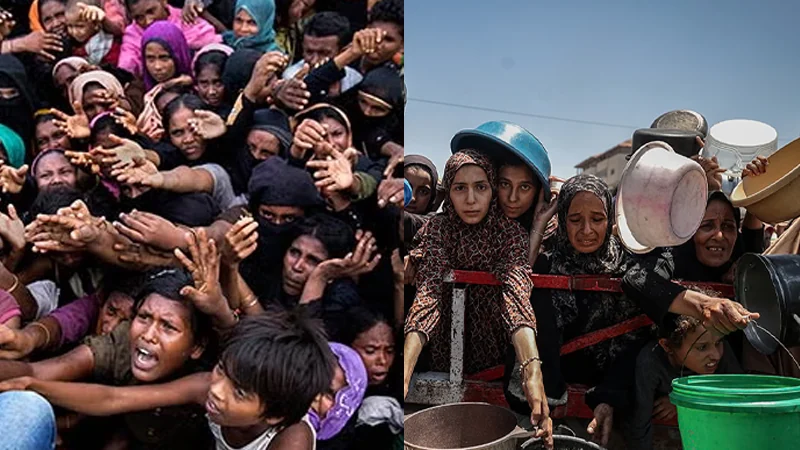
One common feature of the two situations is the targeting of children. The ICJ said attacks on Rohingya children amounted to an assault on the “foundations” of the group’s existence. According to the court’s findings, 2,109 Rohingya children under the age of five were killed. Meanwhile, more than 5,000 Palestinian children under the age of five have been killed in the war in Gaza.
The ruling against Myanmar also addressed another aspect of the crimes: the destruction of villages, followed by the levelling of large areas and extensive land clearance using bulldozers. Security installations were then rapidly built on the cleared land. Similar activities have been reported in areas under Israeli military control in more than 60 per cent of the Gaza Strip.
William Schabas, professor of international law at Middlesex University and an expert on genocide, said, “There are many messages for Israel in this judgment. Of course, there are clear differences between the two situations, and the evidence will also be different. But if you replace the word Myanmar with Israel in the judgment, not much would need to change.” Source: The Guardian.