


 Play store

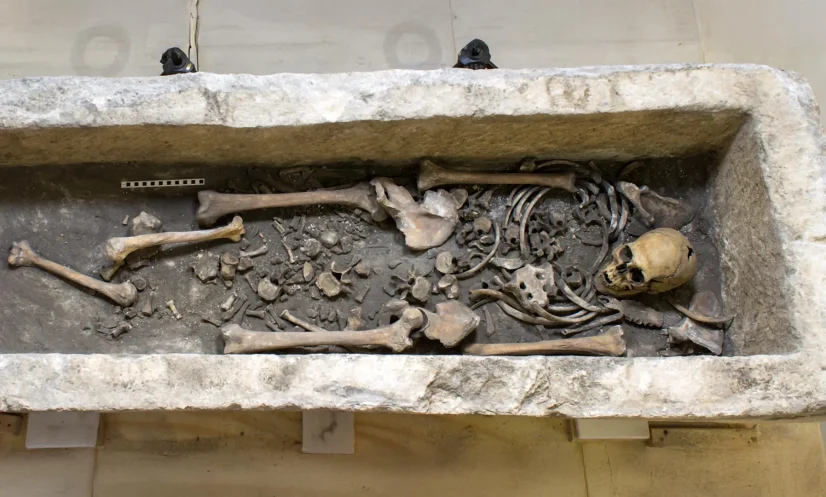
A skeleton discovered inside an ancient Roman stone coffin at Westminster Abbey may belong to a medieval abbot, with new archaeological research narrowing the possible identities to two senior religious figures who lived nearly 1,000 years ago.
The limestone sarcophagus bears an inscription naming Valerius Amandinus, a wealthy Briton believed to have lived in London between 300 and 400 AD. However, a large Latin cross carved into its lid dates to around the 10th or 11th century, suggesting that the coffin was reused for a burial several centuries after the Roman period.
Fresh research by Professor Warwick Rodwell, Consultant Archaeologist at Westminster Abbey, points to two possible occupants: Aelfwig, an abbot who died around 1020, and his successor Wulnoth, who died in 1049.
The findings have been published in the peer-reviewed Journal of the British Archaeological Association.
Rodwell considers Aelfwig the stronger candidate because he had served as a monk at Westminster before becoming abbot. However, both men are believed to have been buried at the Abbey.
“We have two viable contenders for the occupant of the sarcophagus,” Rodwell said, adding that the available evidence was consistent with either man’s age and period of death.
The elaborate burial also suggests that the deceased held a high position in the monastery. Researchers believe the medieval burial involved placing a wooden coffin inside the existing Roman sarcophagus and modifying its stone lid with a prominent Latin cross.
The discovery offers an example of how valuable Roman objects were reused for different purposes during the medieval period.
New analysis reveals age of skeleton
The sarcophagus was first accidentally encountered by workers in 1820 while they were working near Westminster Abbey’s original sacristy. Its lid was broken into six pieces, which were repaired around the time of its formal excavation in 1869.
Further archaeological investigations, including work associated with Channel 4’s Time Team in 2009, examined the history of the area.
More recently, Pre-Construct Archaeology (PCA) conducted another excavation of the site, completed in 2025, ahead of the construction of the King Charles III Sacristy, a new facility scheduled to open in 2027.
During the investigation, human bone specialist James Young Langthorne of PCA re-examined the skeleton.
His analysis found that the remains belonged to a man aged between 35 and 49 who stood approximately 5 feet 9 inches tall. This differs from a 19th-century assessment that described the individual as a robust young man aged no more than 30 and around 5 feet 7 inches tall.
Radiocarbon dating confirms medieval origin
Scientific dating provided a crucial clue to the mystery.
A bone sample was sent to the Scottish Universities Environmental Research Centre for radiocarbon analysis. The results placed the burial between 987 and 1052 AD.
The findings confirm that the individual was buried centuries after the Roman sarcophagus was made and fall within the lifetimes of both Aelfwig and Wulnoth.
Although researchers have yet to establish the occupant’s identity conclusively, the new evidence has significantly narrowed the possibilities, bringing a 150-year-old archaeological mystery closer to resolution.