


 Play store

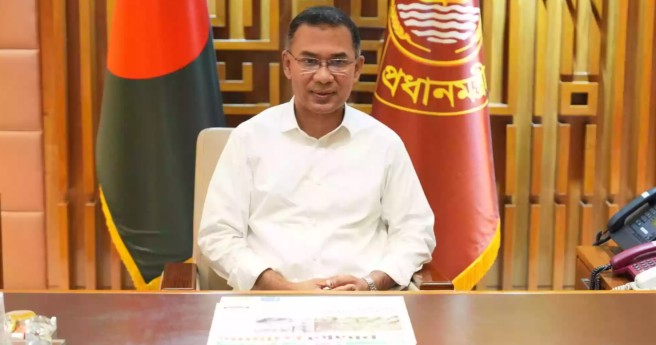
Prime Minister Tarique Rahman on Tuesday announced a government-backed collateral-free financing scheme for young entrepreneurs, saying first-time startup founders with viable business ideas will be able to access funding without land or other assets as security.
He also assured entrepreneurs that startups with genuine potential would be eligible for a second round of funding if their initial ventures failed, describing failure as a natural part of innovation and entrepreneurship.
The Prime Minister made the announcement during an interactive programme titled “Youth, Startups and the Bangladesh of Possibilities” at the Nabab Nawab Ali Chowdhury Senate Bhaban of Dhaka University.
The event, organised by the Information and Communication Technology (ICT) Division in collaboration with Dhaka University, brought together 230 students from eight public and private universities for an open discussion on entrepreneurship, innovation, technology, education and employment.
Responding to a question from Dhaka University student Nusrat Jahan on how young people without property could obtain business loans, Tarique Rahman acknowledged that access to finance remained one of the biggest obstacles for aspiring entrepreneurs.
“The problem is well known to all of us,” he said.
The Prime Minister said the ICT Division has earmarked around Tk 500 crore to support startups, from which entrepreneurs will be able to receive financing ranging from Tk 5 lakh to Tk 5 crore, depending on the nature and potential of their projects.
He said the government has decided in principle to remove conventional banking requirements for first-time startup founders.
“A completely independent committee has been formed. There are no ministers or advisers on it. The committee will evaluate your project, and if it approves the proposal, you will receive funding without any collateral,” he said.
Asked whether failed startups would receive another opportunity to access government financing, the Prime Minister said promising projects would not be abandoned after a single unsuccessful attempt.
“The money we provide is public money, not private money. But if your project still has potential, it will certainly be reconsidered,” he said.
“It happens in business. Sometimes ideas do not work on the first attempt. If there is still potential, it will be financed again, InshaAllah.”
Responding to a question from Jagannath University student Syeda Ananya Faria, Tarique Rahman said the government wants to expand Bangladesh’s startup ecosystem beyond Dhaka.
“We want young entrepreneurs from every part of Bangladesh to come forward. We want to reach you,” he said.
Although building such an ecosystem would take time, he expressed confidence that the goal could be achieved through collective efforts.
“It will take us some time. But if we all work sincerely together, I believe we will achieve our goal,” he added.
The discussion also covered digital governance and data infrastructure.
When a Dhaka University student asked about establishing a national genetic database, the Prime Minister requested his Adviser on Information Technology, Rehan Asif Asad, to respond.
Rehan said Bangladesh is preparing to build its first Digital Public Infrastructure (DPI) through a “One Citizen, One Digital Identity and One Digital Wallet” initiative.
He said the project would initially establish a national population registry before integrating healthcare, education and other public services into a unified digital platform.
“We recently visited Estonia to study its internationally recognised digital governance system. Work on Bangladesh’s Digital Public Infrastructure will begin in the first week of August,” he said.
According to the adviser, the system is expected to be completed within 12 to 18 months, with broader digital public services becoming available within two years.
Responding to a question from BRAC University student Samia Tahsin on helping Bangladeshi startups enter international markets, the Prime Minister said the government is preparing policy reforms and institutional support to help local companies expand globally.
“Our foreign missions will also play a role in supporting entrepreneurs abroad,” he said.
Referring to ride-sharing platform ShareTrip as an example, Tarique Rahman said Bangladesh needs globally competitive technology companies capable of inspiring smaller startups.
“If we can successfully take companies like ShareTrip to the global stage, many other Bangladeshi companies will be able to follow the same path,” he said.
Asked whether agriculture, climate and health technology startups would receive special support, the Prime Minister replied that these sectors were among the government’s priorities.
“Agriculture is one of the sectors where innovation is needed most. We are ready to support new ideas that can bring practical benefits,” he said, adding that projects related to climate adaptation, forestry and food security would also receive government backing.
On the issue of brain drain, Tarique Rahman said the government is pursuing a two-pronged strategy by creating better domestic opportunities for entrepreneurs while attracting major international investors to Bangladesh.
“Many talented people leave because suitable institutions and opportunities do not exist here. We want to bring global investors so our young people can build world-class careers without leaving the country,” he said.
He also reiterated the government’s commitment to increasing support for research and innovation.
During the interaction, BUET student Nafis Azad invited the Prime Minister to visit the university campus.
Tarique Rahman welcomed the invitation and said he had originally wanted the programme to be held in a larger open venue so that thousands of young people could participate.
“I share that wish and hope such events can be organised in the future,” he said.
Responding to a proposal from a Military Institute of Science and Technology (MIST) student for establishing a National Design Innovation Commission, the Prime Minister said the government had not previously considered the proposal in that form but acknowledged the need for greater coordination and standardisation in public infrastructure design.
He also said the government is exploring ways to create more opportunities for young architects, engineers and designers through open competitions and innovation-focused programmes.
When a Dhaka University Robotics and Mechatronics student suggested improving internet connectivity and facilities at government IT parks, the Prime Minister said those parks should provide entrepreneurs with office space, reliable internet and essential infrastructure.
“If you are a robotics entrepreneur, we can allocate workspace in an IT park so that you can focus on innovation without worrying about land, office space or uninterrupted internet,” he said.
He added that such facilities could help young innovators develop practical technologies for agriculture, traffic management and other sectors.
Dhaka University Vice-Chancellor Prof ABM Obaidul Islam and Management Department Professor Morshed Hasan Khan also addressed the programme.
At the end of the event, the Prime Minister formally inaugurated the National Startup and Entrepreneur Platform and later visited exhibition stalls set up by young entrepreneurs, where he interacted with startup founders and innovators.