


 Play store

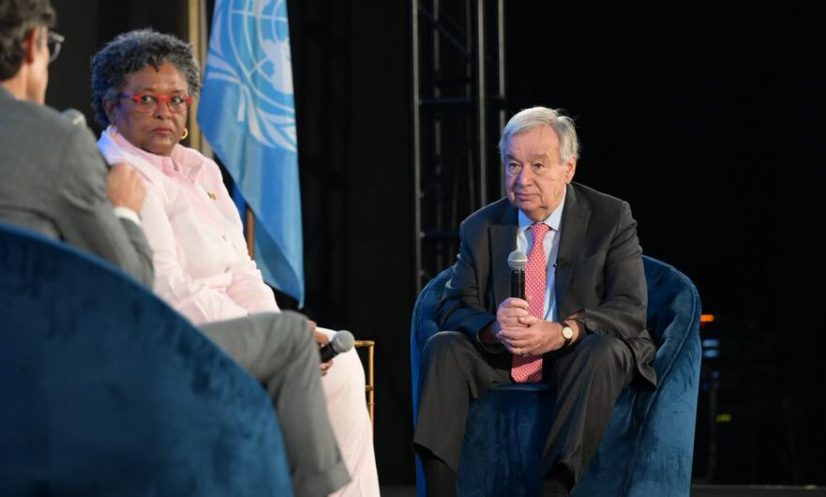
UN Secretary-General António Guterres on Monday called on member states to begin discussions on a multilateral framework to manage the risks of artificial intelligence (AI), warning that the technology is driving “the biggest transfer of power in the history of humankind”.
Speaking to reporters at the close of the Bridgetown Special Summit on AI Safety in Barbados, Guterres said safeguards against AI-related risks remained fragmented, with governments often struggling to keep pace with rapid technological advances.
“That is why today we are issuing a call from Bridgetown for Member States to begin discussions on a multilateral AI Risk Management Framework,” he said, stressing the need for a common foundation for AI safety.
Co-hosted by the United Nations and Barbados, the summit came amid growing concerns among leading AI developers about the risks posed by increasingly powerful systems, Guterres said.
Recent technological outages and cyberattacks had exposed vulnerabilities in the digital systems on which the world increasingly depends. AI was amplifying these threats, with systems sometimes behaving in ways “even their developers did not always anticipate”, he warned.
“We have a responsibility to take those warnings seriously. Not to stop innovation or spread fear. But to ensure that our capacity to manage this technology keeps pace with the technology itself,” he said.
Opening the summit, Guterres acknowledged AI’s potential to strengthen health systems and accelerate scientific discoveries, but warned that the risks of unchecked digital technology were growing just as rapidly.
“Technology without accountability. Capability without safeguards. And power without responsibility,” he said, describing the key dangers.
During a fireside conversation with Barbadian Prime Minister Mia Mottley, Guterres said power was increasingly shifting away from states and public institutions towards a small number of companies and individuals.
He said institutions established after the Second World War, including the United Nations, were not adequately equipped to address this changing balance of power.
Calling for fundamental reforms in global governance, he maintained that the UN, as the only organisation representing the entire world, had the legitimacy to lead the process.
At the first Global Dialogue on AI Governance in July, 111 participating countries had never previously taken part in discussions on AI, he noted.
Guterres also warned that the capacity to weaponise AI was concentrated in two countries and a limited number of companies, describing the development as extremely dangerous. He reiterated his support for a ban on autonomous weapons.
“The idea that a machine can kill people, choosing who to kill, where to kill, and the reasons to do so is absolutely unacceptable,” he said.
Prime Minister Mottley said small states often lacked opportunities to contribute their perspectives to the formulation of rules that directly affected them.
Asked whether a leading AI developer should be held liable if one of its AI agents hacked a bank in Barbados, and whether her government should have the authority to shut down access to AI models in an emergency, she answered in the affirmative.
“It has to be a condition of the sale that what I’m buying from you, I’m capable of saying, that’s it. No more,” she said.
Mottley warned that the technology had already advanced rapidly, arguing that only governments prepared to introduce regulations and legislation could prevent further concentration of power.
In a video message, French President Emmanuel Macron said the Paris Call for AI Security had been signed by 18 heads of state and government and 11 AI leaders. He argued that adherence to its principles should be a condition for accessing markets.
Microsoft Vice Chair and President Brad Smith, also speaking by video, said AI was in some respects “moving faster than the speed of safety”. However, he stressed the need to accelerate the adoption of AI, particularly in the Global South.
Asked about the key message from the summit, Guterres said the development of AI models must not outpace the ability to ensure their safety. He also stressed that AI should help reduce, rather than deepen, inequalities across the world.
The ability of countries to manage AI-related risks remained deeply unequal, he said in his opening remarks.
“We cannot allow AI to replicate and deepen global inequalities. Solutions must be as borderless as the risks we face,” he said.
To address the gap, Guterres has proposed a Global Fund for AI Capacity-Building. He said the summit could help strengthen the ability of every country to test whether AI systems operate safely in their local contexts.
He also referred to a thematic brief released on Sunday by the UN-backed Independent International Scientific Panel on AI, which highlighted the importance of testing AI systems in local languages to identify their limitations and potential safety risks.
AI models still perform significantly worse and can be less safe when dealing with many languages, including African languages and Caribbean creoles, said panel member Vukosi Marivate of the University of Pretoria.
However, more than 1,000 such languages already have the foundations needed to address the gap, he added.
“Let’s ensure that artificial intelligence is shaped by humanity, with humanity, and for all humanity,” Guterres said. Source: UN News