


 Play store

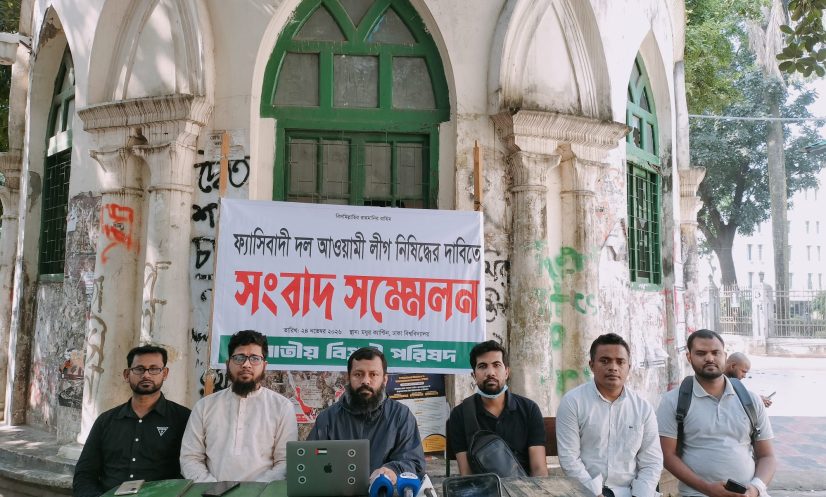
The Jatiya Biplabi Parishad has demanded a complete ban on the Awami League and its associate and affiliated organisations through an executive order, along with the enactment of a permanent constitutional law to prevent the resurgence of fascist politics.
Khomeni Ihsan, convener of the party, said a proposed anti-fascism law should include different terms of imprisonment depending on the nature and severity of offences, including seven years in jail for chanting the ‘Joy Bangla’ slogan or speaking in favour of the Awami League on television talk shows.
He made the remarks at a press conference organised by the party at Madhur Canteen of Dhaka University on Tuesday at 11:30am, demanding a complete ban on the Awami League.
Central convening committee members Touhid Topu, Md Saidul Islam, Sakib Samin and Zainal Abedin; Ibrahim Khalil, a leader of the 2018 quota reform movement; Revolutionary Students’ Council Convener Abdul Wahed; Assistant Member Secretary Mohammad Ariful Islam; and Dhaka University unit leader Md Alamgir Hossain were also present at the press conference.
Khomeni Ihsan said the BNP wanted to resist the Awami League, while Jamaat-e-Islami and the National Citizen Party (NCP) were focused on the July Charter and the reform council. However, none of them was demanding a complete ban on the Awami League as a fascist political organisation.
He warned that incidents of violence similar to those in Gopalganj would continue if fascism were allowed to survive.
Although the Jatiya Biplabi Parishad was a small political party, it had pursued the politics of banning fascism since its inception, he said.
“For the past two years, we have been saying that Bangladesh was also free from fascism in 1975. But fascism was rehabilitated in the name of multiparty democracy, keeping the country trapped in endless conflict and violence for five decades. That mistake must not be repeated after the July Revolution,” he said.
Referring to an investigation by the Office of the UN High Commissioner for Human Rights, Ihsan said around 1,400 people were killed in 2024. He said there were also directives to ensure justice for those involved and inform the United Nations about the progress.
Under the circumstances, there was no scope for further delays, he said, arguing that those responsible should have been brought to justice swiftly and the organisational structures of the Awami League and its associate organisations permanently dissolved.
Ihsan said the Jatiya Biplabi Parishad was formed on December 16, 2024, to work towards eliminating fascism after the government failed to respond adequately to repeated demands following the July Revolution.
Two months after its formation, the organisation launched a 36-day movement demanding a ban on the Awami League. Its leaders and activists held a sit-in programme at the foot of the Raju Memorial Sculpture at Dhaka University from February 15 to March 20, 2025, he said.
He claimed that major political parties initially did not support the movement. However, after public opinion began to build, Jamaat-e-Islami, the NCP and Islamic parties launched separate movements and eventually secured a decision banning the Awami League’s political activities.
As a result, the Awami League was barred from participating in the election, benefiting the BNP, Jamaat-e-Islami and the NCP, he alleged.
However, the ban had failed to make the country free from fascism, as the political and organisational foundations of fascism remained intact, he added.
Expressing concern over what he described as visible signs of a resurgence of fascism across the country, Ihsan alleged that six people had been killed in attacks by individuals associated with the banned Awami League, Jubo League, Chhatra League and Swechchhasebak League since November 1.
Of the deceased, three were BNP leaders and activists, while the other three were working-class people, he claimed.
He also alleged that three police stations in Gopalganj had been set on fire and weapons looted. The homes of BNP leaders, activists and supporters, including two members of parliament, had also been attacked with arson.
He expressed concern over what he described as a lack of significant progress in arresting those responsible and restoring state authority in areas where fascist activities continued to exert influence.
According to Ihsan, the recent incidents of violence demonstrated that temporary restrictions were insufficient to prevent the resurgence of fascism.
He alleged that allowing fascist forces concessions had led to the return of violent political practices, including attacks on workers and political activists, arson attacks on police stations and looting of weapons.
He urged the government and all relevant stakeholders to recognise the urgency of the situation and take effective measures before it was too late.
At the press conference, the Jatiya Biplabi Parishad placed three demands before the government.
The demands include immediately banning all organisational activities of the Awami League and its associate organisations through an executive order; enacting a permanent law consistent with constitutional principles and international human rights standards to prevent the resurgence of fascist politics; and ensuring impartial investigations and trials of all serious crimes committed during the Awami League’s rule.
The party also presented a preliminary framework for the proposed anti-fascism law.
Under the proposal, those leading a fascist organisation would face life imprisonment, active members would face 10 years in prison, and supporters would face seven years in jail.
The proposed provisions also call for legal measures to dissolve the organisational structures of the Awami League and its associated, affiliated and sister organisations, and to settle matters relating to their activities, funding and assets.
Attempts to reorganise a banned organisation under a new name, resume its activities or continue the same operations by circumventing the ban should be treated as criminal offences, the proposal states.
It also proposes life imprisonment for those who re-establish the organisational structures of banned groups, provide funding or instructions, organise violent activities or attempt to continue organisational operations despite the ban.
The proposed law would also provide strict punishment for establishing or operating organisations involved in violence or terrorism aimed at undermining state sovereignty, the constitutional order and public security. Serious offences could carry sentences of up to life imprisonment, depending on their severity.
The framework further proposes legal action against direct incitement to genocide, crimes against humanity, state-sponsored terrorism and political violence, as well as assistance in criminal conspiracies and attempts to revive violence.
It also seeks provisions against using the ‘Joy Bangla’ and ‘Joy Bangabandhu’ slogans, the boat symbol, images and statues of Sheikh Mujibur Rahman and Sheikh Hasina, party flags, uniforms, Mujib coats and other organisational symbols to revive the activities of banned organisations, recruit members, raise funds or organise violence.
The proposal calls for the seizure or confiscation, through due legal process, of assets and memorabilia used for organisational propaganda and activities by banned groups.
It also recommends strict action against violence carried out under the guise of political rallies and gatherings while carrying logi-baitha (oars and poles), machetes, cleavers and other lethal weapons. Exemplary punishment should be ensured for carrying weapons, assaults and killings, it says.
The proposed law also calls for impartial investigations into the roles of those involved in politicising state institutions, the administration, law enforcement agencies and the judiciary during the Awami League’s rule.
It further proposes provisions for dismissing public officials found guilty of fascist crimes, misconduct or abuse of power, alongside measures to restore neutrality and professionalism in state institutions.
Finally, the party called for bringing to justice those who, while staying abroad, direct killings, terrorism, sabotage, financing or other criminal activities of banned organisations inside Bangladesh. It also proposed ensuring international judicial cooperation to prosecute such individuals.