


 Play store

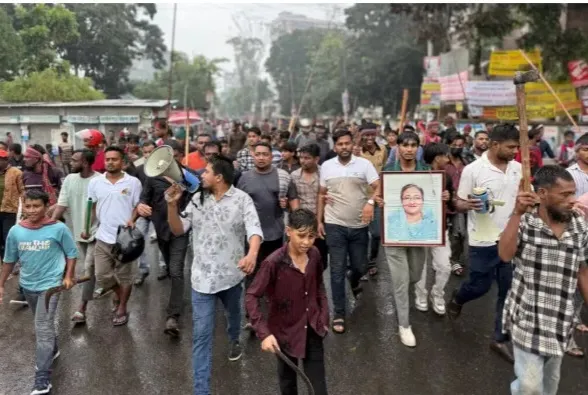
Political violence involving supporters of ousted former Prime Minister Sheikh Hasina has destabilised Bangladesh and added fresh strain to its relations with neighbouring India, according to an analysis published by The New York Times.
The report, titled “Deadly Protests Erupt in Bangladesh Over Exiled Former Leader: What to Know”, says political violence has continued across Bangladesh for more than a week, with Hasina’s supporters clashing with police and targeting activists of the ruling Bangladesh Nationalist Party (BNP).
At least four people have been killed in the incidents so far, while further demonstrations have been called by activists of the banned Awami League.
According to the report, the protesters have carried out attacks aimed at destabilising the current government.
Public transport, a police station and a hospital were set on fire, while the homes of two BNP leaders were also torched.
Two transport workers and two ruling-party members were killed in incidents involving arson attacks on buses.
Gopalganj, Sheikh Hasina’s birthplace, witnessed some of the worst violence. Protesters blocked a major highway connecting Dhaka with the country’s western region for around 36 hours.
Armed processions, attacks on police vehicles and the beating of a police officer were also reported. The highway was reopened on Friday morning, and police arrested several people in connection with the incidents.
The report also highlighted the diplomatic complications arising from Hasina’s continued stay in India. She fled to India in August 2024 following the student-led mass uprising that ended her 15-year rule.
Bangladesh’s International Crimes Tribunal sentenced her to death for crimes against humanity in November last year. However, Hasina rejected the verdict and questioned the legitimacy of the trial.
Tensions between Dhaka and New Delhi have intensified over India’s decision to provide shelter to the former prime minister.
Bangladesh’s State Minister for Foreign Affairs Humayun Kabir has described Hasina as a terrorist and a fugitive criminal and called on India to extradite her to Bangladesh.
However, the prospect of India handing her over remains uncertain.
Meanwhile, Indian Prime Minister Narendra Modi has invited Bangladesh Prime Minister Tarique Rahman to visit India as part of efforts to normalise bilateral relations.
The proposed visit would be Tarique Rahman’s first to India since assuming office, but Dhaka has yet to respond to the invitation.
Tarique Rahman has also expressed concern over the recent unrest, suggesting that some groups are receiving instructions from across the border, an apparent reference to India.
The New York Times analysis concludes that the recent violence has further complicated an already strained relationship between the two neighbouring countries, making the political crisis in Bangladesh an important diplomatic challenge for both Dhaka and New Delhi.