


 Play store

r
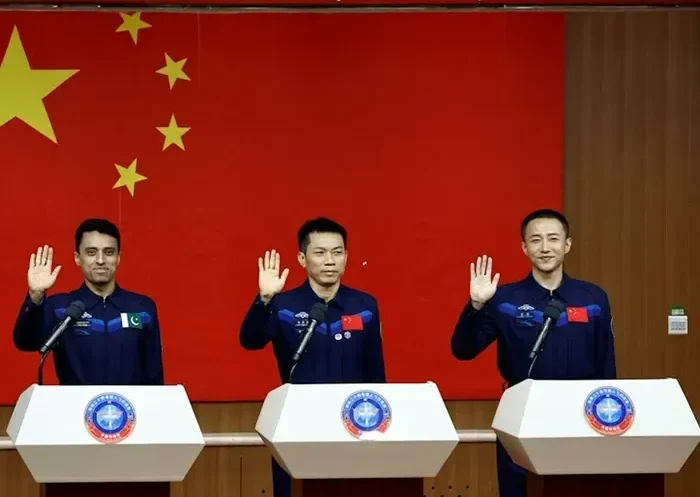
Pakistan has made history in space exploration as its astronaut Muhammad Zeeshan Ali became the first Pakistani national and the first foreign astronaut to travel aboard a Chinese crewed spacecraft to the Tiangong space station.
China’s Shenzhou-24 spacecraft successfully lifted off from the Jiuquan Satellite Launch Centre in northwestern China at 8:18am local time on Wednesday, November 25, using a Long March-2F rocket.
The 40-year-old Ali, a former Pakistan Air Force pilot, is serving as a payload specialist on the three-member mission. He is accompanied by Chinese astronauts Tang Hongbo, who is commanding the mission, and flight engineer Wu Yi.
Ali is expected to spend around five to seven days in space, conducting scientific experiments and participating in research activities aboard China’s Tiangong space station.
The mission involves approximately 90 scientific experiments and technology tests.
His responsibilities include conducting experiments in biotechnology and advanced materials, including research involving photosynthetic microorganisms. The mission also aims to strengthen scientific cooperation between Pakistan and China.
Before the historic flight, Ali underwent seven months of intensive training at China’s Astronaut Centre, where he received specialised spaceflight training, learned Chinese and prepared to work alongside his Chinese colleagues.
Speaking ahead of the launch, Ali said he was not flying for himself but carrying the name and hopes of around 250 million Pakistanis.
The mission marks a significant milestone in Pakistan’s space programme and represents the first time a foreign astronaut has participated in China’s crewed space programme and visited its Tiangong space station.
Pakistan and China signed an agreement in February 2025 to send a Pakistani astronaut to the Chinese space station. The selection process resulted in two candidates, Muhammad Zeeshan Ali and Khurram Daud, being chosen for training, with Ali eventually selected for the mission.
Pakistani President Asif Ali Zardari, Prime Minister Shehbaz Sharif and senior government officials have welcomed the development, describing it as a historic achievement and a source of national pride.
The mission also highlights growing space cooperation between Islamabad and Beijing, which are marking 75 years of diplomatic relations in 2026.
China, meanwhile, is expanding its space programme and aims to send astronauts to the Moon by 2030 as it seeks to strengthen its position in global space exploration.