Play store

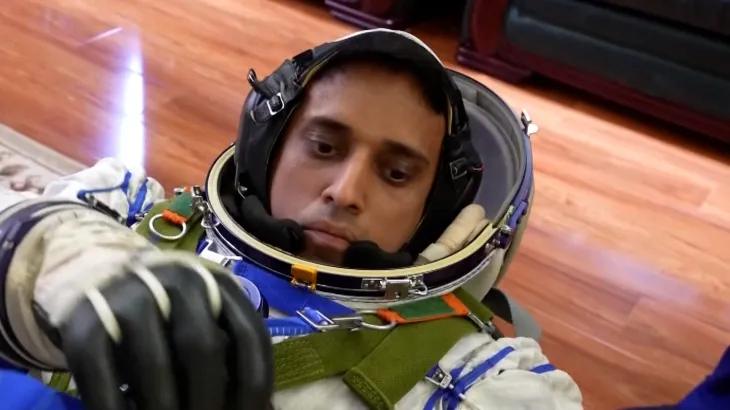
Pakistan’s first astronaut, Mohammad Zeeshan Ali, has recited a famous poem by the country’s national poet, Allama Muhammad Iqbal, while floating aboard China’s Tiangong space station, bringing a literary connection between India and Pakistan into the spotlight once again.
On Wednesday, Ali recited the renowned Urdu couplet before five Chinese crewmates:
“Sitaaron se aage jahaan aur bhi hain / Abhi ishq ke imtihaan aur bhi hain.”
The lines mean, “Beyond the stars, there are other worlds; many more tests of love and devotion still await.”
After explaining the meaning in Mandarin, Ali received applause from his fellow astronauts, Al Jazeera reported.
His recitation also recalled two earlier occasions when Indian astronauts and political leaders invoked Iqbal’s poetry in connection with space exploration.
In 1984, Rakesh Sharma became the first Indian to travel into space aboard the Soviet Soyuz T-11 mission. During a conversation with then Indian Prime Minister Indira Gandhi, he quoted Iqbal’s famous patriotic poem Tarana-e-Hind.
When Gandhi asked how India looked from space, Sharma replied, “Saare Jahan Se Achha” (Better than the entire world), referring to the celebrated poem.
Iqbal’s poetry also featured during the 1997 space mission of Indian-origin astronaut Kalpana Chawla. In a conversation with Chawla aboard the US space shuttle Columbia, then Indian Prime Minister Inder Kumar Gujral recited the opening line of the same poem quoted by Ali nearly three decades later.
Gujral remarked that there were other worlds beyond the stars and that Chawla was now witnessing them. Chawla described the experience as extraordinary, like something out of a fairy tale.
Chawla died in the 2003 Columbia space shuttle disaster.
Born in 1877 in Sialkot, in British India, Allama Iqbal was a renowned poet and philosopher whose ideas had a profound influence on Muslim politics in South Asia.
Writing primarily in Persian and Urdu, Iqbal proposed an autonomous Muslim state comprising Punjab, the North-West Frontier Province, Sindh and Balochistan at the Muslim League’s Allahabad session in 1930. His vision later became an ideological foundation for the creation of Pakistan.
Iqbal died in Lahore in 1938, nine years before the partition of British India and the establishment of Pakistan in 1947.