


 Play store

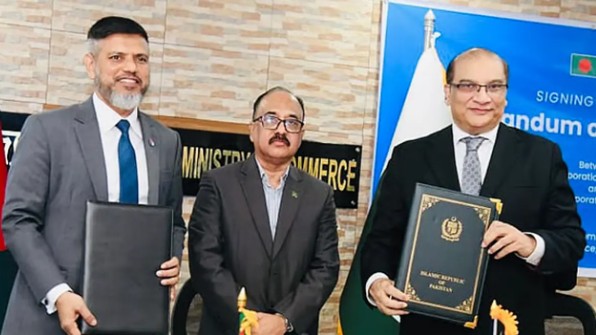
Bangladesh has signed a five-year Memorandum of Understanding (MoU) with Pakistan to diversify sources of essential imports, including rice, wheat, sugar, edible oil and pulses.
Under the agreement, the two countries will be able to import and export essential commodities, agricultural products and agricultural inputs through government-to-government (G2G) arrangements, based on their respective requirements and mutual consent.
The MoU was signed between the Trading Corporation of Bangladesh (TCB) and the Trading Corporation of Pakistan (TCP).
At a ceremony held at the conference room of the Ministry of Commerce at the Secretariat on Sunday, TCB Chairman Brigadier General Mohammad Faisal Azad signed the agreement on behalf of Bangladesh, while Pakistan’s High Commissioner to Bangladesh Imran Haider signed on behalf of his country.
Commerce Secretary Sharif Uddin Ahmed Chowdhury and officials from the two governments were also present.
Under the MoU, the state-owned trading organisations of the two countries will be able to buy and sell various commodities based on their respective needs and mutual agreement.
The potential list of products includes different varieties of rice, wheat, refined and raw sugar, and edible oils such as canola, soybean, sunflower, rice bran and palm olein.
The agreement also covers agricultural products and inputs, including sesame seeds, potatoes, onions, lentils, chickpeas, tea, pineapples, jackfruit, dates and fertilisers.
However, signing the MoU does not mean that final import-export contracts for these commodities have been concluded.
If either party wishes to procure a particular product, it will have to submit a written proposal to the other party specifying the product’s quality, quantity, specifications and expected delivery schedule.
Separate product-specific contracts will subsequently be negotiated and finalised through discussions, with the terms and conditions of supply determined individually.
This means the agreement establishes an institutional framework for direct government-to-government trade between the two countries, while the prices, quantities, quality standards and delivery schedules for individual transactions will be settled separately.
Speaking at the ceremony, Commerce Secretary Sharif Uddin Ahmed Chowdhury said the MoU would establish direct and structured commercial relations between the state-owned trading organisations of Bangladesh and Pakistan.
It would create new opportunities for mutual cooperation in the import and export of essential commodities and agricultural products while safeguarding the economic interests of both countries, he said.
He added that the relevant organisations would be able to hold direct discussions on product quality, quantities, delivery schedules and financial matters to finalise the terms of individual transactions.
The commerce secretary also stressed the importance of regular communication between the TCB and TCP, timely assessment of commercial proposals and overall cooperation between the commerce ministries of the two countries to ensure effective implementation of the MoU.
He said the initiative would play an important role in expanding trade and economic cooperation between Bangladesh and Pakistan.
Pakistan’s High Commissioner Imran Haider said the new MoU would establish direct institutional relations between the state-owned trading organisations of the two countries, helping make the import, export and supply of essential commodities more organised.